MX3D Installs Metal 3D Printed Bridge in Amsterdam

It has been a long wait, but, after two years of anticipation, Dutch 3D printing startup MX3D has finally installed its metal 3D printed bridge in Amsterdam. When first announced in 2015, the MX3D Bridge was widely seen as an impressive vision for 3D printing technology and, while it was completed in 2018, having it installed became the more difficult challenge.
Over the course of three years, the Dutch team behind the project collaborated with a long list of partners—including Autodesk, Heijmans, Joris Laarman Lab, ArcelorMittal, Arup, The Alan Turing Institute, Lloyd’s Register Foundation, Air Liquide, ABB Robotics and Lenovo—to actually build the structure. This involved the use of MX3D’s robotic welding system, which uses Wire Arc Additive Manufacturing to melt metal wire into a freestanding object.
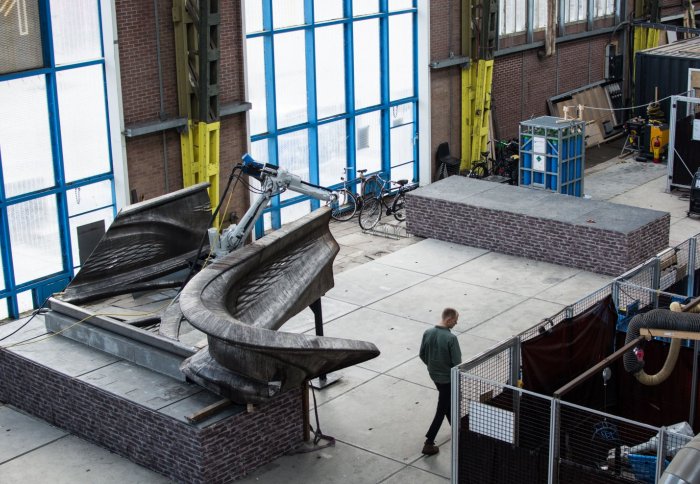
The MX3D Bridge being fabricated in its facility. Image courtesy of MX3D.
Later on in the project, the company determined that they could take the technological aspect of things even further by creating a digital twin of the bridge. With a network of sensors designed by the Centre for Smart Infrastructure and Construction at Cambridge, the Alan Turing Institute, Lloyd’s Register Foundation and Imperial College London, the bridge is able to provide data related to its own health back to the MX3D team, including displacement, strain and vibration. It also captures environmental data, such as air quality and temperature.
By the time the bridge was completed, the city of Amsterdam wasn’t ready to have it installed. As MX3D CEO Gijs van der Velden told 3DPrint.com for a recent article: “In November 2020 we finally had a permit, we removed the old bridge, and prepared the site. We prepared to load our bridge to the barge to ship to site, but… again there was a setback, as a city inspector thought it was wise to check the quay wall for internal defects, as Amsterdam had some other old quay walls collapse over the last months. Better safe than sorry they thought. Early April, the tests have been completed. We now wait for the green light. So, placement is ongoing, and hopes are high we can pop champagne this summer.”
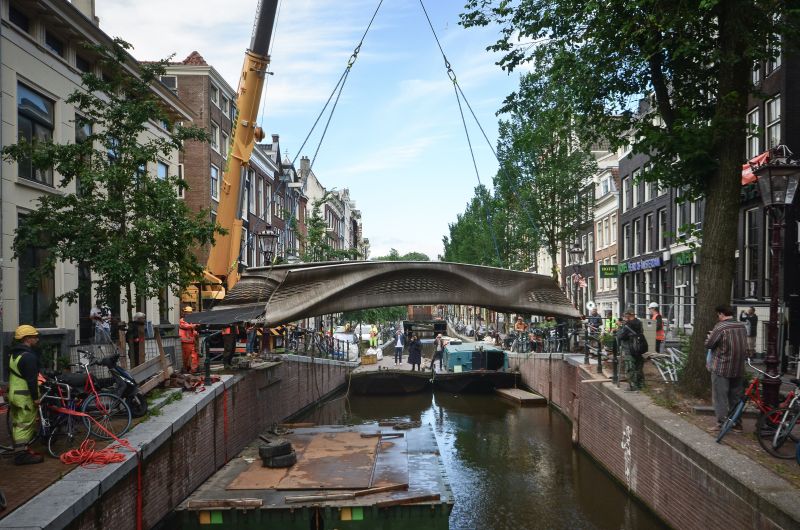
The MX3D Bridge being installed in Amsterdam. Image courtesy of MX3D.
van der Velden’s estimate was an accurate one. The bridge has now been installed and MX3D is testing the sensor network. Visitors to Amsterdam will be able to visit the bridge in the second half of July.
Subscribe to Our Email Newsletter
Stay up-to-date on all the latest news from the 3D printing industry and receive information and offers from third party vendors.
Print Services
Upload your 3D Models and get them printed quickly and efficiently.













You May Also Like
South Korea’s Lincsolution Lands Hanwha Defense Deal as Hanwha Invests Billions in US
I recently wrote about how the South Korean additive manufacturing (AM) firm Lincsolution is building an aerospace and defense hub, part of the company’s construction of “the largest AM facility in...
Bambu Lab and SUSAN FANG 3D Print for London Fashion Week
At London Fashion Week, some of the more unusual pieces on the runway came from 3D printers. Chinese fashion designer SUSAN FANG presented her Spring/Summer 2027 Air-Illusion collection at the...
Why Cross-Border 3D Printing Is Closing the Speed Gap with Local Manufacturing
The fastest 3D printing supplier in your shortlist may no longer be the one closest to your office. That sounds unlikely to many engineers. For years, overseas 3D printing carried...
Arridex Expands 3D Printing Network to Ghana
Nigeria-based Arridex has deep experience in oil and gas additive manufacturing. Previously known as RusselSmith, the firm has in-house metal and polymer additive technology. The company is making 3D printed...