UBQ Materials and Plastics App Make 3D Printing Filament from Waste

Israeli startup UBQ Materials uses advanced conversion technology to transform household waste into a sustainable and cost-competitive thermoplastic that substitutes oil-based resins for manufacturing. The green company announced a new partnership with polymer innovators at Plastics App to launch new filaments with a significantly reduced carbon footprint to enable sustainable and eco-conscious 3D printing and can be tailor-made to serve several functions, including those on an industrial scale.
Made from landfill-destined waste, UBQ’s proprietary material takes in everything from food residues and mixed plastics to cardboard, paper, and even dirty diapers and turns it into a USDA-certified biobased product that can be used in existing manufacturing processes as a replacement for plastics, concrete, wood, and minerals without additional adaptation costs. Through a patented conversion process, UBQ reduces the organic elements into their most basic natural components, which are lignin, cellulose, sugars, and other natural fibers, before bonding them together with mixed plastics into a bio-based thermoplastic composite.
For its novel 3D printing filaments, Plastics App has compounded its post-consumer recycled (PCR) 3D filament with UBQ’s proprietary material to offset emissions across manufacturing. The UBQ material has been incorporated into different carbon-reduced sustainable filaments and is sold through Plastics App online shop. The high-performance Perform Q filament is based on UBQ’s sustainable material and the thermoplastic polymer polypropylene (PP), resulting in a very low carbon footprint printing material ideal for standard functional parts that costs €56 per unit.
The Perform QCF filament with carbon fibers combines reinforced PP with UBQ’s sustainable material and is also suitable for demanding applications at €74. Both grades are available either on virgin PP or PCR PP carriers and are ideal for automotive parts, functional prototypes, sustainable housing designs, jigs, and fixtures.
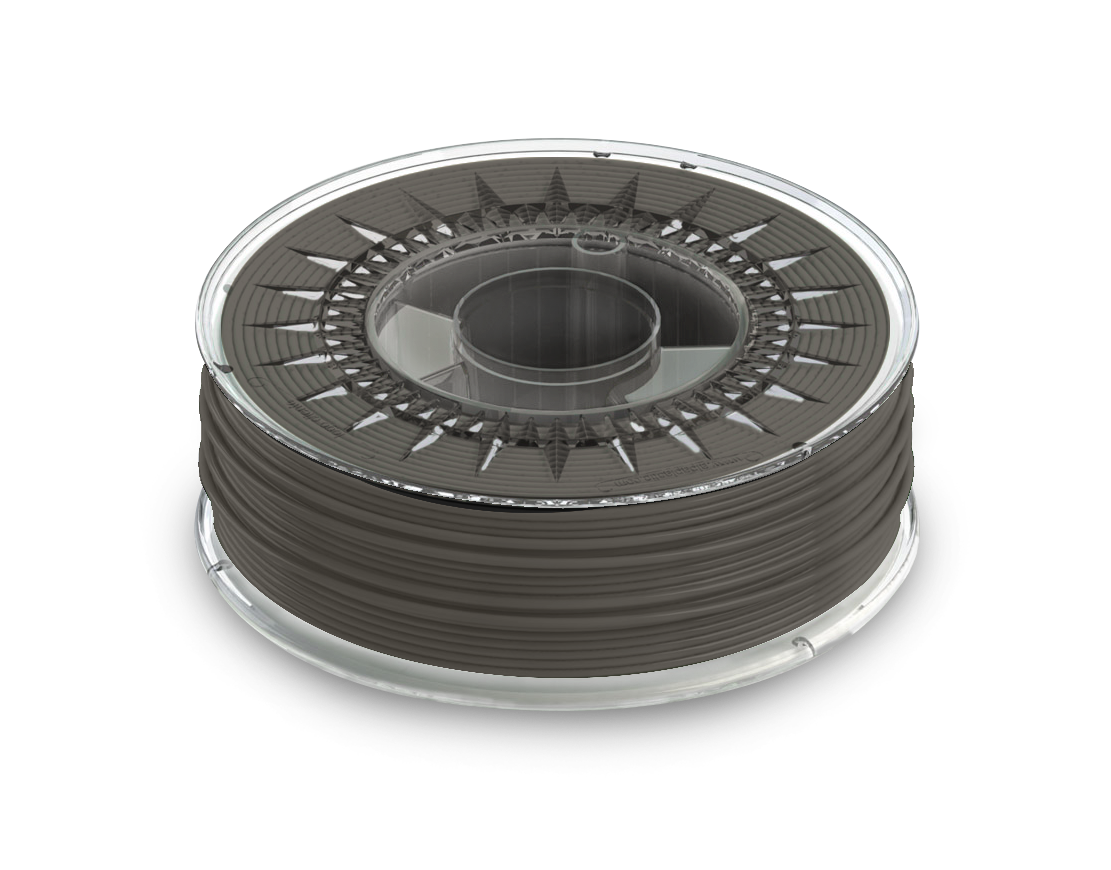
UBQ and Plastics App developed the Perform Q, a functionally sustainable 3D filament. Image courtesy of Plastics App.
Plastics App Founder and General Manager Yanir Shaked said that by combining the Plastics App end-to-end filament development capabilities with UBQ’s climate-positive material, they had opened sustainable opportunities for industries like automotive and housing, where fully functional prototyping is an essential part of research and small-scale production. He believes the new eco-friendly filaments are ideal for 3D printing functional prototypes from the early stages of development and will help companies meet their sustainability goals without compromising product functionality.
There have been significant research efforts across the industry to reduce the carbon footprint of materials used in 3D printing. Yet currently, the most sustainable 3D filaments are largely based on a Glycol-modified version of Polyethylene Terephthalate (PETG), which, according to UBQ, has limited properties and has confined use cases to dimensional models and dummies. Together, the companies hope their novel material will make sustainable 3D printing functional.
Through its novel raw material, UBQ closes the loop on unsustainable waste disposal and provides a path to a more circular economy. By diverting landfill-destined waste, the Tel Aviv-based business prevents methane emission, groundwater leakage, and other harmful emissions for the environment. In fact, every ton of UBQ material produced prevents greenhouse gas emissions equivalent to 11.7 tons of carbon dioxide, and products made with UBQ’s masterbatch can be recycled alongside other standard polymers.

The first rollout of 18,000 climate-positive McDonald’s trays made with UBQ material has diverted 2,600 pounds of waste from landfills. Image courtesy of UBQ Materials via Instagram.
Co-founded by the European Union’s Horizon 2020 program, UBQ’s patented material has already been adopted by large multinational enterprises and startups and incorporated into end products across various industries. The company partnered with McDonald’s in Brazil to launch serving trays made with UBQ; so far, 18,000 trays have rolled out in 30 restaurant branches, helping divert 2,600 pounds of landfill-destined waste.
Along with TU/ecomotive, a student team at the University of Technology Eindhoven, UBQ collaborated to make the first zero-waste car to hit the road. The Luca was unveiled in November 2020 as a ready-to-drive car designed and manufactured from 100% zero waste material. Similarly, automotive giant Mercedes-Benz turned to UBQ for its sustainable product, as the automaker is looking to mass-produce zero waste car parts and even began testing the UBQ material for 3D printing in 2020.
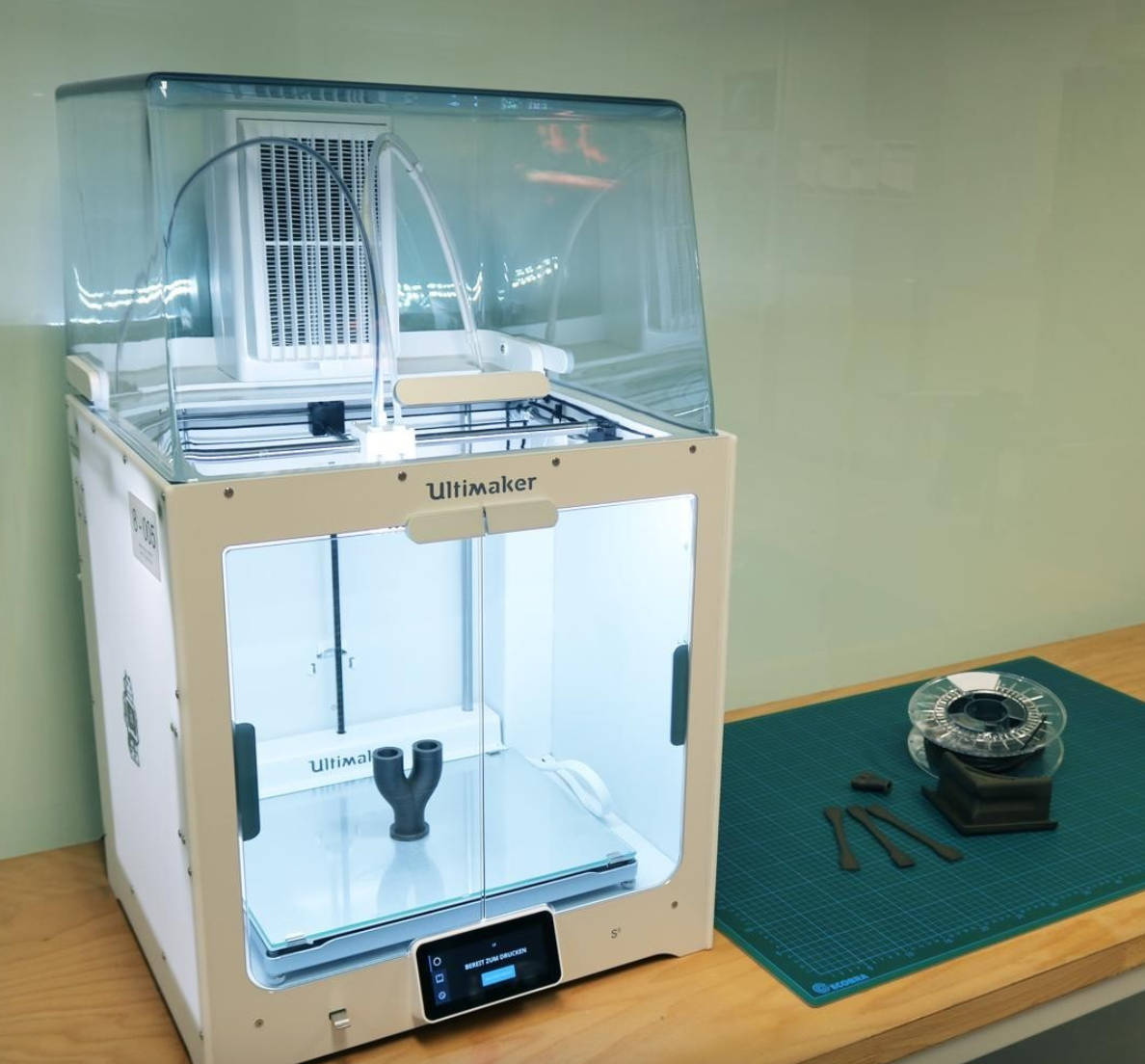
The Lightweight Construction Team at the Mercedes-Benz plant in Hamburg got to know the startup UBQ Materials in Paris in 2019 and is now testing if the material can be 3D printed to make auto parts.
UBQ’s CEO and Co-founder, Tato Bigio, hopes the newly introduced 3D printing filament will test the limits and go “beyond the boundaries of traditional plastic manufacturing techniques,” expanding the scope of companies that can refine their process and prototypes while reducing their energy use.
Subscribe to Our Email Newsletter
Stay up-to-date on all the latest news from the 3D printing industry and receive information and offers from third party vendors.
Print Services
Upload your 3D Models and get them printed quickly and efficiently.











You May Also Like
EOS Invests $3M In Its Texas Manufacturing & Logistics Facilities to Serve North American Customers
The trajectory of reshoring under President Trump has been largely a mixed bag so far. While tariffs still seem to be doing more harm than good to the U.S. domestic...
At AIAA SciTech 2026, 3D Printing Was Part of the Workflow — Part I
The AIAA SciTech Forum 2026 brought much of the aerospace community together in one place. With roughly 6,000 attendees, 115 exhibitors, 21 sponsors, and nearly 3,000 technical paper presentations, the...
3D Printing News Briefs, January 21, 2026: Scanning Inspection, Manufacturing Upskilling, & More
In 3D Printing News Briefs, we’ll start with 3D scanning news from Artec 3D. Then, Nanoscribe opened a demolab in Shanghai, and The Ohio State University Center for Design and...
Camp Lejeune’s II Marine Expeditionary Force Innovation Campus: An Existing Model for the U.S.’s Future in Additive Manufacturing
A recent article in Military.com highlights the II Marine Expeditionary Force (MEF) Innovation Campus, located at Marine Corps Base Camp Lejeune in North Carolina. It provides a good touchstone for the...