Burloak First in Industry to Meet Boeing Specification for 3D Printing Aluminum


Burloak Technologies Inc. has become the first company to achieve Boeing’s BAC 5673 specification for the 3D printing of aluminum AlSi10Mg components. This marks a substantial gain for the service bureau, as it continues to grow in the additive manufacturing (AM) space.
“This approval marks the completion of a qualification process that included a rigorous evaluation of Burloak’s capabilities by Boeing. We would like to thank Boeing’s additive manufacturing team for its collaborative approach,” stated Peter Adams, Burloak’s Founder and Chief Innovation Officer. “Together, we developed a well-defined specification that has demonstrated robust, repeatable processes to produce flight components using additive manufacturing.”
Burloak offers design, engineer, CNC, 3D printing services and more. While Burloak was established in 2005 in Ontario, it was acquired by an even older company in 2017. Established in 1855 as a hardware and metals import/export business in Toronto, Samuel, Son & Co. is now the largest family-owned metals processor and distributor in North America. With the acquisition of Burloak, Samuel expanded its status in metal production with AM with the goal of delivering 3D printing solutions globally.
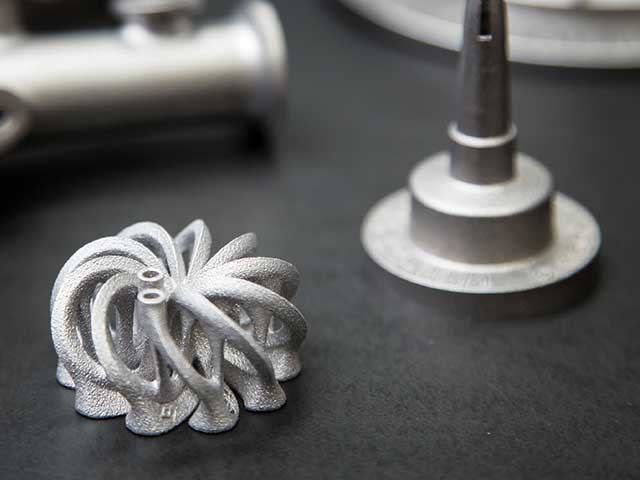
Parts 3D printed by Burloak. Image courtesy of Burloak Technologies.
With a new 40,000-square-foot 3D printing facility and a wide range of AM capabilities, Burloak and Samuel are certainly moving up in the industry. Most recently, Burloak began working on 3D printing parts for satellites. Burloak became one of the founding members of the GE Additive Manufacturing Partner Network alongside Carpenter Technology Corporation. Samuel, meanwhile, partnered with announced in 2017, a strategic alliance with Carpenter for end-to-end 3D printing supply chain solutions.
Among its unique offerings, Burloak offers topology optimization, finite element analysis moldflow, and AM build simulation, poising it for such advanced applications as the type that giant manufacturers like Boeing are likely after.
“Achieving this qualification further validates Burloak’s position as a global leader in the additive manufacturing space, and clearly demonstrates our ability to commercialize this transformational technology,” said Colin Osborne, Samuel’s President and Chief Executive Officer. “This milestone also signals the increasing importance of additive manufacturing within aerospace and represents a step forward on the path to a greener future for aviation.”
Now that it has achieved the BAC 5673 specification, Burloak Technologies is working with Boeing to see it put to use, which means 3D printing components for Boeing aircraft. What the exact form of that will take is yet to be determined.
Boeing has been hit extremely hard by the economic downturn that resulted from the COVID-19 pandemic. It posted a whopping $11.9 billion in losses for 2020 and laid off a total of 30,000 workers last year. Directing attention to its innovative 3D printing partnerships may, then, do the aerospace giant some PR good—especially given the memories of failed jet engines in everyone’s minds.
Subscribe to Our Email Newsletter
Stay up-to-date on all the latest news from the 3D printing industry and receive information and offers from third party vendors.
Print Services
Upload your 3D Models and get them printed quickly and efficiently.













You May Also Like
HeyGears Reflex RS Turbo Sets a New Standard for Resin 3D Printing
When creating highly detailed resin prints, speed only matters if the finished result still captures the details that made the model worth printing in the first place. The HeyGears Reflex...
IFA 2026 Shows Where Multicolor 3D Printing Is Headed
Innovation For All (IFA) is best known for televisions, appliances, and consumer electronics. But this year’s show in Berlin also gave 3D printing companies plenty of room to show where...
3D Printing News Briefs, September 12, 2026: Rebranding, Cybersecurity, Project Call, & More
We’ve got a lot of business news from ATLIX to start off this weekend’s 3D Printing News Briefs, with a new identify for its additive manufacturing (AM) portfolio and some...
Quickparts Builds a Four-Country 3D Printing Network for Space and Defense
For manufacturers trying to win more space and defense work, adding 3D printers is only part of the challenge. They also need to make the same parts to the same...