3D Printed Sharpie Mount Adds a Pop of Color to White Filament


Looking to add multiple colors to your prints but you can only afford a less expensive desktop 3D printing system with a single extruder where your only option is to stop the job and manually swap out the filament? Check out this fun idea that was posted on Hackaday: a simple 3D printed mount that attaches to your printer, and holds up to three colored Sharpie permanent markers against the filament right as it’s going into the top of the extruder.
Maker Devin Montes, who runs the YouTube channel Make Anything, enjoys creating, in his own words, “both functional models and delightful objects that spark inspiration.” I’d say this 3D printed Sharpie mount, which Montes has published on 3D printable design repository MyMiniFactory, would fall into both of those categories.
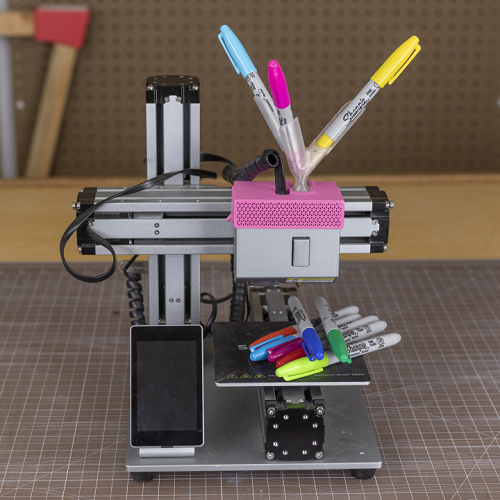
“I made this tool that holds 3 sharpies that color your filament before printing,” he wrote. “The results were surprisingly beautiful!”
In order to make desktop 3D printers less expensive so they’re more accessible to all users, nearly all of them use single extruder setups, which means there aren’t a lot of options for multimaterial printing. Hackaday writer Tom Nardi does admit that from “a practical standpoint, that’s not much of a problem,” but a statement like that is practically catnip for people who like to create 3D printing and life hacks. Montes thought it would be fun to add some more color to his desktop prints, and created this small but mighty 3D printable mount, which he calls the Sharpie 3 Color Blender.
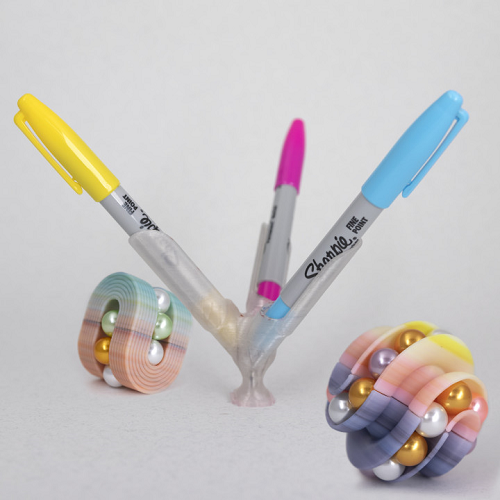
Here’s how it works: just load three colored Sharpie permanent markers into the mount, tip down. The mount is angled in such a way that it holds the tips against the filament as it’s coming into the top of the extruder. If you’re using translucent or white filament, the Sharpies add a vibrant splash of color to your prints. It’s certainly not multicolor 3D printing like Mimaki or Stratasys offer, but it can definitely give your prints a little something extra.
The mount has four parts:
- a connector that mounts to the Snapmaker print head and holds the Blender in place
- Blender part made to connect to Snapmaker Original with the connector
- Blender part with a 40 mm flat circular base for additional modifications
- Blender part with a fitting for PTFE bowden tube
Montes designed this mount for his Snapmaker Original 3D printer, which, according to Nardi, “is relatively well suited to such a contraption as it has a direct drive extruder and there’s plenty of clearance for the markers to stick up.” But he’s working on some upgrades that are compatible with more types of 3D printers, and in his MyMiniFactory download, he also included two additional versions of the Blender part, just in case another maker comes along that can modify his original hack for a different system.
“Technically this isn’t a new concept, as makers were pulling off similar tricks back in the earliest days of desktop 3D printing,” Nardi concluded. “But this is an especially well-implemented version of the idea, and if [Devin] can really come up with a mount that will work on a wider array of hardware, we could certainly see it becoming a popular way to make printed projects a bit more exciting.”

Subscribe to Our Email Newsletter
Stay up-to-date on all the latest news from the 3D printing industry and receive information and offers from third party vendors.
Print Services
Upload your 3D Models and get them printed quickly and efficiently.













You May Also Like
Metal 3D Printers for the Desktop Are Finally Starting to Feel Like Desktop Products
FDM 3D printing is becoming increasingly accessible, yet metal 3D printers designed for everyday desktop use remain rare on an ordinary workbench. The real challenge is not making a metal...
What 3D2GO Says About 3D Printing’s Growth in Southeast Asia
The Philippines offers an interesting case study in how 3D printing can develop in Southeast Asia, and Manila-based 3D2GO helps illustrate it. 3D printing in Southeast Asia doesn’t have to...
The Frankenservice Part 2: Have Your Cake and Eat it Too
This series of articles delves into a thought experiment. What if we let go of using a few machines very optimally, but instead use lots of different machines to meet...
Silencer Market Set to Test Metal Additive’s Readiness for Production Prime Time With Enormous Market Expansion
Throughout the history of additive manufacturing (AM) technologies, there are only a couple of really interesting case studies in which we see a market significantly disrupted and revolutionized by AM....