Recycling Titanium Chips for Metal AM Could Cut CO2 Emissions by 80%

During traditional CNC machining processes, most raw titanium material is wasted. For instance, in the case of machining large parts for aircraft structures results in over 90 percent material waste. Now, researchers at Leibniz Universität Hannover are experimenting with ways to recycle the titanium chips left over from machining processes via 3D printing.
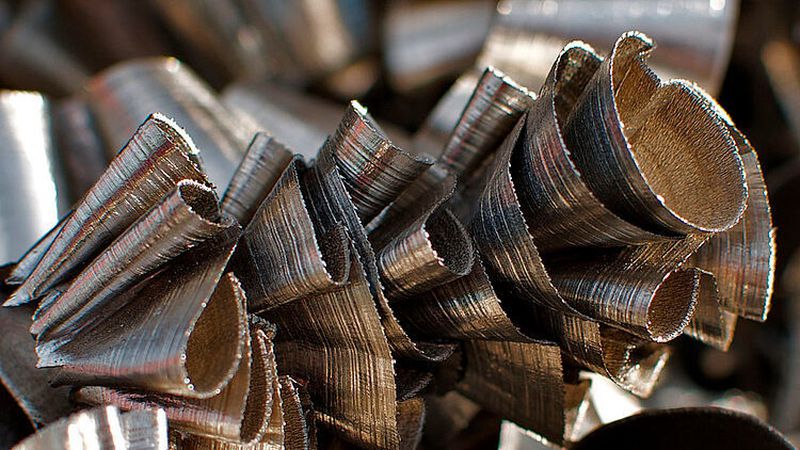
A new recycling process developed by researchers from Leibniz University Hannover could reduce CO2 emissions by up to 80 percent. (Photo: Leibniz Universität Hannover)
While titanium chips may be recycled in some lower-quality applications (for example, use in composites), the leftover material is often corrupted. The researchers have already shown that impurities can be reduced by changing processing parameters in melting the material.
“During the cutting process, the titanium chips are heavily contaminated, among other things by oxidation, cooling lubricant residues and tool particles. These contaminants make recycling the chips significantly more difficult,” said project team member Jonas Matthies.
However, the team believes that further gains can be made by recycling the material directly into powder for additive manufacturing, forgoing the energy-intensive melting process. Instead, the researchers are grinding the material into a fine powder via a spraying process.
“We want to increase resource and energy efficiency by developing a manufacturing process chain for converting chip material into powder,” explains Matthies. “By using chips as input material in powder production, we expect a reduction in energy consumption and CO2 emissions by up to 80%.”
Naturally, the material is a good fit for additive manufacturing. Titanium is one of the most commonly used materials in metal AM, whether for aerospace applications, automotive parts, or designing medical implants. In this case, the researchers are focused on making aircraft components. The research is led by the Institute for Manufacturing Technology and Machine Tools (IFW), the overall goal is to overcome “deficits” in affordability, efficiency and energy usage, and conservation of resources. Four other industrial partners—engaged in the aircraft construction and recycling industries—are working on the project too.
As the researchers continue to research the AM production of parts, they are striving to find out more about ‘the targeted setting of component properties in the overarching process chain.’
“The advantage of a holistic view of the process chain lies in the knowledge of the various mechanisms of action at the various production stations . By adjusting these set screws, it is possible to manufacture components with specific material properties. “
What do you think of this news? Let us know your thoughts! Join the discussion of this and other 3D printing topics at 3DPrintBoard.com.
[Source / Images: konstruktions praxis]Subscribe to Our Email Newsletter
Stay up-to-date on all the latest news from the 3D printing industry and receive information and offers from third party vendors.
Print Services
Upload your 3D Models and get them printed quickly and efficiently.











You May Also Like
Cybersecurity: A Necessity in a Maturing Additive Manufacturing Industry
Additive Manufacturing is no longer an experimental technology operating on the margins of industrial production. Over the past decade, it has become an integral part of how OEMs design, produce,...
How Metal Additive Manufacturing Is Reshaping the Future of Aerospace and Defense Engineering
Additive manufacturing (AM) is steadily changing the way we think about producing metal parts for aircraft. Whilst aerospace and defense companies have been using metal AM for over twenty years,...
The AM Adoption Problem No One Models
Through its short history, Additive Manufacturing has been presented to the investment community as a classic high growth technology story. Manufacturing is a multi-trillion-dollar market. Even a small percentage looks...
The Business of Customized Sports Equipment: How 3D Printing Is Changing Athletic Gear
For years, 3D printing in sports has been linked mostly with prototypes, concept shoes, and one-off experiments for elite athletes. Helmets, cleats, and footwear midsoles often took over the headlines,...