Fragaria Launches Karmen – Remote 3D Print Monitor


IT solutions supplier Fragaria, located in the Czech Republic, invests in developing its own products as much as it focuses on helping clients create prototyping solutions and development methodologies. Two months ago, the company first introduced its Karmen solution, which is as cute as it is helpful. The two-part solution turns ordinary 3D printers into smart ones, and has now officially launched on the 3D printing market.
The solution is made up of a cloud service and the Karmen Pill controller, which is a small box with a camera and an LED light – helpful when 3D printing in enclosed spaces or at nighttime. The controller provides a network connection to FDM 3D printers, most of which could previously only be directly controlled at the device in person. Once connected to a USB port, 3D printers are accessible through the internet or a local network, which is what allows users to remotely control the printer through the Karmen cloud service. The first batch sold out in pre-orders in just one week.
“We had a lot of interest even before the official launch, so we enabled pre-orders on our website. The pre-orderers actually bought out the entire first production run of Karmen Pills,” said Fragaria CEO Martin Buriá. “Due to the current coronavirus situation and the fact that some of our suppliers have had to shut down their operations, we found ourselves without stock for a while. We’ve managed to gradually get this shortage under control, and we believe we’ll be able to deliver Pills worldwide by mid-May at the latest.”
There are many testers working to make the Karmen accessible to more 3D printers, as the open source and 3D printing communities are important for this kind of innovative solution. Already, the company is working to develop an online service so users can share their experiences and knowledge, which will not only help further develop Karmen but also offer assistance to other users. The solution itself is mostly open source, and developer and end-user documentation is already available.
“We’ve seen many skilled do-it-yourselfers who have created their own solutions for remote 3D print monitoring,” explained Product Manager Martin Bílek. “Because we’ve tried to build Karmen as an open solution from the beginning, it’ll be possible very soon to register 3D printers on the Karmen cloud service that either have their own connectivity built in, or which connect through similar homebuilt solutions built on things like OctoPrint or Raspberry Pi. We love the 3D printing community and are looking forward to them starting to model and share Karmen Pill mounts. These aren’t included in the package, but anyone can print their own mount in any shape. There’s also a lot of room for students of schools that use Karmen.”

You can purchase the Karmen Pill on the Fragaria website, or at the mall.cz online store, for €130 without VAT. This price includes a solution that’s automatically updated, and it’s simple to connect to a 3D printer, register the system with the Karmen cloud service, and start printing once the basic setup has been completed.
The cloud service for the Karmen solution is available to register for all 3D printers that have a standard interface and can be managed with solutions like Octoprint. You can collectively manage all the 3D printers in an organization with this solution, along with individual devices, and print management is free in the application. This makes it easy for companies, schools, and other institutions to connect, remotely manage, and monitor their 3D printers. Other features include:
- Live statistics
- Team management
- Open API
- SaaS or on-premise
Additionally, the Karmen cloud service development roadmap includes several new features, like automatic print error detection, functionality for monitoring print costs and hours, intelligent distribution and print planning, and records of consumed material.
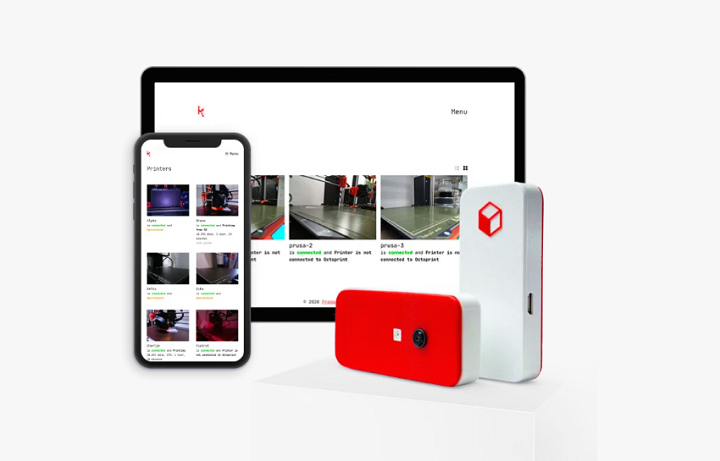
The Karmen Pill is compatible with popular slicers, such as Ultimaker Cura, PrusaSlicer, and Slic3r, and can be installed easily with the use of a wizard. At the moment, the Pill only supports 2.4GHz WiFi. Although relying on USB may be an issue this kind of device will augment Octoprint and other offerings and potentially make it easier for all of us to print.
The Karmen solution will soon be expanded to include other helpful features, such as print analysis and monitoring functions. Later in 2020, Karmen will be working with secondary schools and universities to help them incorporate 3D printing into the curriculum with its solution.
Discuss this news and other 3D printing topics at 3DPrintBoard.com or share your thoughts in the Facebook comments below.
Subscribe to Our Email Newsletter
Stay up-to-date on all the latest news from the 3D printing industry and receive information and offers from third party vendors.
Print Services
Upload your 3D Models and get them printed quickly and efficiently.













You May Also Like
3D Printing News Briefs, October 10, 2026: Drones, WAAM, Ceramics, & More
We have a packed 3D Printing News Briefs for you this weekend! First, America Makes celebrated the recent National Manufacturing Day with 3D printed drones, and then it’s on to...
3D Printing News Briefs, October 3, 2026: Hypersonics, Hotends, & More
We’re starting off with defense in this weekend’s 3D Printing News Briefs, as Titomic was awarded a $5 million U.S. defense contract, and VulcanForms announced a partnership with Specter Aerospace...
The Part Is Only Half the Story: Why 3D Printing Needs a Digital Thread
A 3D printed part can generate a lot of information. The challenge is keeping track of it. Manufacturers need to know which design was used, what material went into the...
Advanced Manufacturing at IMTS 2026: 3D Printing and AI and Drones, Oh My!
Last week’s International Manufacturing Technology Snow (IMTS) in Chicago welcomed over 90,000 attendees to the jungle that is McCormick Place. With over 1.17 million square feet of exhibit space, and...