Aston University Researchers Review Current Approaches in 3D Printing Solid Oral Dosage Forms

UK researchers from Aston University are studying impacts on the pharmaceutical industry, releasing their findings in the recently published ‘Current formulation approaches in design and development of solid oral dosage forms through three-dimensional printing.’
3D printed medication, while progressing perhaps more slowly than previously expected, is expected to be the wave of the future for patient-specific dosages with many different options available. In this study, the authors review the potential for solid oral dosage forms and challenges that remain in manufacturing such products.
Beginning by pointing out that the manufacturing of solid oral dosage forms began over 200 hundred years ago, the authors recognize the benefits of treating medical conditions with tablets, along with progress made in their form—from coating to compression to controlled release mechanisms. Still, however, greater versatility in production, along with the ability to customize further will benefit everyone.
“Additive manufacturing (AM), a set of techniques including 3D printing, has recently aroused much interest in pharmaceutics due to its large flexibility, which makes it a promising tool to produce the bespoke drug delivery devices, including solid oral dosage forms,” state the researchers.
Because there is such latitude available with 3D design, tablets can be 3D printed in different shapes (round, square, rectangle, capsule, oval), sizes, and colors. The researchers used Tinkercad for modeling dosage forms to be evaluated for SLA 3D printing later.
Tablets and dosages must be tuned accordingly, with performance in terms of disintegration and dissolution with the body being critical—and reliant on a set of parameters.
“Tuning dosage form properties through digital design relies on either fabricating devices where different excipients and/or APIs are deposited in specific regions (multi-material 3D printing), or engineering approaches,” explained the researchers.
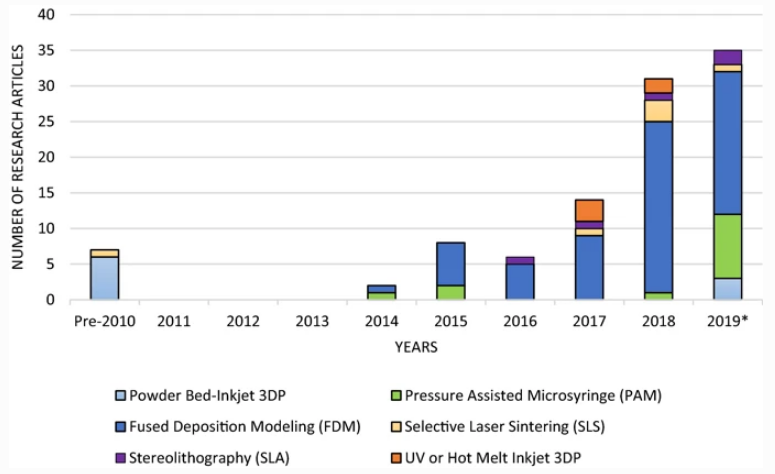
Number of research articles related to 3D printing of solid oral dosage forms published within the years 1996–2010 (grouped as pre-2010) to 2019 (partial data updated to June 2019). Colored bars represent different 3D printing technologies. Google scholar, Science direct and PubMed search engines were used to find relevant peer-reviewed research articles. Keywords for searching were ‘3D printing’, ‘solid oral dosage forms’, ‘tablets’ and ‘personalized medicine’
Different structures are used to customize properties in 3D printing, such as channeled tablets accelerating drug release or multi-block tablets offering more rapid disintegration. Such tablets can be produced not just more affordably, but exponentially faster.
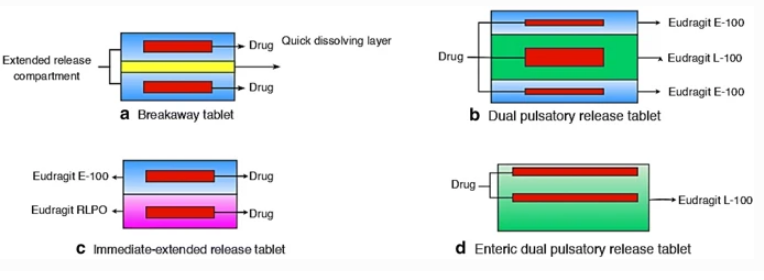
Drug delivery devices designed and fabricated by Rowe et al. a breakaway tablet, b pulsatory release tablet, c immediate-extended release device, and d enteric dual pulse release tablet. Picture adapted from [19]
- Powder-bed inkjet 3D printing
- Pressure-assisted microsyringe 3D printing
- FDM 3D printing
- SLS
- SLA
The options are countless, it would seem, for ways to fabricate 3D printed medications, and especially in cases where patients may be allergic to typical ingredients used to make pills. Polypharmacy concerns can be solved too, allowing for bespoke pills that combine daily medication—especially helpful for seniors.
“Hospital pharmacies have a primary role in dispensing such personalized pharmaceutical products. The future for 3D printing in this setting could see a complete cycle of diagnosis through to treatment all at the point of care. A possible example would see a patient in hospital undertaking a test which elucidates the individuals’ personal profile, this may be based on genetics or molecular composition of fluid samples,” explained the authors.
As the process evolves over time, with the potential for a dependence on 3D printing, patients who need medication may find themselves with ‘bespoke prescriptions,’ spelling out their detailed needs—with 3D printing of completely customized pills following.
“When coupled with parallel advances in testing, diagnosis and data processing informing personalized medicine, this approach promises to deliver truly personalized medicine,” explained the authors.
“To conclude, we believe that the path to the medical application of 3D printing has now been traced and it is, therefore, possible to envision a future with smart, accessible and personalized medicine, where novel technologies will not replace conventional large-scale manufacturing, but rather meet the unmet needs of contemporary medicine.”
A wide range of research is being performed today regarding the manufacturing of 3D printed tablets, printlets, patient-specific doses, and continuing the evolution of personalized medicine overall. What do you think of this news? Let us know your thoughts! Join the discussion of this and other 3D printing topics at 3DPrintBoard.com.
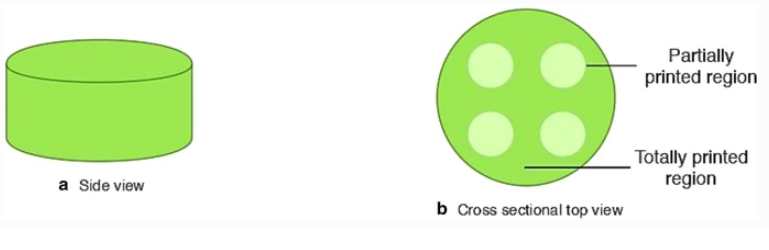
Schematic representation of a fast disintegrating tablet. Partially printed regions consist in loose powder that allows faster disintegration and dissolution. Picture adapted from [24]
Subscribe to Our Email Newsletter
Stay up-to-date on all the latest news from the 3D printing industry and receive information and offers from third party vendors.
Print Services
Upload your 3D Models and get them printed quickly and efficiently.











You May Also Like
Portsmouth Naval Shipyard Installs 3D Printed Part on In-Service Submarine in Key Milestone for US Defense Sector
I’ve been tracking the US Navy’s additive manufacturing (AM) buildup as it relates to submarines for a while now, and even amidst the AM efforts that all the branches have embarked...
6K Additive Lands Long-Term Nickel-Alloy Powders Supply Agreement with Siemens Energy
We’ve still got a month left in Q1, but I’ve already come back to the theme of the role of additive manufacturing (AM) in the ‘sustainability-as-security’ thesis — a topic...
Cheap Printers Make Metal Powders Costly
Last year, on stage at AM Strategies, the argument was simple: additive manufacturing had to stop chasing elegance and start chasing economics. The 3D printing community had spent decades refining...
Adoption of Advanced Powder Metal Manufacturing in the Global Small Arms Space – SHOT Show 2026 Additive Manufacturing Analysis
Back in 2013, I remember being completely blown away when a company called Solid Concepts reportedly additively manufactured nearly a complete firearm as a proof of concept. Although desktop polymer...