The Promise of 3D Printing Sustainable Society & Development

Italian researchers from the University of Chieti-Pescara are exploring the ongoing pervasiveness of 3D printing and additive manufacturing and what that really means for the future in ‘Investigation of the Impact of Sustainability on 3D Printing Technologies.’ While they understand much about performance in terms of software, hardware, and materials—along with a wide range of peripheral products now being produced to accentuate sales in a burgeoning industry—the research team considers how 3D printing can play a role in the ‘sustainable society.’
 Defining 3D printing as a method for ‘joining or solidifying’ materials under computer control, the researchers remind us that the technology was not meant for the enjoyment of the masses originally; after all, at first there was no concept of how other users would grasp the magnitude of what can be accomplished with such processes. Meant as an engineering tool to further rapid prototyping in industrial and commercial applications, 3D printing has been behind many designs for companies like NASA. Today, users of all ages and with a variety of different interests are enjoying the affordability and accessibility of 3D printing—often sharing Fab Labs which are equipped for groups to enjoy a common creative space.
“However, uncontrolled industrial, commercial and new ‘informal’ 3D Printing applications – intended as new distributed socio-technical forms of production – might produce unsustainable impacts on the ecosystems. In the perspective of a Sustainable Development defined as ‘a development that meets the needs of the present without compromising the ability of future generations to meet their own needs’ (UN WCED, 1987), it is important to control this type of innovations to mitigate the anthropic impacts on ecosystems both at micro-and at macro-scale,” state the researchers, encouraging a more ‘systemic approach’ for sustainability-oriented technology following a vertical direction in mono-disciplinary research, and cross-fertilization.
Sustainability of 3D printing has a better chance of thriving when all the elements are considered, to include:
- Material supply
- Design of solutions
- Processes simplification
- Design based in sustainable conditions

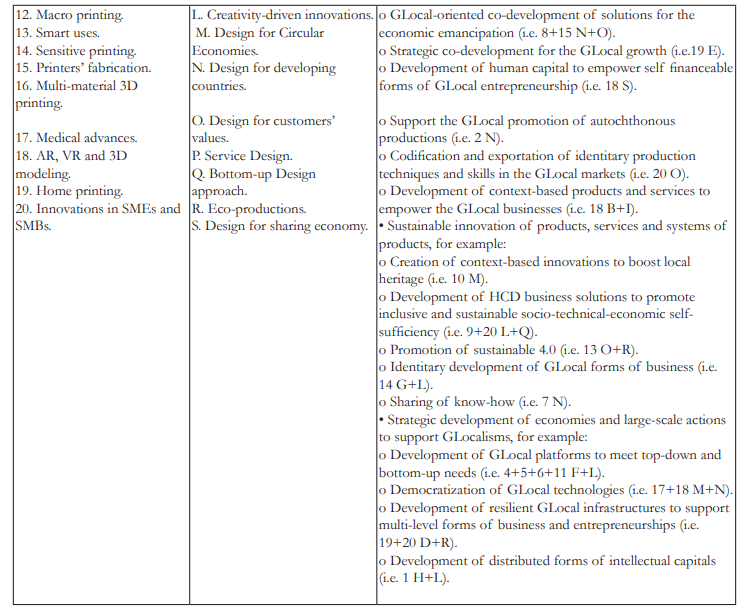
“Accordingly, as the need of sustainable solutions is still high, the evolution of 3D Printing’s paradigms toward network-based, hybrid PSS-based and SLOC-oriented scenarios, can surely meet the Design Research in the field of Design for Sustainability and the technology-driven research of 3D Printing industry,” concluded the researchers.
“… the results here achieved can be useful to develop a new design awareness, which can be used by designers, makers, entrepreneurs and stakeholders to address the future development of new proactive printable sustainable solutions for new emerging markets and countries.”
As 3D printing exploded into the mainstream several years ago, its level of sustainability has been a central topic within the industry. And while the technology has certainly proven to be far more than a one-hit wonder or a fad, researchers are still exploring the promise and potential of what seems to be an infinite realm ripe with innovation.
While there may have been many critics of 3D printing at first, world leaders in a wide range of industries have made their interest in this progressive technology known, from GE to HP, to automotive manufacturers like BMW and retailers like Adidas or Nike.
What do you think of this news? Let us know your thoughts! Join the discussion of this and other 3D printing topics at 3DPrintBoard.com.
Fablabs are cropping up around the world (from ‘We Need to Talk About Fablabs‘)
Subscribe to Our Email Newsletter
Stay up-to-date on all the latest news from the 3D printing industry and receive information and offers from third party vendors.
Print Services
Upload your 3D Models and get them printed quickly and efficiently.













You May Also Like
3D Printing News Briefs, October 10, 2026: Drones, WAAM, Ceramics, & More
We have a packed 3D Printing News Briefs for you this weekend! First, America Makes celebrated the recent National Manufacturing Day with 3D printed drones, and then it’s on to...
10 Years of Multi Jet Fusion: Onsite at HP’s Vancouver, Washington Facility
At this year’s RAPID event in Boston, HP Additive Manufacturing Solutions celebrated ten years in the additive manufacturing (AM) market. The company ushered in the milestone with several innovations, including...
PharmaTher Plans U.S. Network to 3D Print Medicines on Demand
3D printing medicines has often been tied to the idea of personalization, basically making a pill in the right dose, shape, or drug combination for a patient. PharmaTher is now...
3D Printing News Briefs, September 17, 2026: 3D Printed Boat, UAS Development, & More
We’ll start with maritime manufacturing in this week’s 3D Printing News Briefs, and continue on to defense 3D printing. We’ll end with funding for Tripo AI. Read on for all...