
3Dealise Uses One of The World’s Largest Commercial 3D Sand Printers to Create Prototypes for Customer

 If we are to see a third industrial revolution borne out of the up-and-coming technology of 3D printing, many ideologies must change. Industrial leaders must realize that 3D printing won’t just completely replace more traditional methods overnight. Upgrading machinery, and machine practices throughout industry is a gradual process. There are workers who must be trained, and funds that must be raised in order to slowly move in a new direction.
One London-based company, 3Dealise Ltd., understands this, and so they came up with quite the interesting method of creating accurate prototypes for their clients. Using the ExOne S-Max sand 3D printer, they created what they say is the world’s first prototype from this printer.
The ExOne S-Max works by dispensing special resin into thin layers of engineered silica sand. It features an incredible build area of 1800 x 1000 x 700 mm, which makes it perfect for creating molds which can be used for the casting of large metal objects. This completely removes an entire step in the casting process by eliminating the need for a casting pattern. The S-Max is currently the fastest and largest 3D sand printer on the market.
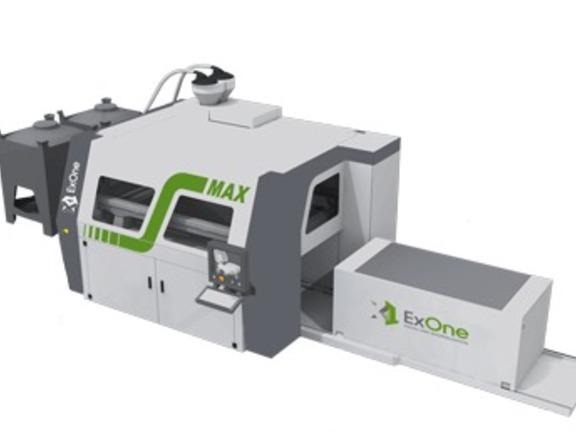
ExOne S-Max 3D Printer
“This new technology is important for two reasons,” explained Roland Stapper, CEO of 3Dealise. “First, the success of UK manufacturing depends on the ability to quickly innovate and turn ideas into prototypes and then products. By enabling clients to go directly from a computer design to a high quality and high precision prototype, we can speed up the prototype cycle, which can give UK manufacturers a real edge. Second, there is a major trend away from mass production and towards customized products designed to meet specific needs. 3D printing is particularly well suited to produce customized products because every print can be different. Local UK production is crucial to this concept, because shipping time must be minimized.”
Sand printing is quite different from other means of 3D printing. It is one of, if not the, best way to produce product molds in a quick time frame. This can be used for the creation of prototypes or even to mass produce final products. Sand printing allows for a tremendous freedom in the designing of products because more traditional obstacles and constraints such as draft angles no longer apply. The process has the ability to greatly reduce waste, save energy, and take up much less time when compared to more traditional methods of manufacturing.
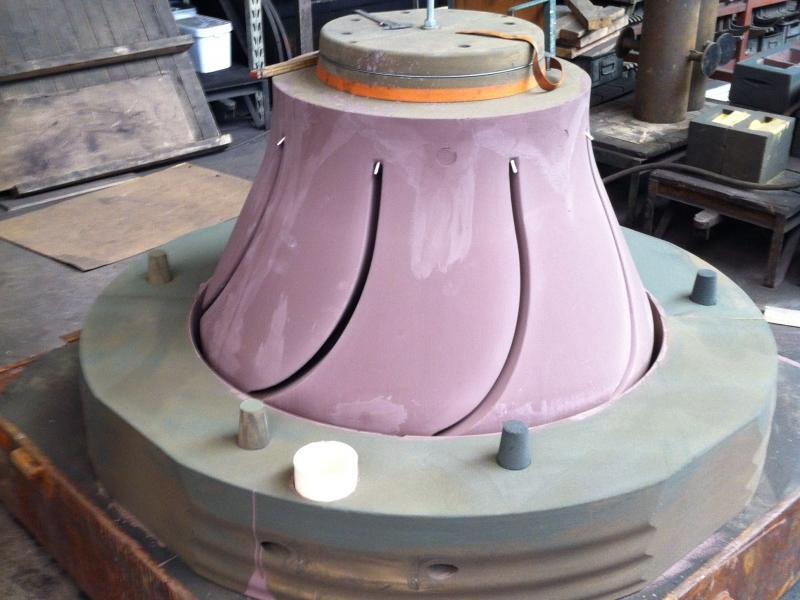
If the build volume on the 3D printer is not large enough for the size needed for a particular part, it may be broken down into multiple parts, and than they can be stacked like Legos to make the object as large as is needed. 3Dealise did this recently in the production of a 1200 mm diameter pump, seen in the image below.
It should be interesting to see if more and more companies begin creating molds through the use of 3D printing technology, for a quicker, more efficient way of producing both prototypes and final products. What do you think about this method of manufacturing? Discuss in the 3Dealise forum thread on 3DPB.com. Check out the video below.
Subscribe to Our Email Newsletter
Stay up-to-date on all the latest news from the 3D printing industry and receive information and offers from third party vendors.
Print Services
Upload your 3D Models and get them printed quickly and efficiently.













You May Also Like
Why the AM Industry Should Pay Attention to Schneider Electric’s $22.6B PTC Acquisition
By late 2024, there was already enough signaling of the additive manufacturing (AM) industry opportunity in the data center infrastructure market for AM Research to write a report on the...
How Does Nike’s 3D Printing Approach Fit Into Its Restructuring Plan?
Shares of Nike stock hit all-time highs in late 2021 but have cratered in the years following, with the company losing nearly 80 percent of its market cap since peaking....
3D Printing News Briefs, October 1, 2026: Defense, Enclosures, & More
In today’s 3D Printing News Briefs, we’re starting with defense news, first from Massivit and then from AML3D. Then we’ll move on to U.S. manufacturing of a new large-format LPBF...
South Korea’s Lincsolution Lands Hanwha Defense Deal as Hanwha Invests Billions in US
I recently wrote about how the South Korean additive manufacturing (AM) firm Lincsolution is building an aerospace and defense hub, part of the company’s construction of “the largest AM facility in...
























































