How Feasible is it to use 3D Printing to Maintain Military Assault Rifles?

 In ‘Additive manufacturing for field repair and maintenance of the assault rifle AK5C – a feasibility study,’ Master’s student Emmelie Simic of Uppsala Universitet (Sweden) explores the feasibility for using such technology in connection with Swedish forces who might be stationed in areas such as Mali or Afghanistan.
Simic points out that the Swedish Defense Materiel Administration (FMV) is responsible for supplying their armed forces with material, and 3D printing could very possibly be in their best interest. She also considers that the European Defence Agency sees potential in using 3D printing and additive manufacturing to ‘improve the defense capabilities’ due to the chance for greater:
- Mobility
- Sustainability
- Power
- Protection
All the above are relevant to both field maintenance and repair, especially if they bring about a ‘reduced logistic burden.’ With the ease in creating on-demand spare parts offered by 3D printing, the Swedish armed forces could benefit greatly for maintenance of so many different military aspects – from boats and planes to ammunitions.
“When equipment is used over time it tends to break,” states Simic. “This is why the Swedish armed forces is severely impaired without spare parts in field.”
Many systems in the military may be so old also, that spare parts have become obsolete—and this is a topic we have touched on numerous times regarding why 3D printing is so critical to maintenance endeavors; in fact, along with following projects where obsolete 3D printed parts have been created to finish projects such as returning older vehicles to new condition, we have also noted militaries for numerous countries using the technology to fabricate parts such as the Dutch Army and Taiwanese defense forces.
Simic has chosen the assault rifle of choice for the Swedes, the AK5C, as a prime example of how 3D printing could be used to benefit the military. This weapon has both semi-automatic and automatic modes, and each setting affects the rifle differently, according to Simic:
“For semi-automatic fire, the hammer is released and thrown against the rear part of the spark plug, the spark plug is pushed forward and the cartridge fires. After that the hammer is brought back to the tightened position where it is hooked up by the hammer latch. Automatic fire has almost the same principle, except that the hammer of the rifle is against the rear of the spark plug during the whole time when firing until the trigger is released. Then the hammer is brought back to the tightened position the same way as for semi-automatic firing.”
“Since the hammer-axis works as an axis for the hammer to rotate around, it is more affected during semi-automatic than automatic firing. This is because for every round that is fired in semiautomatic, the hammer goes back and forth around its axis, causing friction and wear, whereas for automatic fire, it only goes up every time the trigger is pressed.”
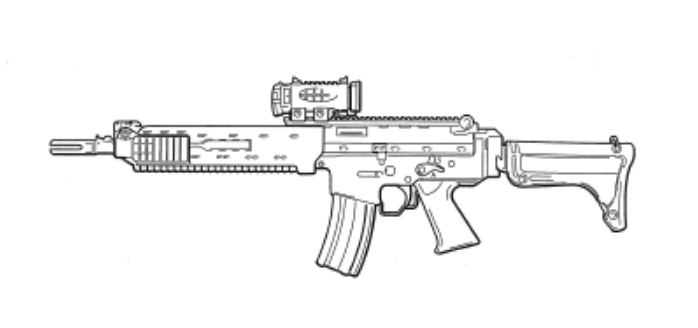
The AK5C rifle, the Swedish soldiers’ primary field arm.
Another problem area for added wear and tear is the hammer axis, subjected to enormous amounts of movement, exposing it to friction and causing so much wear that it may break. The gas cylinder is a part that also takes a lot of the heat too, literally, along with large amounts of pressure—causing the material to break down eventually. The magazine follower in the plastic magazine is another area that breaks down easily due to repetitive use.
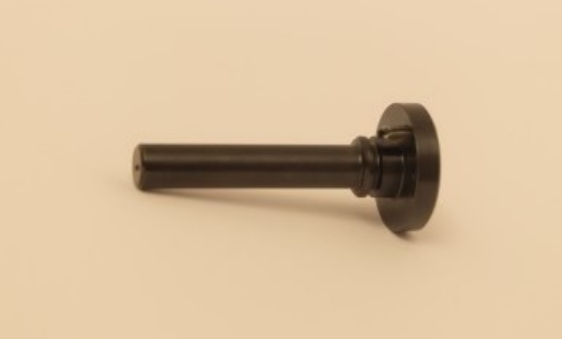
The hammer axis

The gas cylinder
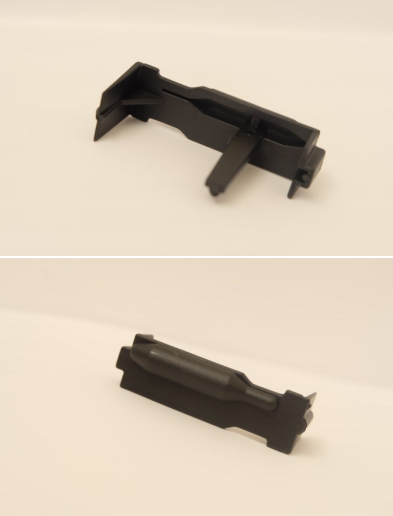
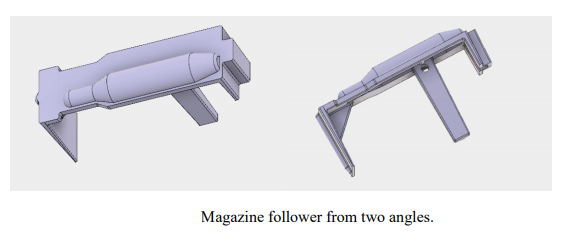
The magazine follower from two different angles.
Simic outlines the different modes of 3D printing and additive manufacturing, adding that all the parts were made by Lasertech LSH AB in Karlskoga. DLMS processes (using the EOS M 290) were chosen for printing the metal parts, while SLS (using the EOS P 395) was used for polymers. A minor amount of post-processing and assembly was required.

The testing area.
Test results in firing the weapons showed that the 3D printing processes were successful, with some minor adjustments required to the gas cylinder, and added recommendations for materials, along with explaining difficulty in that area:
“Because of ethical reasons, since the components are part of a rifle, it was hard to find a company that offered to print the components. This caused limitations to which type of material that could be used for the parts manufactured in AM, and to the type of method.”
“To use additive manufacturing as a manufacturing process in the future for field repair and maintenance is very promising. In this case, it gave almost the same dimensions as the conventional methods, the components were of high quality and didn’t break during functional evaluation. To use AM in Mali or Afghanistan is probably possible with the method that were chosen here for the parts, but more evaluation and testing are needed,” states Simic.
For the future, Simic also suggests further evaluations regarding temperature issues during military use of the rifles and how parts might be affected, along with considering different materials and economic factors.
“In conclusion, additive manufacturing does allow for fabrication of functional spare parts – at least the ones evaluated here,” says Simic.
We would be curious to see how DED processes performed in such a role. Perhaps these would outperform DMLS (powder bed fusion, LPBF) in cost if they could handle the accuracy. The AK5C is a variant of the widespread FN FMC rifle so the study has broader implications than just Sweden. Maintenance, especially overseas, restricts modern militaries as does ageing equipment generally. This indicates that 3D Printing May have a broad role to play in maintenance and repair.
What do you think of this news? Let us know your thoughts! Join the discussion of this and other 3D printing topics at 3DPrintBoard.com.

Source / Images: ‘Additive manufacturing for field repair and maintenance of the assault rifle AK5C – a feasibility study‘]
Subscribe to Our Email Newsletter
Stay up-to-date on all the latest news from the 3D printing industry and receive information and offers from third party vendors.
Print Services
Upload your 3D Models and get them printed quickly and efficiently.













You May Also Like
Oerlikon Adds ATLIX’s xBUILD 5000, Plans More for 2027
Oerlikon has installed a new ATLIX xBUILD 5000 metal 3D printer at its facility in Huntersville, North Carolina, marking the first production deployment of the system worldwide. The machine will...
The Manufacturing Race Behind the Drone Revolution
We are in the middle of a major manufacturing shift focused on the production speed and payload capacity of uncrewed aerial systems (UAS), or drones. A recent Manufacturing Dive article...
Stratasys vs. Bambu Lab: Why Europe and the U.S. Reached Different Results, Part II
Editor’s note: This is Part 2 of a two-part series by Xu Fanglei examining the technology and patent issues behind the Stratasys-Bambu Lab dispute. Part 1 looked at the $27.6...
3D Printing News Briefs, October 1, 2026: Defense, Enclosures, & More
In today’s 3D Printing News Briefs, we’re starting with defense news, first from Massivit and then from AML3D. Then we’ll move on to U.S. manufacturing of a new large-format LPBF...