Couple Uses 3D Printing, Biomechanics, and Ergonomics to Design Innovative New Coffee Mug


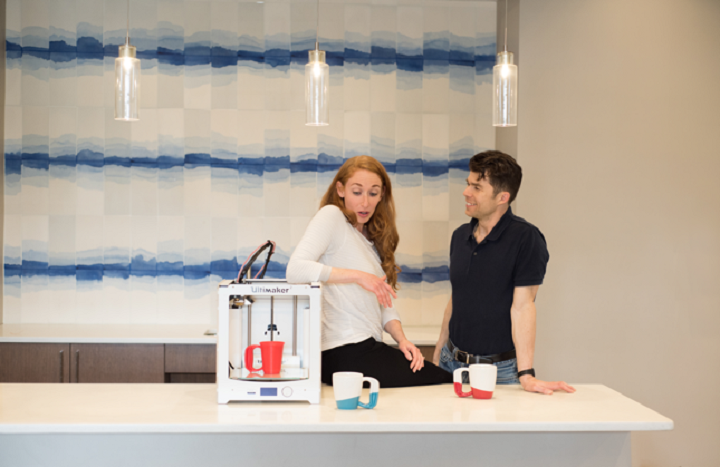
I have far more coffee mugs than any sane person in the world should reasonably own. I recently had to get rid of a couple because I received three more for Christmas – two literary mugs and a black one with the letter ‘S’ emblazoned on it in white. I have Harry Potter mugs, a mug from college, one that my grandmother gave me for Christmas several years ago, a full set of mugs that matches our dishware…and that’s all without listing our multiple travel mugs of varying sizes. It’s a good thing I like coffee, otherwise that would be a lot of wasted room in my cupboards.
However, what I do not have is a coffee mug that is 3D printed, or one that takes ergonomics into consideration. The tried and true design for the coffee mug has been mostly unchanged for almost 5,000 years…until now. You may think I’m being needlessly dramatic when I say that, but for a cup that many people have come to revere as an additional limb, I think this is a big deal.
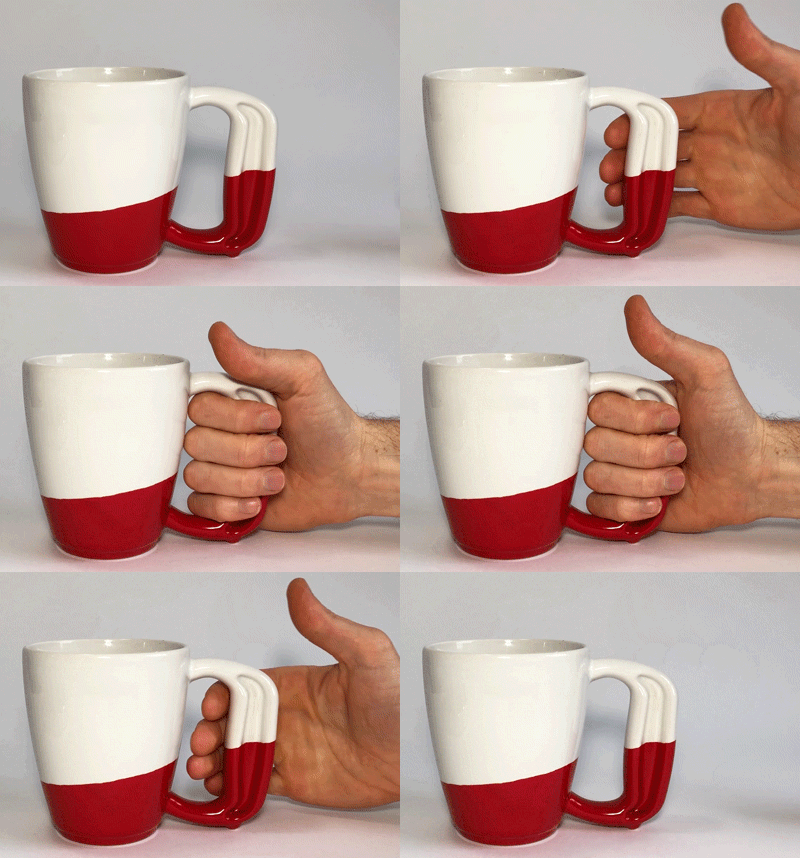 Typical coffee mugs create stress on the joints, ligaments, and tendons of a person’s forearm, hand, and wrist, and can easily burn you. Married couple Allen and Diana Arseneau – one a biochemical engineer and one a scientist – noticed how uncomfortable coffee mugs actually are, and vowed to change things. Over the course of two and a half years, the couple used the principles of 3D printing and bioengineering to change up how coffee mugs are designed, combining ergonomics, science, and biomechanics to develop the patented Jamber Mug.
“We are a husband-and-wife team trying to improve the quality of life for people around the globe,” the Arseneaus wrote on the Jamber website.
“We do this using a human-centric data-driven design approach to reinventing everyday consumer products.”
Turning to extensive data analysis and receiving assistance from an advisory team of industry experts, the Arseneaus, who reside in Massachusetts with their two children, purchased a 3D printer and got to work on designing their new and improved mug, analyzing the anatomy of the human hand, typical coffee mug handles, and grip strength. The result is the Jamber Mug, which is less strenuous on your joints and therefore very comfortable to hold, thanks to its innovative handle.

This handle puts a person’s hand in a more restful, anatomically neutral position, which lowers joint stress, while also easily keeping it in an efficient, strong power grip. In addition, a stabilizing foot nub located at the base of the Jamber Mug’s handle adds some extra stability, which reduces accidental and potentially painful spills when you’re pulling your hand away.
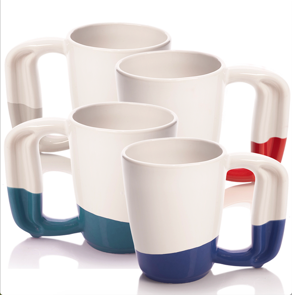 The Jamber Mug is a really great concept for people suffering from arthritis, carpal tunnel, tendonitis, Parkinson’s, and thumb and hand injuries, since it’s so much easier to hold, and the mug is attractive as well. Each one is made out of industrial-grade ceramic in the US, and they’re also safe to use in both the microwave and the dishwasher.
The mug, made with 3D printing, is available in both a 12 oz. and 16 oz. size, and while it weighs the same as a traditional coffee mug, it feels much more lightweight since it’s so easy to hold. A set of two mugs is just $12.50, while the gift set of four Confetti mugs is $49.95. For US customers, shipping is free for orders of four mugs or more.
Available designs include Lemon Zest Solid, Ruby Red, Admiral, and Moroccan Blue Sweep and Incline, Dove White, and the special Vivian Mug (#BeatCancer), which was made especially for a customer’s daughter, who is battling Stage 4 High-Risk Neuroblastoma. $2 from the sale of each Vivian Mug goes directly to her family.
What do you think of the Jamber Mug? Discuss this story and other 3D printing topics at 3DPrintBoard.com or share your thoughts in the Facebook comments below.
[Images: Jamber]Subscribe to Our Email Newsletter
Stay up-to-date on all the latest news from the 3D printing industry and receive information and offers from third party vendors.
Print Services
Upload your 3D Models and get them printed quickly and efficiently.













You May Also Like
Printing Money Episode 42: Q2 2026 Public Markets 3D Printing Earnings Analysis with Troy Jensen, Cantor
Welcome to Printing Money Episode 42. Troy Jensen (Managing Director, Cantor) returns, joining Danny Piper (Managing Partner, NewCap) to review Q2 2026 publicly traded 3DP/AM company earnings reports. Troy’s quarterly...
3DPOD 314: Debinding, Sintering, and Metal Binder Jetting with Stefan Joens, Elnik Systems and DSH Technologies
Stefan Joens of Elnik Systems sells ovens. Their debind and sintering equipment powers a lot of high-volume binder jet and MIM production. We learn about Elnik and its origins. But...
The Frankenservice Part 1: Print the Rainbow
So far, most service bureaus and manufacturing companies stick to what they know. Not only for OCD reasons, but gleaming lines of identical LPBF machines are also arrayed on impossibly...
3DPOD 313: Patient-Specific 3D Printing with Ruben Wauthle, Amnovis
Ruben Wauthle studied at Leuven University at a very serendipitous time. Through working with pioneering additive professors and surgeons, he entered into a specialty that was emerging. He joined pioneering...