3d.fab’s BioAssemblyBot Wants to 3D Print Skin onto People

3D bioprinting continues to diversify as more and more companies and research organizations join the field, each bringing their own take on the technology to the table. French collaborative platform 3d.fab has an intriguing approach towards bioprinting that involves a freeform robot capable of directly printing on a part of the body. In the video below, the BioAssemblyBot prints what appears to be a bandage directly on an arm:
The “bandage” is actually a bio-ink made from the skin cells of a patient. When applied to the patient’s skin, it forms an autograft that will, within a couple of weeks, create new skin. The BioAssemblyBot is capable of both additive and contour 3D printing, as well as pick and place and assembly thanks to its interchangeable tools. It’s only one of 3d.fab’s bioprinting technologies; the platform has a few other bioprinters in development as well, including another skin printer.
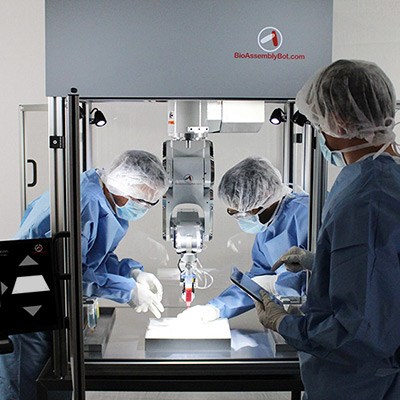 3d.fab works with other 3D printing technologies as well, including FDM and Polyjet, but everything is geared toward the pursuit of new developments in healthcare. Skin 3D printing is a major priority for the platform, as evidenced by the “Stresskin” project, one of several projects 3d.fab is pursuing. The approach of directly 3D printing on a body part is highly promising; while other organizations have worked on 3D printed skin, the samples generally are too fragile to be sutured, according to 3d.fab. The direct 3D printing concept would eliminate the need for sutures, creating a living bandage that would incorporate itself into the surrounding skin.
This is exciting news for victims of burns, illness or trauma who have lost significant portions of skin. Traditional skin grafts are painful and prone to infection or rejection, and the larger the wound, the more difficult it is to repair with a graft. 3D printing new skin cells directly onto a wound would reduce the risk of rejection, as it uses the patient’s own skin cells to grow new skin, and there would be no limit to the size of the “bandages” that could be applied, thanks to the free-form robot.
3d.fab’s other projects include a 3D printed device for faster and more cost-effective diagnoses of diseases. The goal of the project is to avoid further contributing to antibiotic resistance by thoroughly genetically analyzing pathogens. The platform is also working on improving silicone materials for 3D printed medical models and implants, as well as developing 3D printing technologies that can repair nasal cartilage loss.
Those are just a few of the initiatives 3d.fab is working on to advance 3D printing in the medical field. The platform collaborates with multiple partners and is open to further collaborations; if you are interested in working with 3d.fab, you can contact the organization here.
Discuss this and other 3D printing topics at 3DPrintBoard.com or share your thoughts below.
Subscribe to Our Email Newsletter
Stay up-to-date on all the latest news from the 3D printing industry and receive information and offers from third party vendors.
Print Services
Upload your 3D Models and get them printed quickly and efficiently.











You May Also Like
Bambu Lab A1 Used to Directly 3D Print Copper Electroplated Parts
Maker Dzingof was doing tonnes of electroplating of desktop and other 3D prints years ago with his Metalizzr project. I’ve been playing, a lot less successfully, with electroplated 3D prints...
3D Printing News Briefs, October 1, 2025: Bambu Lab Store, Shape-Morphing Materials, & More
In today’s 3D Printing News Briefs, Bambu Lab has opened its first retail store, and Meltio is inaugurating its first international additive manufacturing reference site. A consortium has launched a...
3D Printing News Briefs, August 13, 2025: Public Utility, Rocket Engine, Brains, & More
In today’s 3D Printing News Briefs, AML3D’s large-scale metal 3D printing system is now online at the largest public utility in the U.S. Moving on, Bright Laser Technologies is 3D...
Soft Robotics is Finally Coming Together: Northwestern Researchers Make Strides Towards a Better Actuator
Soft robotics for a long time was a lot of nice videos, papers, and very little in the way of useful technology. It was kind of an engineering Esperanto: a...