Defense Logistics Agency Awards Senvol Grant to Predict Mechanical Performance of 3D Printed Parts

 New York-based Senvol, which provides data to companies to help them adopt 3D printing into their workflows, has been pretty focused on military applications as of late. The company joined the National Armaments Consortium in July, and it received a grant in August from the National Institute of Standards and Technology (NIST), a non-regulatory agency of the United States Department of Commerce, to use its Senvol ML data-driven machine learning software suite for 3D printing to set up Process-Structure-Property (PSP) relationships.
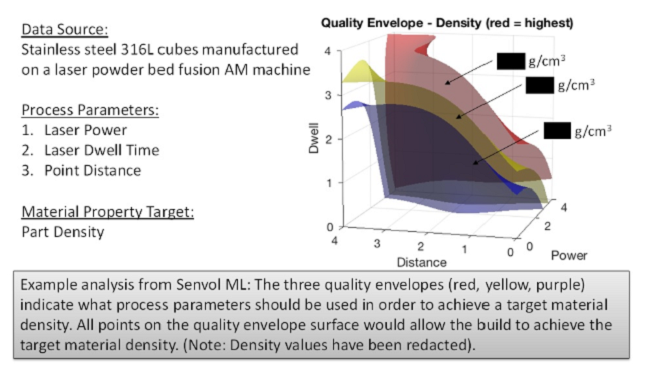
Senvol ML helps companies characterize or qualify 3D printing materials and processes fast, so users can select the appropriate process parameters, given the target mechanical performance, for specific 3D printers.
[Image: DLA]
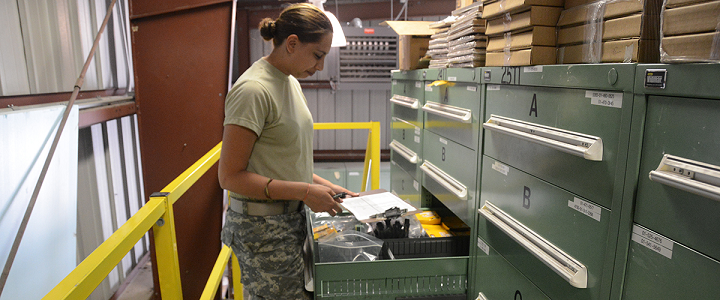
The DLA manages the global supply chain, all the way from raw materials to end user and disposition, for the country’s Army, Navy, Air Force, Marine Corps, Coast Guard, several federal agencies, ten combatant commands, and partner and allied nations. The agency also manages a total of nine supply chains and roughly 5 million items, which includes the supply of 86% of the military’s total spare parts.
 Recently, the DLA announced that it had awarded Senvol a grant for a new project, called “Additive Manufacturing Sensor Fusion Technologies for Process Monitoring and Control,” which will focus on accurately predicting a 3D printed part’s mechanical performance by analyzing additive manufacturing in-situ monitoring data. So Senvol’s ML software will be coming into play here to conduct the analyses for the project.
“The goal of this project is to demonstrate that parts of equivalent mechanical performance can be made on two different additive manufacturing machines, and that a suite of in-situ monitoring equipment is able to collectively provide sufficient data to monitor the process signatures and ensure that the additive manufacturing process will indeed yield equivalent parts,” said Annie Wang, the President of Senvol.
Senvol will work to demonstrate that a 3D printed part’s mechanical performance can be accurately predicted by using its ML software to analyze data from different 3D printing in-situ monitoring sensors.
[Image: Senvol]
During the joint project with the DLA, Senvol will be working to implement, into one or more laser powder bed fusion 3D printing systems, what it calls its “advanced in-situ monitoring systems of various modalities.” Then, once the data has been collected from the 3D printers, Senvol will analyze it using its data-driven machine learning algorithms, in order to relate mechanical performance and material properties to process signatures. The company will also use its real-time data processing algorithms, which extract data such as process signatures, for analysis purposes.
What do you think? Discuss this story and other 3D printing topics at 3DPrintBoard.com or share your thoughts in the Facebook comments below.
Subscribe to Our Email Newsletter
Stay up-to-date on all the latest news from the 3D printing industry and receive information and offers from third party vendors.
Print Services
Upload your 3D Models and get them printed quickly and efficiently.











You May Also Like
3D Printing News Briefs, February 21, 2026: Vapor Smoothing, Brain Models, & More
In this weekend’s 3D Printing News Briefs, we’re starting with material and post-processing news from Quickparts, and some more post-processing news from AM Solutions. We’ll end with researchers at the...
3D Printing News Briefs: February 19, 2026: Market Data, Africa, Metal Parts for Defense, & More
We’re starting with some business news for you in today’s 3D Printing News Briefs! The Wohlers Report 2026 is now available, Carbon announced its new Chief Technology Officer, and Farsoon...
From “Magic” to Metal: How Intrepid Automation Wants to Make 3D Printing Matter at Scale
Ben Wynne still talks about 3D printing the way people do when they’ve felt that “wow” moment up close. Back in the early 2000s, he was working at HP’s advanced...
Takeaways From MILAM 2026: Defense’s Growing Role in Driving 3D Printing – Part II
At the recent Military Additive Manufacturing Summit & Technology Showcase (MILAM 2026), additive manufacturing wasn’t just being discussed as a production strategy; it was being packaged for deployment. A big...