NASA Awards Grant to Tethers Unlimited for Microgravity 3D Printer/Filament Recycler

 Two of my favorite things to write about are outer space and recycling – so imagine how excited I am about recycling in outer space. Last year, we wrote about a company called Tethers Unlimited, Inc. (TUI), a Washington-based technology firm that was awarded a Small Business Innovation Research (SBIR) grant from NASA to further develop their Positrusion Recycler for use on the International Space Station. The Positrusion, which was developed specifically with the ISS in mind, recycles plastic waste into filament in a process that, according to TUI, is as easy as operating a microwave.
While commercial versions of the Positrusion system are still in development, NASA has evidently been very satisfied with the technology, as they’ve just awarded Firmamentum, a division of TUI, a Phase III SBIR for the creation of a combination 3D printer/recycler for the ISS. The device, dubbed the Refabricator, will be an experiment in closed-cycle manufacturing in outer space, and NASA hopes that it can eventually be used on missions to Mars.
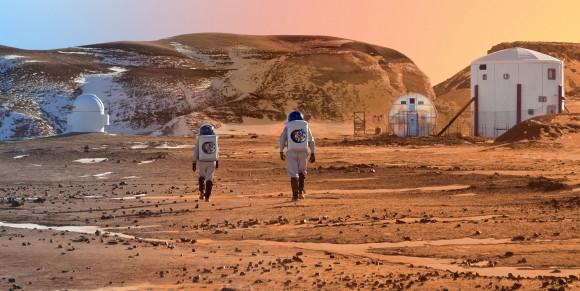
“On a manned mission to Mars, the astronauts must bring everything they need with them,” said Jesse Cushing, Principal Investigator for the Refabricator project. “Due to the incredibly high cost of launching mass to Mars, carrying every tool or replacement part that they might possibly need simply isn’t affordable. The Refabricator will demonstrate the ability to recycle plastic parts and waste to make new parts and tools on-demand.
“This capability will enable the astronauts to use material that would otherwise be waste to maintain their spacecraft and adapt to unforeseen challenges on the Martian surface. For example, if Mark Watney had a Refabricator, he could have easily recycled his food trays and other plastic waste into the tools and parts he needed to survive, and The Martian would have been much less of a nail-biter.”
[Image: Mars Society MRDS]
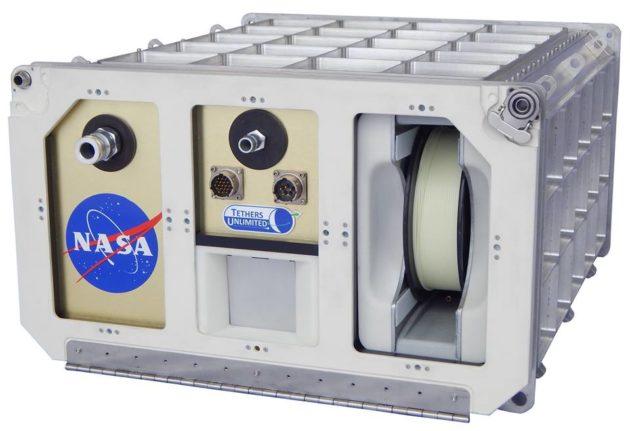 While there are lots of plastic and filament recyclers out there already, the Refabricator, which will integrate Positrusion technology with a 3D printer, is designed to minimize material degradation and to produce filament to standard specifications without needing much time or attention from the astronauts. So far, Firmamentum has tested the device for about four manufacturing cycles, but the next step is to see how it does in zero gravity. The launch of the Refabricator to the ISS is tentatively expected to happen in early 2017.
“The Refabricator demonstration is a key advance towards our vision of implementing a truly sustainable in-space manufacturing ecosystem,” said Dr. Rob Hoyt, CEO of TUI/Firmamentum. “With this technology the astronauts will be able to process our recyclable launch packaging materials into 3D printer filament, manufacture and recycle food-safe utensils, and turn what is now inconvenient waste into feedstock to help build the next generation of space systems. We believe these solutions will help dramatically reduce the cost and risks for NASA and private space exploration missions.”
TUI and Firmamentum are hoping that the device will also find a market down here on Earth. Discuss further in the 3D Recycler forum over at 3DPB.com.
Subscribe to Our Email Newsletter
Stay up-to-date on all the latest news from the 3D printing industry and receive information and offers from third party vendors.
Print Services
Upload your 3D Models and get them printed quickly and efficiently.











You May Also Like
AMUG 2026 to Feature LEGO, Aerospace Collaboration Keynotes
AMUG 2026 puts the spotlight on the people and partnerships driving additive manufacturing forward. According to AMUG’s pre-conference overview, this year’s agenda reflects cross-industry collaboration, hands-on learning, and tangible business...
Generative AI Is Moving From Design to Factory Floors: TCT Asia 2026 Shows the Full Workflow
Generative AI is rapidly moving beyond digital experimentation and into real manufacturing environments — but the key challenge remains: can AI-generated 3D models move seamlessly from creation to production? At...
From “Magic” to Metal: How Intrepid Automation Wants to Make 3D Printing Matter at Scale
Ben Wynne still talks about 3D printing the way people do when they’ve felt that “wow” moment up close. Back in the early 2000s, he was working at HP’s advanced...
From Vision to Volume: The Next Chapter for Additive Manufacturing
Additive manufacturing has spent years navigating skepticism, hype cycles, and industrial validation. Now, the industry finds itself at a decisive turning point. The conversation has shifted away from futuristic possibilities...