CollPlant Receives Funding for Research in Developing Collagen-Based Bioinks for 3D Printing Tissues & Organs


 This week regenerative medicine company CollPlant announced that they have received authorization from the Chief Scientist of Israel’s Ministry of Economy to partially fund their 2016 development project. CollPlant is exploring new uses for their human collagen-based medical products, including the development of a bioink material for use in the 3D printing of human tissue and organs. The ₪5.6 million ($1,450,000) grant awarded by the Chief Scientist is expected to cover 50% of CollPlant’s projected ₪12 million ($3,114,800) development costs. The company was awarded a grant of ₪4.7 million ($1,220,000) from the Chief Scientist last year for the development of their plant-based rhCollagen technology.
CollPlant is an Israel-based clinical-stage regenerative medicine company that has developed a proprietary, plant-based collagen material for use in tissue repair products. The cutting-edge technology developed by the company is capable of quickly and efficiently generating recombinant human collagen (rhCollagen), as well as several other patent-protected recombinant proteins. Their rhCollagen technology was originally designed to be used by orthobiologics or for advanced wound care, however the material has proven to be quite versatile and has been used in several advanced products.
“We are delighted to receive the Chief Scientist’s authorization for funding of CollPlant’s development programs. The Chief Scientist’s support over the years is an expression of his trust in the commercial potential of the Company’s products. We are currently working on the European sales launch of Vergenix FG, our wound healing product, and are in discussions with potential parties for European distribution of Vergenix STR, our product to treat tendons inflammation, based on the projection that marketing authorization will be granted in the coming months. CollPlant is also working diligently to expand its pipeline products through the development of innovative new products addressing significant market needs, and which will contribute meaningfully to the value of the company,” said CollPlant CEO Yehiel Tal.
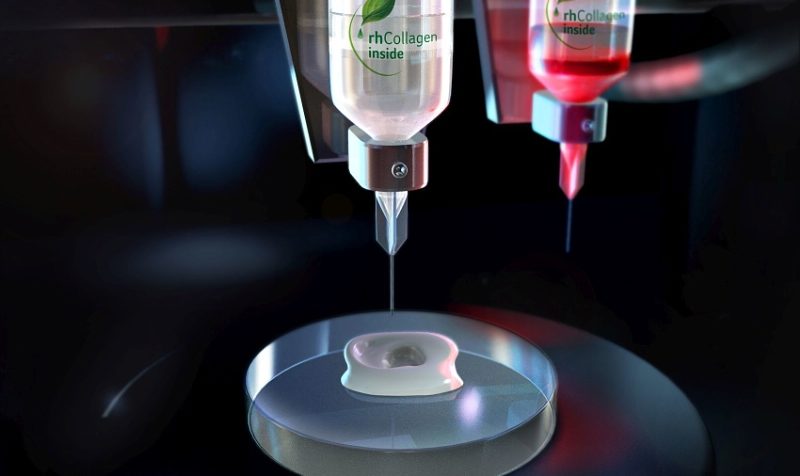
Bio-Ink for 3D printing.
The authorized development programs include using CollPlant rhCollagen to develop a variety of collagen-based materials that can be adapted as a 3D printable bioink material that can encourage the natural development of human tissue. The bioinks will be used to develop 3D printed organs and 3D printed replacement tissue for the treatment of wounds and burns. The Chief Scientist also funded the development of a product that will treat tears in tendons and ligaments common in Anterior Cruciate Ligament (ACL) knee joint injuries. Both projects will utilize CollPlant’s Vergenix STR (Soft Tissue Repair Matrix), a product originally developed to treat tendinopathy.
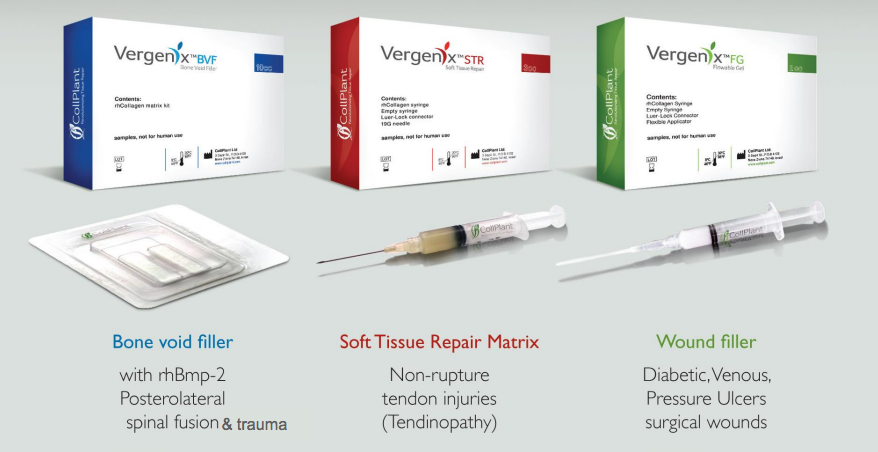
CollPlant rhCollagen-based medical products.
The company produces their rhCollagen material by introducing five human genes that are essential for the production of collagen into tobacco plants that have been specially genetically engineered. Tobacco was chosen because it is an easy to grow plant that will thrive in most soil types or environments, and crops grow quickly and can be easily harvested. Once the tobacco leaves are harvested they will be processed to create an extract that undergoes several purification processes until the final rhCollagen material is produced. The resulting rhCollagen demonstrated superior biological functions when compared to tissue collagen derived from animal or human tissue sources.
Because CollPlant’s rhCollagen is identical to type I collagen typically produced by the human body it has several advantages compared to animal tissue-derived collagen, including improved biofunctionality, superior homogeneity and a significantly reduced risk of an immune response. The company has several products containing their rhCollagen, including the tendinopathy treatment Vergenix STR, the Vergenix FG (Flowable Gel) wound filler used to treat acute or chronic wounds and Vergenix BVF (Bone Void Filler) that is used for spinal fusion procedures. You can learn more about all of CollPlant collagen products on their website.
Here is a video explaining the process of creating rhCollagen. Discuss further in the CollPlant & 3D Printing forum thread over at 3DPB.com.
Subscribe to Our Email Newsletter
Stay up-to-date on all the latest news from the 3D printing industry and receive information and offers from third party vendors.
Print Services
Upload your 3D Models and get them printed quickly and efficiently.













You May Also Like
3D Printing News Briefs, October 21, 2026: Digital Twins, AI CAD Service, AR Smart Glasses, & More
In today’s 3D Printing News Briefs, America Makes announced the winners of its MIAMI Project Call, and AM Europe released a new report. Artec 3D launched its new Artec Twins...
3D Printing News Briefs: October 17, 2026: Affordable Housing, Bone Implants, Rubber Gloves, & More
In this weekend’s 3D Printing News Briefs, we’re starting off with quality assurance in metal additive manufacturing (AM), a new 3D printer, and 3D printed housing. We’ll finish up with...
3D Printing News Briefs, October 14, 2026: Bolus, Aerospace Tooling, Water Filter, & More
In today’s 3D Printing News Briefs, we’re starting with medical news, as Myrava has received FDA 510(k) clearance for its 3D printed bolus. Moving on to aerospace and metals, AML3D...
Can India’s AM Push Help Make it a Viable Supplement to China?
Diversifying manufacturing supply chains to locales outside of China has nothing to do with actually cultivating “substitutes” to the Chinese economy. The real stakes are these: China is an irreplaceable...