3D Shaver: Shapeways and Philips Partner to Create the World’s First Customizable 3D Printed Electric Shaver


 As manufacturing technology starts to shift from large-scale, mass-produced consumer products to smaller, 3D printed to order products a whole new level of customization will be available to customers. Modern online ordering tools already offer a surprising amount of customization options for a wide range of products. We already know that things like t-shirts can be ordered in specific sizes, different colors and even with unique text or images printed on them. The same principles will soon be possible with more than just things like clothing, because there is no economy of scale involved with 3D printing, it costs the same to mass produce hundreds of the same object, or produce hundreds of personalized objects.
Back in 2007, an idea was born at Dutch technology company Philips to create a service that would offer customers the ability to send in a 3D printable model and have it manufactured to order. The idea eventually was moved to the Philips Lifestyle Incubator program that helps develop innovative tech startups. Since Shapeways was spun off from Philips the two companies have still maintained a close working relationship, and collaborated on several projects over the years. To celebrate the 125th anniversary of Philips being founded in Eindhoven, Netherlands the two companies came together to offer an electric shaver with a customizable, 3D printed case.
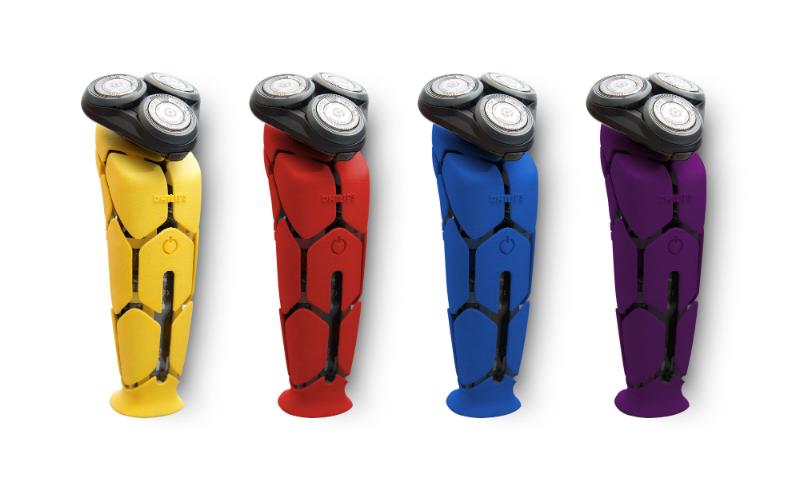
Up to eight different colors are available.
The 3D Shaver was developed by Philips, Shapeways and Twikit, an online 3D printable product customization app. On the inside, the 3D Shaver is based on technology from Philips’ line of best selling men’s shavers, but the outside case is personalized and 3D printed based on the customer’s specifications. The 3D Shavers handle can have different designs, textures and colors chosen online at 3dshaver.com. There are eight different colors that can be chosen, and two different external textures, and the design can be customized and altered using a slider.
Once an order is placed for a shaver, the custom parts are 3D printed and dyed by Shapeways at their facility in Eindhoven. The process takes three days total, one day to 3D print the parts, one day for the binding agent in the parts to completely dry and a third to dye them. When the parts have been 3D printed and colored, they are sent over to a Philips facility in the Netherlands where the final manufacturing and assembly takes place. The shaver and its accessories are packed up in a personalized box and shipped out to the customer. The entire process takes about two to three weeks from order to deliver, and according to Phillips it takes seventeen different people to produce each 3D Shaver.
Shapeways has shared a first-hand look at the 3D Shaver, and shared some impressions.
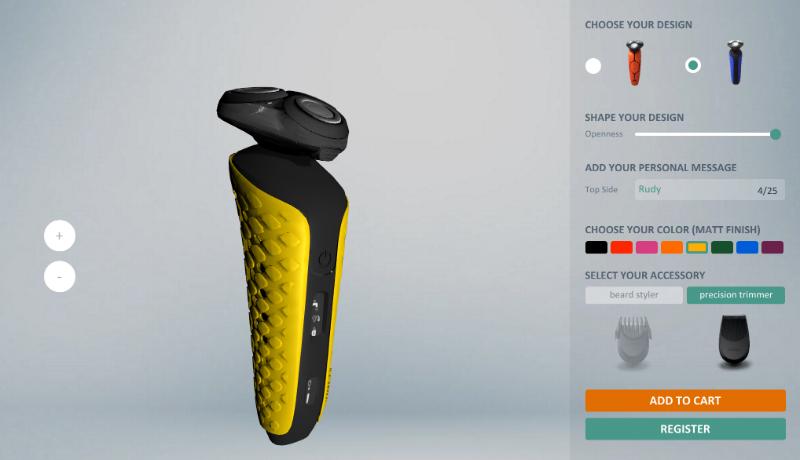
Online 3D customization tools by Twikit.
Here is a video of the 3D Shaver being unboxed:
And here is some video of Shapeways’ European Community Manager, Ruud, shaving off his beard with his 3D Shaver:
Each 3D Shaver costs about $111, which is actually not as expensive as you would think a customized product would be. Unfortunately the 3D Shaver is a limited edition test product, and Philips is only manufacturing 125 units to celebrate their 125th anniversary. Sadly, the 3D Shaver will only be available to customers located in the Netherlands, so we’re out of luck. You can learn more about the 3D Shaver and play around with the Twikit-powered customization tools here. Discuss further in the 3D Printed Electric Shaver forum over at 3DPB.com.
[Videos: Shapeways]
Subscribe to Our Email Newsletter
Stay up-to-date on all the latest news from the 3D printing industry and receive information and offers from third party vendors.
Print Services
Upload your 3D Models and get them printed quickly and efficiently.













You May Also Like
50,000 Orders and Counting: EPlus3D & Chinese AM Services Provider Are Scaling Liquid Cooling Solutions for AI Servers
An under-appreciated story driving the additive manufacturing (AM) industry this year has been the divergence between what’s driving the market in China and what’s driving it everywhere else. Let’s start...
Additive Manufacturing Has a Major Growth Opportunity; Trust Will Decide Who Captures It
After years of overpromising, the next phase of AM growth will be won by companies that consistently deliver what they say. When I entered additive manufacturing in 2014, after 15...
Seven Trends Reveal What’s Next for 3D Printing at TCT Shenzhen 2026
TCT Shenzhen 2026 opened on October 14 in Hall 15 of the Shenzhen World Exhibition & Convention Center in Bao’an, and ran through October 16. The event brought together equipment...
AM Investment Strategies 2026 Sets the Stage for AMS 2027
AM Investment Strategies 2026 Nov. 5 · 12 p.m. ET · Free online event RESERVE YOUR SPOT ↗ A one-hour online discussion featuring some of the biggest names in 3D...