Dep. of Energy Working On 3D Printer 500 Times Faster Than Top of The Line Printers Today

Talk about exponential progress in technology. If the Department of Energy’s Oak Ridge National Laboratory (ORNL) has its way, we will have a 3D printer capable of printing out polymer objects at speeds anywhere from 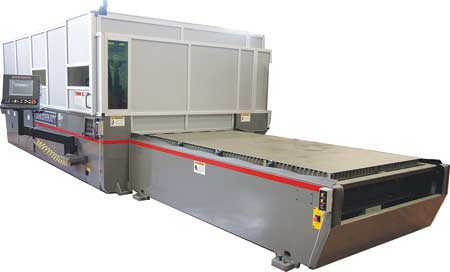 200-500 times faster than the 3D printers used in manufacturing facilities today. If that’s not enough to get you excited about where the 3D printing industry is headed, than maybe the fact that they are also looking to print items which are 10 times larger than those printed with machines today, will.
The ORNL signed an agreement earlier this month with Cincinnati Incorporated, who was the first laser cutting system manufacturer to put linear-motor axis drives within their printers, which provide .001 in. accuracy per axis.
“The agreement with Cincinnati Incorporated exemplifies ORNL’s strong commitment to working with industry to move our innovations into real-world applications,” said ORNL Director Thom Mason. “These partnerships come with the potential for significant energy and economic impacts.”
This initiative is in line with the Department of Energy’s goal of greener, more efficient technology, and hopefully will lead to an advantage within the United States manufacturing industry.
“The Energy Department and its national labs are forging partnerships with the private sector to strengthen advanced manufacturing, foster innovation, and create clean energy jobs for the growing middle class,” said David Danielson, the Energy Department’s Assistant Secretary for Energy Efficiency and Renewable Energy. “Developing innovative manufacturing technologies in America will help ensure that the manufacturing jobs of tomorrow are created here in the United States, putting people to work and building a clean energy economy.”

Cincinnati Inc. has a long history of innovation within large scale manufacturing systems. They have produced and shipped over 55,000 machines in the last 115 years, since 1898. The experience, and know-how is certainly there, and they are very familar with the ORNL.
“Cincinnati Incorporated has enjoyed a long working relationship with Oak Ridge National Laboratory,” said Cincinnati CEO Andrew Jamison. “Over the years we have supplied over 40 metal working machine tools to Oak Ridge and its various subcontractors.
There has been no timetable issued by either the ORNL, or Cincinnati Incorporated on when such a printer will be available, however a prototype of the machine is already under development. Discuss this development at 3DPrintBoard.
Subscribe to Our Email Newsletter
Stay up-to-date on all the latest news from the 3D printing industry and receive information and offers from third party vendors.
Print Services
Upload your 3D Models and get them printed quickly and efficiently.












You May Also Like
Josh Makeshift and the New Gold Standard 3D Printing Content Creation
In the beginning, 2007 or so, 3D printing videos were almost wholly absent from the web. Then, here and there, makers started to upload pictures of their rickety RepRaps and...
Teen Developed Desktop 3D Printing Extruder
Inexpensive desktop 3D printing extrusion has always been an impactful potential ally to 3D Printing users. Filabot and 3Devo have been trying to make this a reality for years, with...
Polymaker Unveils HT-PLA & HT-PLA-GF Line of 3D Printing Filaments
Today, Polymaker has launched a new line of HT-PLA & HT-PLA-GF filaments. These enhanced PLA versions increase the glass transition temperature of PLA from a normal 60°C to above 130°C....
3D Printing News Briefs, May 17, 2025: Color-Changing Materials, Humanoid Robot, & More
We’re covering research innovations in today’s 3D Printing News Briefs! First, Penn Engineering developed 3D printed materials that change color under stress, and UC Berkeley researchers created an open source,...