Do3D Develops Revolutionary Multi-side “MAP” 3D Printing Technology

For Martos Barton and the guys behind Budapest-based Do3D Innovations, the work on the professional level Genesis (G1) DLP 3D printer last year was only the beginning: they have now set out to radically change the approach to all 3D printing by introducing the revolutionary MAP™ (Multidirectional Additive Production) technology in their Squarewave prototype DLP-SLA 3D printer.
By enabling any 3D printing technology to build an object from multiple sides at the same time, this patent pending approach can improve 3D printing speeds by up to 200% or more by enabling the process to take place on both sides of the build plate. The possibilities could further expand in the future, as MAP Technology is compatible with powder, liquid resin and even thermopolymer filament based processes.
https://www.youtube.com/watch?v=qBdUIIg46gM&feature=youtu.be
MAP™ Technology has already been implemented by Do3D in a proof-of-concept working prototype and more information can be found in the dedicated website at www.maptechnology.eu. This innovative approach, developed by a team lead by Do3D’s co-founder and CTO Marton Bartos, can improve 3D printing speeds significantly without any sacrifice in terms of geometrical capabilities.

A close up of a part multidirectionally 3D printed on the Squarewave prototype
Multidirectional Additive Production begins by doubling the number of sides and could potentially be expanded to several different sides at the same time.
“We have been asking ourselves how we could achieve multidirectional 3D printing for a couple of years,” said Bartos. “By rethinking the basic concept of creating physical 3D geometries, we have found solutions that could be implemented in marketable products in the near future. We have filed a patent for this new approach and have proved with concept prototypes that our process is well within reach.”
While such a promise would seem to defy the rules of additive part fabrication, it is based on sound physical and chemical principles.
“The first prototype offers simultaneous upward and downward printing and is especially fit for very large parts,” Bartos explained. “Our main goal is to be able to take this idea to the next level and by that we mean establishing potential partnerships in industries that can benefit from our technology. Production speeds achievable with MAP technology could change the face of 3D printing.”
Unlike ultra-fast continuous-DLP approaches, MAP technology focuses on increasing 3D printing speeds without the issue of limiting a technology’s geometrical capabilities. Although difficult to implement, the idea of 3D printing from multiple sides at the same time (thus multiplying the axes) is the key to building larger and more complex products (such as, for example, bioprinted organs), and to do it faster. The Squarewave 3D printer and its MAP technology could be the answer to a broad range of issues that 3D printing is facing today.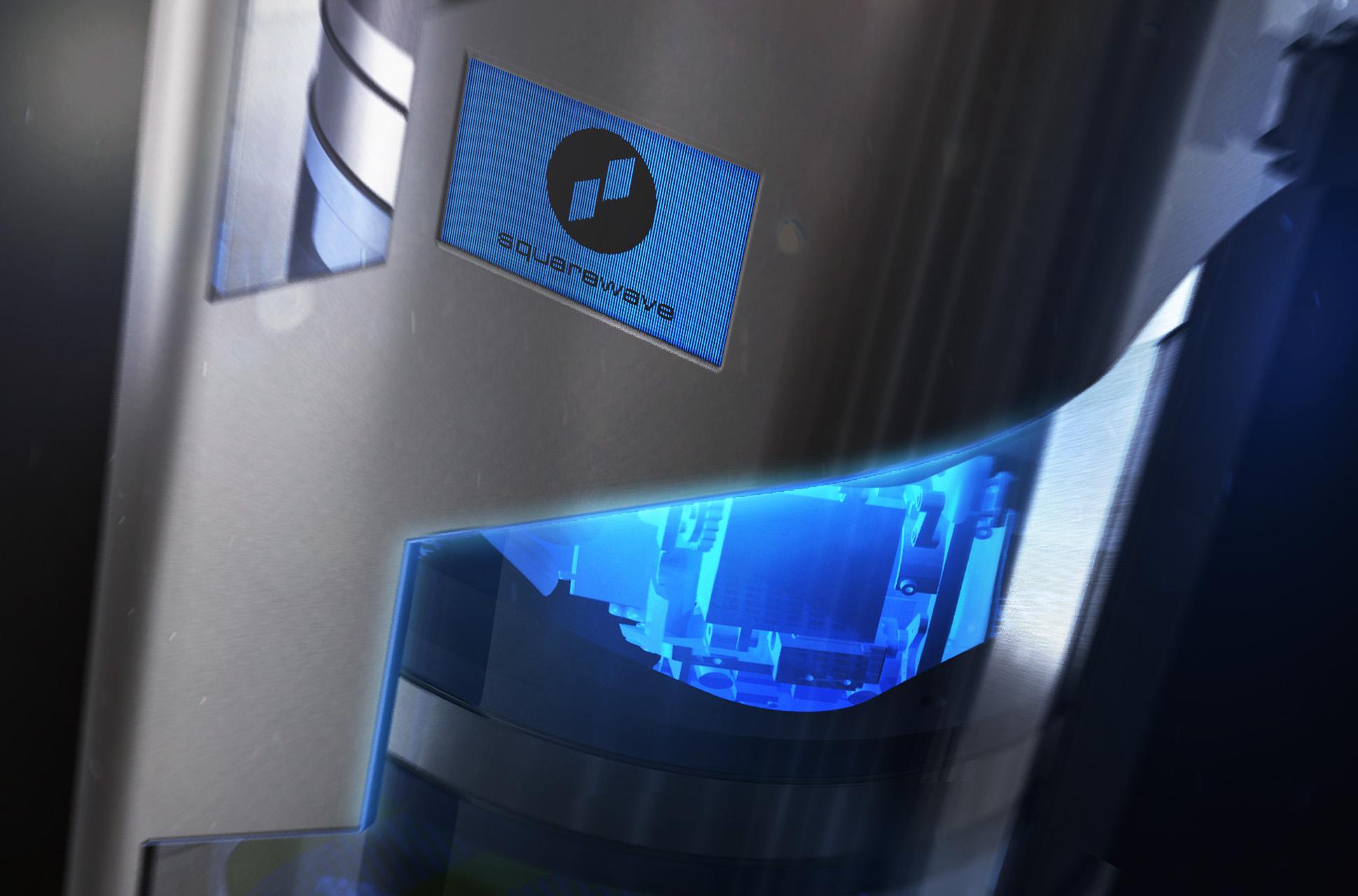
Subscribe to Our Email Newsletter
Stay up-to-date on all the latest news from the 3D printing industry and receive information and offers from third party vendors.
Print Services
Upload your 3D Models and get them printed quickly and efficiently.













You May Also Like
The “Apple Effect”: Are 3D Printers Becoming Lifestyle Products?
For most of its history, desktop 3D printing has been a technology business. Companies competed on speed, accuracy, build volume, temperature, materials and reliability. Buyers compared specifications because the machines...
Prusa Core One L+: A Worthy Upgrade?
Disclosure: The Core One L+ was provided to me by Prusa3d free of charge for the purpose of this review. I have not received any other compensation. All opinions expressed...
3D Printing Services Near $2.5B as AM Market Shifts Beyond Hardware
The additive manufacturing market may be growing again, but one of the more interesting numbers behind that recovery has little to do with selling 3D printers. AM services generated nearly...
Bambu Lab and SUSAN FANG 3D Print for London Fashion Week
At London Fashion Week, some of the more unusual pieces on the runway came from 3D printers. Chinese fashion designer SUSAN FANG presented her Spring/Summer 2027 Air-Illusion collection at the...