Orbital ATK Successfully Tests 3D Printed Hypersonic Engine Combustor


 Scramjet technology has been around for a while, but recently it seems like it’s everywhere. I love the name — it stands for “supersonic combustion ramjet” — but it also just sounds fitting for a technology that could produce commercial aircraft capable of zipping from Los Angeles to Sydney as fast as you can say “scram, jet!” NASA has been working with the supersonic technology for well over a decade, producing a record-breaking aircraft capable reaching speeds of Mach 9.6 (nearly 7,000 mph) all the way back in 2004.
 It’s going to be a while before hypersonic aircraft are ready for commercial air travel, so resign yourself to a few more terrible in-flight meals, if you’re lucky enough to be flying with an airline that still provides them. But several leading aircraft manufacturers are hard at work on the technology, including Boeing, Lockheed Martin and Airbus, and, unsurprisingly, a lot of those hypersonic engine components are being 3D printed.
Orbital ATK, a global leader in aerospace and defense and a favorite contractor of NASA, recently tested a 3D printed hypersonic engine combustor at the Langley Research Center in Virginia.
The test took place over 20 days, and the combustor was subject to multiple high-temperature hypersonic flight conditions, as well as propulsion wind tunnel tests that were some of the longest ever performed on a component of this kind.
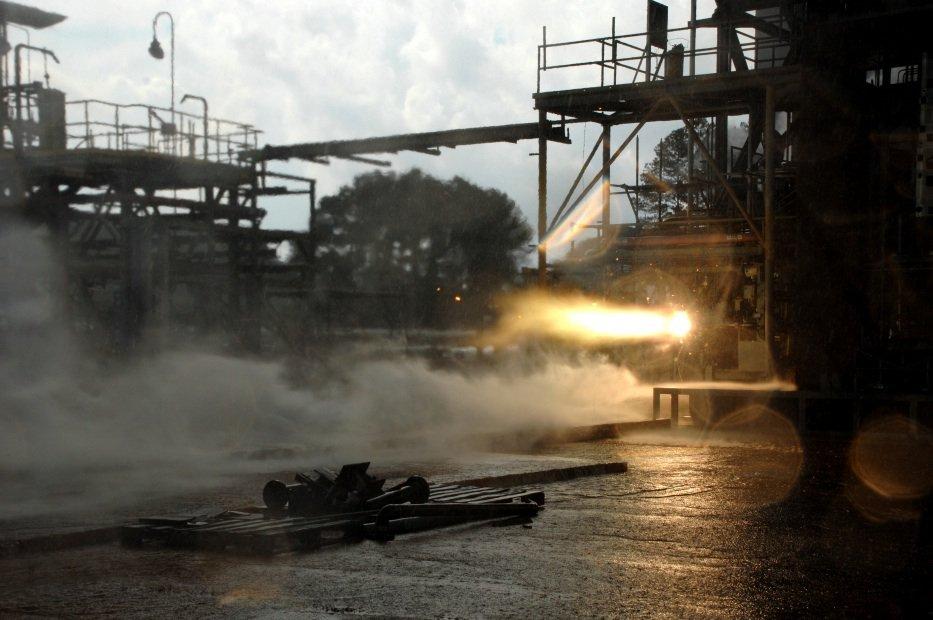
[Image: NASA/MSFC/David Olive]
The engine combustor was manufactured at Orbital ATK’s headquarters in Ronkonkoma, New York, and at the Allegany Ballistics Laboratory in West Virginia. The part was produced via powder bed fusion, an additive manufacturing process that involves using laser beams to fuse together metal powders, one layer at a time. The use of 3D printing allowed for much construction to be completed much more quickly and inexpensively than other manufacturing techniques. It’s a very complex part, but 3D printing allows it to be built with fewer parts, and multiple prototypes can be churned out and tested quickly and cheaply.
“Additive manufacturing opens up new possibilities for our designers and engineers,” said Pat Nolan, Vice President and General Manager of Orbital ATK’s Missile Products division of the Defense Systems Group. “This combustor is a great example of a component that was impossible to build just a few years ago. This successful test will encourage our engineers to continue to explore new designs and use these innovative tools to lower costs and decrease manufacturing time.”[Image: Nick Kaloterakis/Popular Science]
Orbital ATK is currently exploring several different manufacturing methods, but with the successful testing of the hypersonic engine combustor, 3D printing, particularly powder bed fusion, will likely stay at the top of the list. Surprised? I didn’t think so – 3D printing has shown itself, again and again, to be a fantastic and reliable asset for the aerospace industry. Discuss your thoughts on this latest space technology in the Orbital ATK Tests 3D Printed Combustor forum over on 3DPB.com,
[Image: NASA]
Subscribe to Our Email Newsletter
Stay up-to-date on all the latest news from the 3D printing industry and receive information and offers from third party vendors.
Print Services
Upload your 3D Models and get them printed quickly and efficiently.













You May Also Like
3D Printing News Briefs, June 6, 2026: Expansions, New 3D Printers, & More
We’re starting with business in this weekend’s 3D Printing News Briefs. Axtra3D just opened its expanded facility in Italy, and Austal USA expanded its leadership team. Then we’ll move on...
3Dnatives to Present ADDITIV Metals 2026: Resolving Key Barriers to Scaling Metal Additive Manufacturing
As the metal additive manufacturing sector prepares for a massive leap—with market valuations expected to climb from $6.02 billion to $7.02 billion this year—the industry is shifting its focus from...
3D Printing News Briefs, May 28, 2026: Continuous Fiber Reinforcement, Bioprinted Trachea, & More
In today’s 3D Printing News Briefs, America Makes announced the winners of its JAQS-SQ Project Call. Axtra3D is partnering with Keystone Industries to expand its dental material ecosystem, while BigRep...
DoW Accelerates Drone Readiness with AMTrain Phase 2 Launch at Camp Lejeune
Equipping today’s warfighter with the most advanced technology is paramount, driving increased prioritization and investment in drone development and advanced manufacturing training within the Department of War (DoW). In this...