
3D Printed Smart Mask From Sendinaden Allows You to Monitor Your Own Breathing Habits

 I’ve been thinking about getting a Fitbit. I know lots of people who have them; I’ve almost stopped noticing the brightly colored bracelets on the wrists of my fitness-nut friends. The appeal is obvious; without a personal trainer, it’s hard to design an ideal workout and nutrition program for yourself without knowing what kind of calories you’re burning each day. Our culture has become obsessed with tracking just about everything, you may notice: from calories consumed vs. calories burned, to the amount and quality of sleep we’re getting every night, to our babies’ bathroom habits (really), there’s at least one app for that.

New startup Sendinaden is combining health tracking with another of today’s most rapidly growing technologies: 3D printing. Their first product, the Pattern Breathe Mask, is slated to go on the market in January 2016, after a Kickstarter campaign that will be launched at the end of this month. The 3D printed face mask is designed to track the most important of human functions: breathing. Made of smart materials, it will gather data on the wearer’s breathing patterns and display the data either on the user’s smart phone or directly on the mask itself. Breathing may be automatic, but the fact is that most of us are doing it wrong.
“Stress and breathing are highly interconnected,” said David Hartmann, founder and CEO of Sendinaden. “When we breathe too fast or too shallow we add to the existing stress in our bodies and this can cause serious health problems. It’s a two-way relationship. When we breathe well, we reduce the stress on our body from outside influences. We make better decisions at work and we sleep better. Good breathing is the cornerstone of a healthy and happy life.”
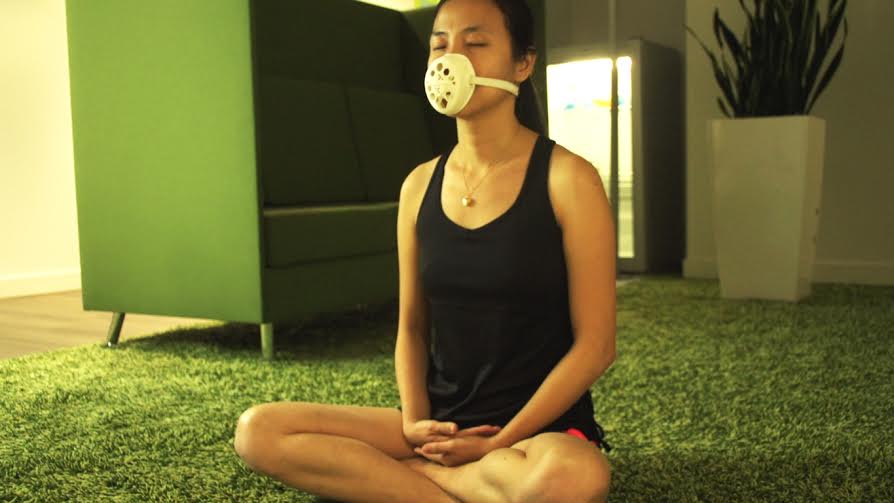 Like with other fitness applications, it is up to the consumer to change his or her behavior, but the Pattern Breathe Mask enables the wearer to see where he or she falls short of what is considered healthy breathing, and then work to form new habits. When designing the mask, the company also thought particularly of people living in places like China, where the air quality is notoriously bad. The mask includes a HEPA filter, which cleans the air of particles as it is breathed in.
Because of the flexibility that 3D printing offers, each mask can be custom-made for the wearer so that it conforms perfectly to his or her face. Elaine Saulnier, who handles corporate identity, design and online marketing for Sendinaden, noted that products such as the Pattern Breathe Mask are signs that the consumer electronics industry, which has long been dominated by injection molding, is rapidly being overtaken by 3D printing.
“Wearable technology represents a completely different paradigm that is best served by 3D printing,” Hartmann added. “We see a consumer experience where you walk into a retail outlet, get a Pattern Breathe Mask curated and customised for you, go shopping and come back 45 minutes later to pick up your finished 3D printed mask.”
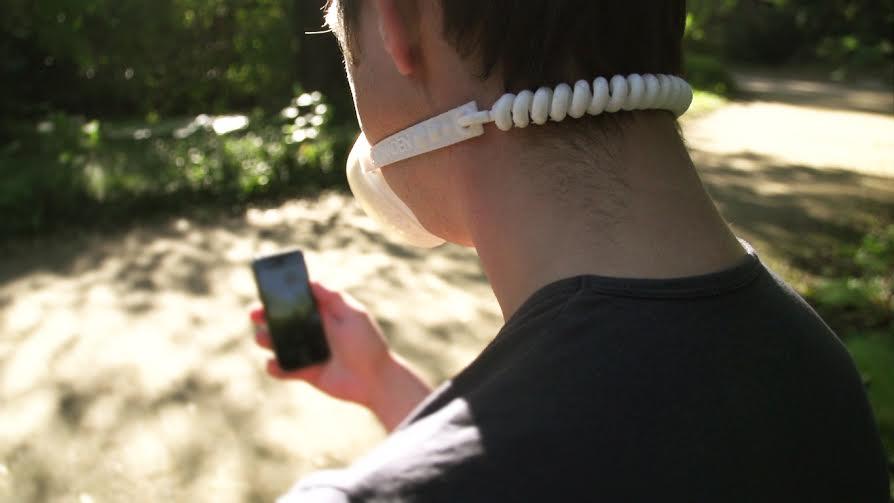
To print the mask, Sendinaden partnered with filament manufacturer Polymaker, whose PolyMax PLA filament was used to print the casing and front panel, while the strap was printed with their PolyFlex material. The Polymaker polycarbonate filaments were chosen specifically for their strength, flexibility and safety, enabling the mask to be held firmly against the face without skin irritation. The company is currently using Mass Portal printers to create its flagship product.Watch for Sendinaden’s first Kickstarter campaign to launch later this month, and don’t be surprised if the health tracking industry soon begins to include a lot more sophisticated, 3D printed devices.
Discuss this story in the 3D Printed Breathing Mask forum thread on 3DPB.com.
https://youtu.be/aeBxnHfZIrM
Subscribe to Our Email Newsletter
Stay up-to-date on all the latest news from the 3D printing industry and receive information and offers from third party vendors.
Print Services
Upload your 3D Models and get them printed quickly and efficiently.













You May Also Like
The Manufacturing Race Behind the Drone Revolution
We are in the middle of a major manufacturing shift focused on the production speed and payload capacity of uncrewed aerial systems (UAS), or drones. A recent Manufacturing Dive article...
ADDMAN to Buy Up to $10.8M in Nickel 718 Powder from 6K Additive Over 30 Months
After years of buildup, we’re finally starting to see what the US metal additive manufacturing (AM) market could look like at scale. To be sure, it’s still not quite there,...
Metal AM in a Multipolar World, Part 2: How PBF and DED Could Change by 2035
The first decades of PBF development were heavily shaped by machine capability: more power, more lasers, larger build volumes, better recoating, and improved process monitoring. These developments will continue, but...
Advanced Manufacturing at IMTS 2026: 3D Printing and AI and Drones, Oh My!
Last week’s International Manufacturing Technology Snow (IMTS) in Chicago welcomed over 90,000 attendees to the jungle that is McCormick Place. With over 1.17 million square feet of exhibit space, and...

























































