Organovo and Johnson & Johnson Team to Evaluate 3D Bio-printed Tissue Use

It’s only a matter of time before 3D bio-printing really takes off. One of the leaders in the space is Organovo, a company who has already been able to 3D print living liver tissue, and has an ultimate goal of 3D printing a  functioning liver for transplantation within a human being.
Before we get there though, there are many useful applications to 3D printed living tissue, which can already be used today. One such application is that of drug discovery testing. Every year billions of dollars are spent performing clinical trials on potential new drugs for the market. Many of these trials involve human beings, oftentimes being put at some risk. Liver toxicity testing, in particular, is usually performed using tissue samples from cadavers, meaning it’s not all that easy to obtain such samples. What 3D bio-printing enables researchers to do, is create live human tissue, which can then be used as a test bed to discover any negative reactions a particular drug may have on that tissue. Once scaled up, such a process could make available as much tissue as is needed for research, as well as tissue of extremely high quality.
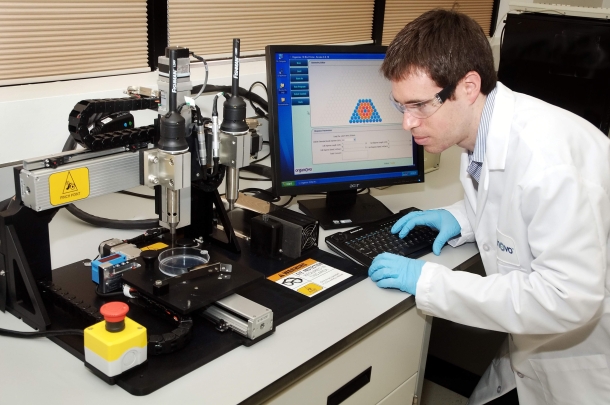
Organovo has been leading the way in this space. They have been working for years to perfect the 3D printing techniques required to produce high quality tissue, which is able to stay alive over a long period of time.  Today, the company announced an agreement with one of the largest pharmaceutical corporations on the planet, Johnson & Johnson. The actual agreement was signed between Organovo and Janssen Research and Development (JRD), a pharmaceutical company of Johnson & Johnson.
Under this agreement, of which the exact terms have not yet been disclosed, the companies will work together to evaluate the use of 3D bio-printed tissue in a drug discovery setting. Just what kind of tissue, and to what extent the testing will be done, is yet to be seen, however, it certainly bodes well for the progress of 3D bio-printing technology. To have a major, globally recognizable, corporation like Johnson & Johnson on board, could push the adoption of this technology, as well as its progress to a whole to level. It is interesting to note that following the release of an 8K filing disclosing this agreement this morning, shares of Organovo are up over 11%.
What will the implications of this agreement be? Let’s hear your opinions in the Organovo/Johnson & Johnson forum thread on 3DPB.com.
Subscribe to Our Email Newsletter
Stay up-to-date on all the latest news from the 3D printing industry and receive information and offers from third party vendors.
Print Services
Upload your 3D Models and get them printed quickly and efficiently.













You May Also Like
Creality K3 Opens for Pre-Order at $849, Advancing Multi-Color 3D Printing
Creality has officially opened pre-orders for the Creality K3, its latest flagship K Series 3D printer, starting at $849 in the United States. Recognized as an IFA Innovation Awards 2026...
Beyond the Printer: HP and DyeMansion Tackle the Future of Prosthetics
Making a custom orthotic or prosthetic device involves much more than producing the final part. Patients need to be measured, devices must be designed to fit their bodies, and finished...
3D Printing News Briefs, October 14, 2026: Bolus, Aerospace Tooling, Water Filter, & More
In today’s 3D Printing News Briefs, we’re starting with medical news, as Myrava has received FDA 510(k) clearance for its 3D printed bolus. Moving on to aerospace and metals, AML3D...
Can India’s AM Push Help Make it a Viable Supplement to China?
Diversifying manufacturing supply chains to locales outside of China has nothing to do with actually cultivating “substitutes” to the Chinese economy. The real stakes are these: China is an irreplaceable...