Bucktown Polymers Rolls Out 3D Printing Resins Which Cure with Light and Remain Water Soluble

 As more and more jewelers and metal workers take up 3D printing, they discover that SLA machines are capable of rendering very high detail and that some resins on the market can be burnt away in a “lost wax” sort of process. But the process takes time. Lots of time.
Now the scientists at Bucktown Polymers say they’ve developed a 3D printing material which cures rapidly when exposed to light, yet remains water soluble once it has cured.
Bucktown Polymers specializes in the research, development, formulation and manufacture of coatings, inks, resins, adhesives and composites for a wide range of industries. They say this latest material is simply one of hundreds which the company has developed or formulated in the recent past.
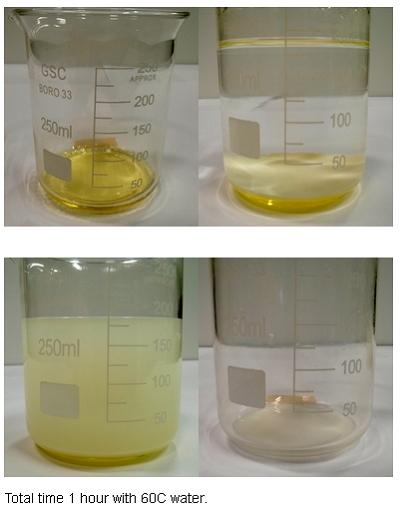 Bucktown Polymers says these new materials have a number of interesting uses in additive manufacturing and casting. Since they change from a liquid into a solid using only light to act as a temporary support structure for other materials or as patterns for casting, the post-cure water soluble support material or pattern can be rapidly dissolved – in just minutes rather than hours – using nothing more than warm water.
The company says these water soluble materials can be formulated to be compatible with a wide range of technologies such as SLA, DLP, Inkjet and powder processes, and when used via a 3D printer, they can replace the wax patterns entirely. As wax has been used for more than 5,000 years in investment casting and forms the basis for one of the oldest known metal-forming techniques, it’s a rather big breakthrough indeed.
Carl Wang of Bucktown Polymers says that when used as a replacement for resin or wax patterns in casting, this “ROR” – or Rinse Out Resin – drastically reduces the amount of time it takes to produce investment cast objects. In replacing the 8-12 hour long burn-out cycle – a process which doesn’t always remove the entirety of the wax or resin – ROR cuts down production time by utilizing just a few minutes of water rinse cycle to complete the task.
Wang says Rinse Out Casting Resin produces no airborne volatile organic compounds, is fast curing and comes in V420 for curing by UV-light, LED or laser. He adds that ROR features low viscosity, low odor, and dissolves rapidly in hot water.
The company says their ROR material is compatible with SLA, laser and DLP 3D printers.
Beyond investment casting, can you imagine any other uses for this novel 3D printing resin which dissolves in nothing more than hot water? Let us know in the Bucktown Polymers forum thread on 3DPB.com.
Subscribe to Our Email Newsletter
Stay up-to-date on all the latest news from the 3D printing industry and receive information and offers from third party vendors.
Print Services
Upload your 3D Models and get them printed quickly and efficiently.











You May Also Like
3D Printing News Briefs, February 21, 2026: Vapor Smoothing, Brain Models, & More
In this weekend’s 3D Printing News Briefs, we’re starting with material and post-processing news from Quickparts, and some more post-processing news from AM Solutions. We’ll end with researchers at the...
3D Printing News Briefs: February 19, 2026: Market Data, Africa, Metal Parts for Defense, & More
We’re starting with some business news for you in today’s 3D Printing News Briefs! The Wohlers Report 2026 is now available, Carbon announced its new Chief Technology Officer, and Farsoon...
From “Magic” to Metal: How Intrepid Automation Wants to Make 3D Printing Matter at Scale
Ben Wynne still talks about 3D printing the way people do when they’ve felt that “wow” moment up close. Back in the early 2000s, he was working at HP’s advanced...
Takeaways From MILAM 2026: Defense’s Growing Role in Driving 3D Printing – Part II
At the recent Military Additive Manufacturing Summit & Technology Showcase (MILAM 2026), additive manufacturing wasn’t just being discussed as a production strategy; it was being packaged for deployment. A big...