How a Ukrainian Mathematician Can Make Your 3D Printed Models Look Better

 The Ukrainian mathematician Georgy Voronoy, among his many accomplishments, defined what is now known as the Voronoi diagram.
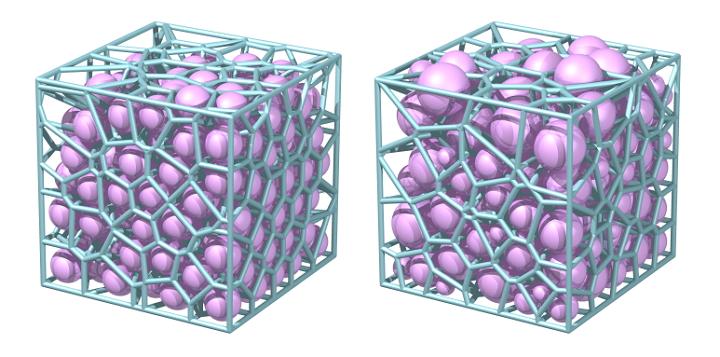
 A Voronoi diagram, at least in a very simple form, describes the partitioning of a plane into separate regions based on the distance to points in a specific subsection of the plane. Vornonoy called those partitions seeds, sites, or generators, and each of them includes a corresponding region which is made up of all the points closer to that seed than to any other.
The Voronoi diagram itself is a representation of a set of points made by taking pairs of points that are close together and drawing a line that is both equidistant between them and perpendicular to the line connecting them. What you end up with is a form in which all points on the lines in the diagram are equidistant to the nearest pair of source points.
The diagrams are sometimes referred to as Voronoi tessellation or Voronoi decompositions, and they’ve been used in practical and theoretical applications in science, technology and the visual arts.
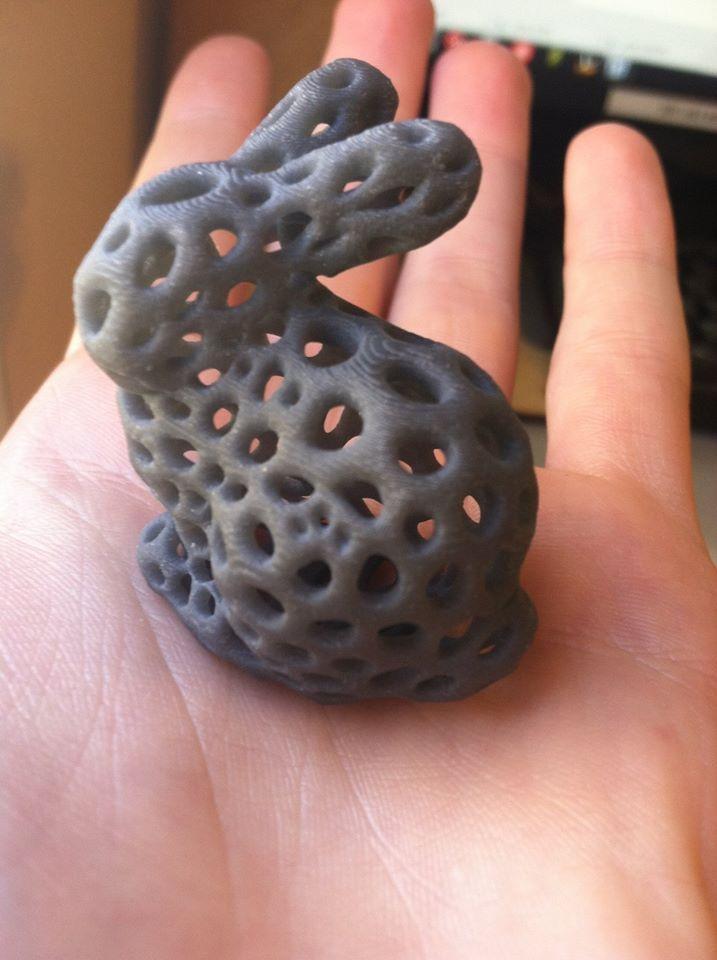
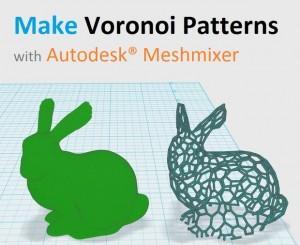
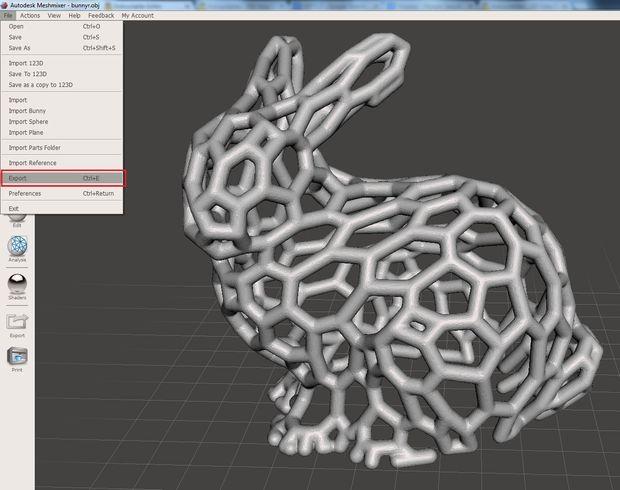
Marshall Peck of ProtoBuilds used Voronoi patterns to make some organic-looking models by adding the pattern to his STL files and the resultant 3D models by importing them into Autodesk Meshmixer. Peck operates a design and printing hub service out of Austin, TX, and he’s a networking and technical support professional during the day.
 He reduces polygons and applies the Dual Edges pattern to create tube-like structures to replace the original polygons, and he says the patterns can provide “consistent horizontal cross sections for slices that might be helpful when using SLA resin 3D printers” and adds that models created with the technique “can print well on most Fused Filament 3D printers.”
Peck begins the process by importing a model into Meshmixer, selecting the entire model and then using the Reduce tool to drop down to a lower triangle or polygon count. He says fewer polygons will ultimately result in larger openings in the final model.
The models he used were the Brown Bear and Pink Panther Woman Voronoi Style downloaded from Thingiverse and the Bunny model which comes pre-loaded in Meshmixer.
He adds that adjusting certain pattern settings might gobble up a lot of resources on your CPU and that you may wish to reduce the new mesh polygons for easier 3D printing or to make the files smaller for importation into other design programs.
You can check out his tutorial on how to apply the Voronoi effects to your 3D models on his site, as well as further details in an Instructable he wrote on the subject.
Have you ever built objects with your 3D printer that feature the Voronoi technique? If you have, please let us see your work in the Voronoi Patterns forum thread on 3DPB.com.

A Voronoi diagram of weather stations around the world
Subscribe to Our Email Newsletter
Stay up-to-date on all the latest news from the 3D printing industry and receive information and offers from third party vendors.
Print Services
Upload your 3D Models and get them printed quickly and efficiently.











You May Also Like
The Deskside Manufacturing Evolution
When the desktop 3D printing revolution reared its beautiful head in the 2010’s the world was still suffering from a housing boom hangover. Technoptimism seemed to be the path ahead...
Is 2.20mm Filaflex a Goldilocks Solution for Flexible Filament?
TPU and other elastomeric materials have traditionally been tricky and difficult to print. Elastomers are generally difficult in additive manufacturing (AM). In the case of material extrusion, the use of...
Italy PM Meloni’s Bahrain Visit Spotlights ASRY and Roboze’s New 3D Printing Alliance
Bahrain is boosting its high-tech manufacturing, with Italy playing a key role. Arab Shipbuilding and Repair Yard (ASRY) and Italian 3D printing company Roboze signed a major partnership to build...
Applied Acoustics Uses Additive for Subsea Gear
Subsea equipment has to be rugged, temperature-resistant, and able to cope with the long-term effects of saltwater. Extreme pressure and pressure changes are also problems endemic to this industry. Subsea...