L’Oréal USA & Organovo Team for 3D Printed Human Skin Tissue Research

 You all probably know by now that Organovo (NYSE: ONVO) is leading the charge when it comes to 3D printing organ tissue. They have already brought human liver tissue to market via their exVive3D brand, and have plans to bring kidney tissue to market sometime in 2016.
The human body’s largest, and arguably most important, organ is the the epidermis and dermis, better known as skin. Organovo of course has shown interest in this area as well when it comes to bioprinting, as there are numerous applications in which 3D printed skin could certainly come in handy.
Today the company, which seems to be quite busy as of late, announced a Research Collaboration Agreement with one of the world’s largest skincare companies, L’Oréal USA Products, Inc. As a part of this agreement, both firms will contribute significant technology to this collaborative work. Organovo will provide their NovoGen Bioprinter and L’Oréal, their skin cell technology.
The partnership will be broken down into three key phases, of which L’Oréal will have the power of continuing or ending the collaboration at the completion of each phase, depending on whether or not certain specified criteria are met. These phases include ‘development,’ ‘validation,’ and ‘commercial supply.’
For the initial two phases, L’Oréal USA will provide up-front funding for the project, and for the final phase both parties will eventually forge a commercial supply agreement, including customary licensing and royalty terms, should the collaboration make it to this final phase. The financial  terms of this agreement have not been made public, and Organovo intends on submitting a FOIA Confidential Treatment Request to the SEC requesting that they be permitted to hold back some of the sensitive details as ‘trade secrets.’
The agreement will provide L’Oréal with exclusive rights to the skin tissue that the two companies develop. These rights will remain intact for the purposes of development, testing, manufacturing, evaluation, and sale of non-prescription skincare products as well as nutraceutical supplements. Organovo on the other hand will retain the rights to these tissue models for efficacy testing of prescription drugs, toxicity tests, and the development and testing of therapeutic or surgically transplanted tissues.
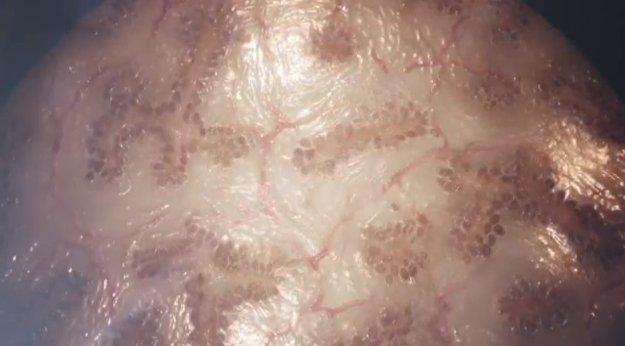
A Sample of Organovo’s Printed Liver issue
There is little doubt that the potential impact this agreement could have on the bottom lines of each company involved could be staggering. It will be interesting to see if this agreement makes it to the final phase, and just what may result from a product standpoint.
Organovo seems to be spreading their wings all over the 3D bioprinting space. As the next year or two go by, they will certainly be an interesting company to follow. Let us know your thoughts on what this collaboration may mean, both for Organovo as a company, and for the general bioprinting industry. Discuss in the Organovo & L’Oréal forum thread on 3DPB.com.
Subscribe to Our Email Newsletter
Stay up-to-date on all the latest news from the 3D printing industry and receive information and offers from third party vendors.
Print Services
Upload your 3D Models and get them printed quickly and efficiently.











You May Also Like
The Great AM Reset: Why Applications Will Decide Who Survives
For decades, the AM industry has been powered by an exciting narrative of endless growth and disruptive potential. We celebrated every new technology, every injection of capital, and every bold...
3D Printing Financials: Materialise Reports Strong Finish to 2025, Led by Medical Growth
Materialise (Nasdaq: MTLS) closed out 2025 with a solid fourth quarter, showing stronger profitability, steady revenue growth, and continued momentum in its medical business. While some parts of the company...
The 3D Printing Pioneers’ Journey from HZG Group: From Bavaria to the World
In Lichtenfels, two hours’ drive north of Munich, there is a globally recognized 3D printing center with a modern infrastructure and many companies focusing on this future technology. At the...
Additive Manufacturing’s Next Chapter: From Prototype Tool to Operating Model
Additive manufacturing is shedding its legacy reputation. While it remains the go-to for prototyping, its potential now extends beyond. Today, it’s increasingly used to support real production requirements, helping teams...