Soccer Playing, 3D Printed MANAV Robot Debuts at IIT Mumbai TechFest

MANAV, which the developers say is India’s first 3D printed humanoid robot, was launched at IIT Mumbai TechFest recently.
Built by the A-SET Training & Research Institute in New Delhi, the first humanoid robot made its debut at the IIT Bombay campus this past weekend. This was no small event, featuring speakers like Bjarne Stroustrup, the inventor of the C++ programming language, and Dr. Vint Cerf, better known as the co-founder of the Internet.

A-SET say the MANAV is almost entirely 3D printed and can, among other things, dance and play soccer.
A-SET is an academy dedicated to training students in the assembling and repair of electronics and computer devices and instruments. Students at the school take on disciplines and devices such as monitors, DMP printers, color printers, laser printers, motherboards, routers, switches, and, in this case, robotics.
The director of the institute, Uday Kumar Vaish, has worked with prominent institutions such as the Human Resources Development Department of the Central Government, Directorate General of Resettlement, and the Indian Ministry of Defence. A-SET say in designing their curriculum, they seek to make it practically-oriented and cost effective, and from their work on MANAV, that seems to have paid dividends.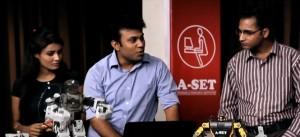
The TechFest is a showcase for innovations from around the campus and includes everything from underwater robots to flying drones and some of the hottest inventions from across India each year on the 550-acre campus of IIT-B.
This year, 3D printing featured prominently and many of the projects had 3D printed components or orientation such as a 3D printer made at the MIT Media Labs, India.
One of the slickest projects was MANAV.
The MANAV robot is two feet tall, weighs just 4.4 pounds, and is driven by some 21 separate servos. It’s packed with interesting technology and it can perform some wild stunts.
Capable of recreating headstands, push-ups, and – at least according to the builders – also playing football, the ‘humanoid robot’ was largely made from 3D printed parts in plastic. It can follow various instructions, features two cameras for eyes, and two headphones which serve as ‘ears.’
The MANAV was entirely designed, printed, and manufactured in India by a team at A- SET, and they say it took them a total of two months to complete.
The developers say MANAV will be available for purchase for between $2500 and $4000 (Rs 1.5 and 2.5 lakh), depending on the level of customization required.
Up until recently, India has lagged behind the United States and most of Europe in their adoption of 3D printing technology. Do you think projects like MANAV will spur sufficient interest in 3D printing to offer India a leg up? Let us know in the 3D Printed MANAV Robot forum thread on 3DPB.com.
Subscribe to Our Email Newsletter
Stay up-to-date on all the latest news from the 3D printing industry and receive information and offers from third party vendors.
Print Services
Upload your 3D Models and get them printed quickly and efficiently.











You May Also Like
Next-Gen CAD/CAM Tool Accelerates Development of Innovative AM Electronics Applications
3D-printed electronics is an emerging field that combines additive manufacturing techniques with the integration of electronic components to produce previously unachievable results. It enables the creation of complex, customized electronic...
3D Printing News Briefs: February 19, 2026: Market Data, Africa, Metal Parts for Defense, & More
We’re starting with some business news for you in today’s 3D Printing News Briefs! The Wohlers Report 2026 is now available, Carbon announced its new Chief Technology Officer, and Farsoon...
From “Magic” to Metal: How Intrepid Automation Wants to Make 3D Printing Matter at Scale
Ben Wynne still talks about 3D printing the way people do when they’ve felt that “wow” moment up close. Back in the early 2000s, he was working at HP’s advanced...
From Vision to Volume: The Next Chapter for Additive Manufacturing
Additive manufacturing has spent years navigating skepticism, hype cycles, and industrial validation. Now, the industry finds itself at a decisive turning point. The conversation has shifted away from futuristic possibilities...