Researchers Combine Robotics & Artec Spider for Unrivaled 3D Scanning of Complex Shapes

 As the new year looms and the holiday season comes to a close, we’ve all had our share of wrapping gifts that were complicated in shape, sometimes with numerous angles that poked out all over the place, or with rounded edges that made the thoughtful presentation of a gift equally challenging.
Most of us do our best, but unless we are wrapping specialists, some areas are impossible to encompass neatly, with the finished product bearing an overall slightly sloppy look. This problem could be equated to what it’s like trying to 3D scan an object with a more challenging shape, sometimes resulting in data that is damaged, with blind spots that are difficult to manage.
Often it takes two or more motivated teams coming together to solve a problem. While innovators have been working to create technology that can offer competent 3D scanning, and it certainly exists, Artec Group and a team of international researchers have put together their own high performance technological team in the form of a specialized 3D scanner and program that can manipulate robotics to perform total scans of objects that require uncommon attention to detail.
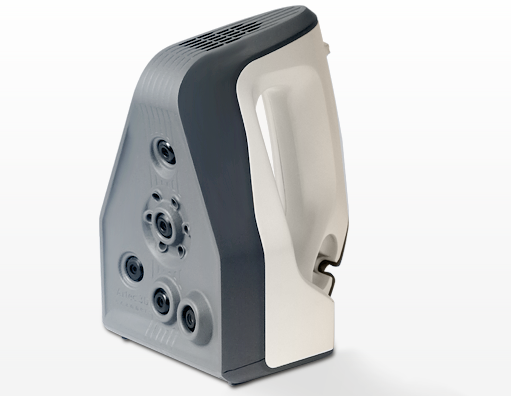
Artec Spider 3D Scanner
Artec Group, headquartered in Luxembourg, is comprised of experts who specialize in 3D scanning and processing involving surfaces, as well as face recognition. With the Artec Spider, they have created what they announce to be “the first handheld 3D scanner for CAD applications.” It’s meant to thoroughly scan items with extremely intricate shapes — in full color.
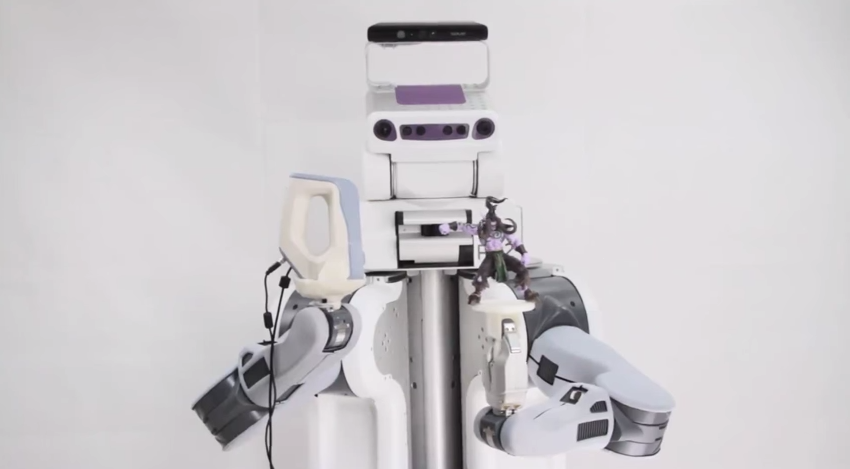
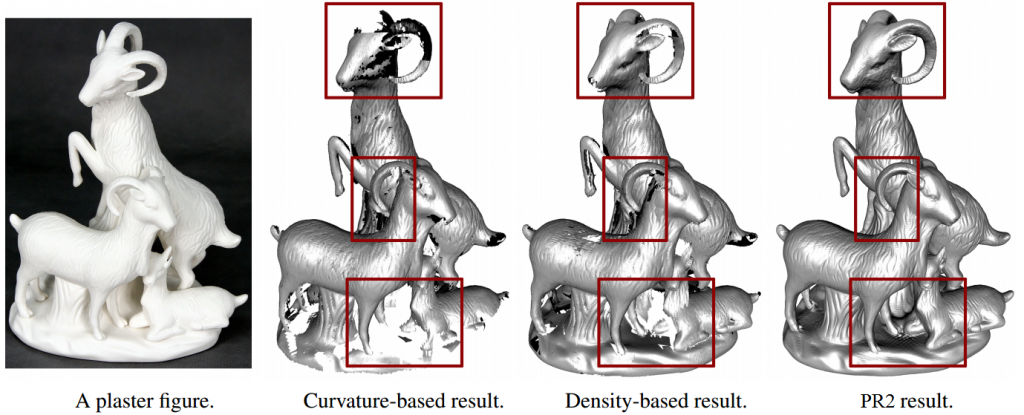
Collaborating with engineers from the Visual Computing Research Center, Tel-Aviv University, the Memorial University of Newfoundland, the University of Konstanz, and Shandong University, a new system has been created by using the Artec Spider in tandem with the research group’s PR2 robot. The PR2, boasting a humanistic look and sense of movement, holds the Artec in its ‘hand’ and puts it to use, rapidly scanning the most detailed and ornate objects from every angle. The double system captures 7.5 frames per second and processes 1 million points per second, meaning it gets the job done more expediently than a laser printer, and requires no post-processing.
The researchers found that the Artec Spider worked best with the PR2 in terms of high resolution and extreme accuracy regarding edges and miniature parts. In a completely automated scanning system, the PR2 is able to respond to analysis and data from the Artec Spider, moving it and the object strategically and precisely as instructed to complete comprehensive scanning. At each viewpoint, it takes a snapshot, which is merged with the last picture, until a whole object is completed.
 Artec’s Scanning SDK is responsible for the program running the Spider, which is able to make a “confidence map” that eliminates challenges with blind spots, recognizing the areas where more scanning is necessary to collect all the data. With the programming from Artec’s Scanning SDK, the system understands when total scanning is complete. During complete testing of Artek’s Scanning SDK, the Artec Spider, and the PR2 working together, researchers concluded that the algorithms responsible for visibility and boundaries were excellent, as well as algorithms regarding rounded edges and density.
While there is always talk about automation eliminating much needed human jobs, often new robots are created for new tasks that simply never could have been done otherwise, and are making changes that transform our world in almost every capacity from the most serious of areas like the medical industry — to the engineer and design sectors, where robotics accentuate the jobs of many professionals.
What impact do you think the combination of robotics and scanning will have on the 3D printing industry? Have you tried to create anything like this, or used a similar system? Tell us about it in the Unrivaled 3D Scanning forum at 3DPB.com.
Subscribe to Our Email Newsletter
Stay up-to-date on all the latest news from the 3D printing industry and receive information and offers from third party vendors.
Print Services
Upload your 3D Models and get them printed quickly and efficiently.











You May Also Like
Scaling 3D Printing Takes More Than You Think; HP’s Webinar Looks at Making It Work Long Term
3D printing is no longer new. In fact, most manufacturers already know what it is, where it fits, and what it can do. But knowing the technology and actually scaling...
How AtomForm’s 12-Nozzle System Cuts Multi-Color FDM Transition Waste by Up to 90%
Pull up the print stats on multi-color FDM jobs. The number that stings isn’t time; it’s material efficiency. On six-color models, single-nozzle systems consume significant filament during transition flushing, expelling...
RAPID 2026: Democratizing Metal Laser Powder Bed Fusion 3D Printing with Mastrex
Aside from a quick mention in an episode of our Printing Money podcast, I didn’t know much about Mastrex. But when I heard that the company had developed a $39,000...
3D Printing News Briefs, April 25, 2026: Competition Winners, AI Platform, X2D Printer, & More
In this weekend’s 3D Printing News Briefs, AMUG announced the winners of its Technical Competition, and Authentise launched AI platform Whisper at RAPID. Bambu Lab wasn’t at RAPID, but launched...