DIY Telescope 3D Printed by UK Researchers Will Have You Seeing Stars

Galileo and Newton would have been impressed. And NASA should take note! Researchers in the UK have created the first highly efficient, 3D printed telescope out of cheap, basic parts that are available to anyone—as are the plans, for anyone who wants to make their own.
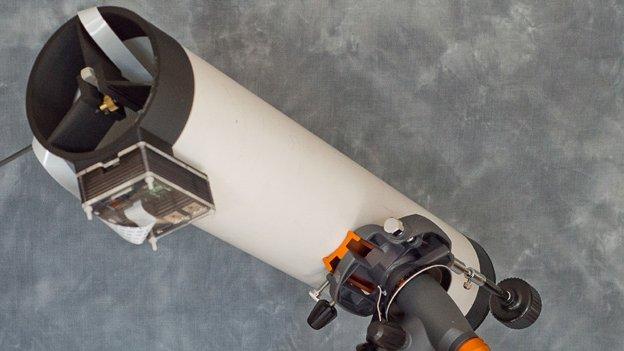
DIY telescope with 3D printed components.
The University of Sheffield researchers behind the project must have been pretty psyched when they were able to capture pictures of the moon on their first try. While telescopes are pretty simple tools, this is the first one to be created using 3D printed parts at a cost of £100, which translates to about $163.
Featuring magnification of times 160, and dubbed the Pikon, it is described as being comparable to telescopes that generally cost ten times as much. Physicist Mark Wrigley, one of the creators of the Pikon, says he hopes this new telescope will be a game changer, affording young scientists accessibility to the stars for a very low price, while encouraging interest in the new technology of 3D printing.
 Made with the simple, classic Newtonian design using a mirror to form an image, the DIY telescope is composed of basic components, with one interesting twist—a camera module, the Pi Infrared camera, taken from a Raspberry Pi computer—a credit card-sized computer developed in the UK by the Raspberry Pi Foundation—an organization that was involved with getting computers into schools.
The camera is able to be mounted right in front of the mirror on the end of the telescope’s components, which are 3D printed. Taking Newton’s idea one step further, the mirror focuses an image directly onto the Pi camera sensor, offering pictures of what the user is able to view. The lens and mirror are cheap parts that can be obtained easily.
“We hope that one day this will be seen on a par with the famous Dobsonian ‘pavement’ telescopes, which allowed hobbyists to see into the night skies for the first time,” said physicist Mark Wrigley, who will be demonstrating the the PiKon at University of Sheffield’s Festival of the Mind today. “This is all about democratizing technology, making it cheap and readily available to the general public.”

Images of the moon taken with 3D printed telescope.
While Isaac Newton was not the first to consider making tools to see out into space, he was the first to build a ‘reflective’ telescope with the use of mirrors in 1668 while working on his theory of color.
For everyone inspired by science, space, and out-of-this-world new technology, plans for making and 3D printing your own telescope will be available online soon on Thingiverse for everyone to download, make, and 3D print. Is this something you are interesting in pursuing? Join the conversation in the 3D printed telescope forum thread at 3DPB.
Subscribe to Our Email Newsletter
Stay up-to-date on all the latest news from the 3D printing industry and receive information and offers from third party vendors.
Print Services
Upload your 3D Models and get them printed quickly and efficiently.













You May Also Like
3D Printing Financials: $28M in China, U.S. Deals and a Metal AM Comeback
Money continues to go into additive manufacturing (AM). From a $30 million raise for a Chinese metal 3D printing company to new funding for naval AM and a European company...
AmeraLabs Offers New Dental 3D Printing Resins
Lithuania-based AmeraLabs is putting new dental 3D printing resins on the market. Its new Made in Europe resins will include one material for impression trays, one for surgical guides, and...
AM Pulse Asia: Consumer Metal AM, Nuclear Parts and Rockets Push New Ground
The second half of August produced financing milestones, facility openings, and qualification results across Asia-Pacific additive manufacturing. Rongsu Technology closed a CNY 100 million Series A+ and launched a consumer...
3D Printing Financials: New Money Flows Into Medical, Industrial and AI 3D
Money continued to move into 3D printing in the second half of August. Hike Medical raised $22.5 million as it grows its 3D printed custom medical device business. Swiss additive...