3D Printed Electronics Move Forward as Optomec Unveils New Aerosol Jet 5X System

 Some of the most exciting future applications for 3D printing involve the high precision fabrication of integrated electronics within objects. Imagine being able to 3D print an entire electronic device, with all the sensors and antennas incorporated into that device, and doing it in one single piece. Such a technique could cut down on the weight of these devices, as well as pack more components into a confined space. This is the future which lies ahead for us, and Optomec is one of the companies leading the way.
Just last week, we reported on a story where the Factory Automation and Production Systems (FAPS) Institute in Germany were utilizing an Optomec AerosolJet 3D Printer to begin fabricating artificial muscles, or dielectric elastomer actuators(DEAS). They chose Optomec’s technology because of its ability to print conductive elements into an object using multiple materials, at extremely fine resolutions.
Today, the New Mexico based company has announced the launch of their latest additive manufacturing system, the Aerosol Jet 5X. The company has specifically developed this new system in order to cater towards those developing electronics such as smart phones, tablets, sensors, and molded interconnect devices (MIDs), as the ‘Internet of Things’ begins to take off.
“Optomec continues to break through traditional manufacturing barriers by extending the advantages of 3D printing to advanced applications such as 3D printed electronics, and further showing the promise to be competitive in the production of cost-sensitive devices such as smart phones and the sensors driving the Internet of Things. With the Aerosol Jet 5X system, Optomec is enabling functional electronics to be readily integrated onto and within 3D structures in ways not previously imagined,” said Mike O’Reilly, Director Aerosol Jet Product Management at Optomec.”
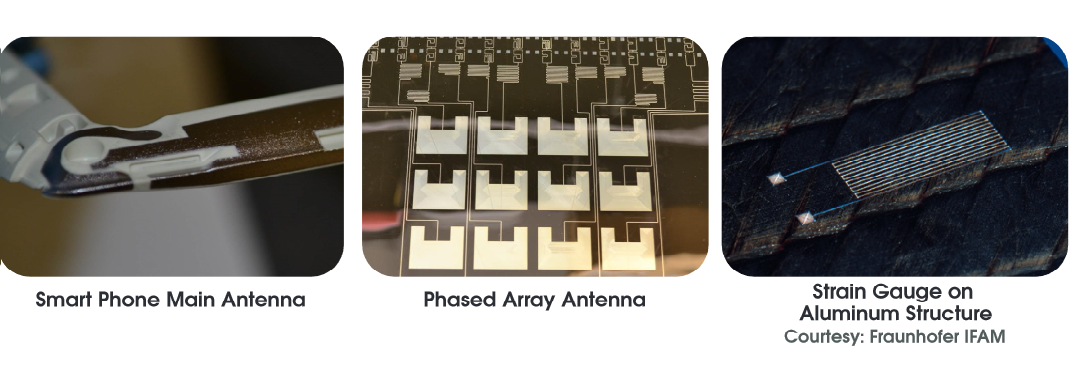
Hence its name, the Aerosol Jet 5X System comes equipped with 5 axes of coordinated print motion, and is ideal for prototyping or low volume manufacturing. Below you will find a full list of specifications for this new system:
- Print Envelope: 200mm x 300mm x 200mm
- Print Accuracy: X,Y,Z motion system +/- 10 microns accuracy per stage
- Single Pass Layer Thickness: 100 nanometers to 2+ microns
- Print Resolution: Fine Feature Sizes to 10 um
- Printable Materials: Conductive inks, dielectrics, polymers and adhesives
- Droplet Size: 1-5 microns
- Weight of System: 835kg
There are exciting times ahead indeed, and Optomec seems to be leading the way. Let’s hear your thoughts on this new additive manufacturing system, which could be the start of a trend which revolutionizes how electronics are manufactured. Discuss in the Optomec Aerosol Jet 5X forum thread on 3DPB.com. Check out the video below of the Aerosol Jet 5X printing onto a golf ball.
Subscribe to Our Email Newsletter
Stay up-to-date on all the latest news from the 3D printing industry and receive information and offers from third party vendors.
Print Services
Upload your 3D Models and get them printed quickly and efficiently.











You May Also Like
Scaling Beyond 10 Printers: When Support Becomes a Bottleneck
The leap to industrial-scale 3D printing is a support problem, not a hardware problem. A 3D print farm is a centralized facility that uses a large number of 3D printers...
Reshoring Requires Rules of Engagement
Reshoring manufacturing in the U.S. is a stated national priority. Policymakers, industry leaders, and defense planners agree that domestic production capacity is essential for economic resilience, national security, and long-term...
When a Factory Stops Being a Building and Starts Being a Machine
Metal manufacturing still carries the layout and logic of an older industrial age. Most factories run as a collection of isolated disciplines, each with its own equipment, staff, and data....
Bridging the Gap: 2D to 3D AI in Manufacturing
For decades, the early stages of manufacturing have been defined by a simple, frustrating trade-off: you can have it precise, or you can have it fast. AI just broke that...