New Zealand Scientists Bring Extinct Birds Back Through 3D Scanning


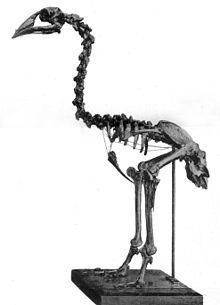
Adzebill skeleton
The extinction of a species is a heartbreaking thought, especially when you consider that some of our most beloved species, like monarch butterflies, frogs and toads, and bats are threatened, by disease or climate change, to the point that they may not be around for our grandchildren to see. Someday, they may only exist in museums, as remote to humans as moa and adzebills.
Say what now? Yes, moa and adzebills existed once, but the flightless birds have been extinct for thousands of years. You may never have heard of them (I certainly hadn’t) but a collaboration between scientists at Massey University, the Auckland War Memorial Museum and the Museum of New Zealand Te Papa Tongarewa is bringing them back to life. Okay, not literally bringing them back to life – stop your Jurassic Park fantasies – but thanks to 3D scanning, the birds, along with several other of New Zealand’s extinct bird species, are being made more real than they have been for a long time.
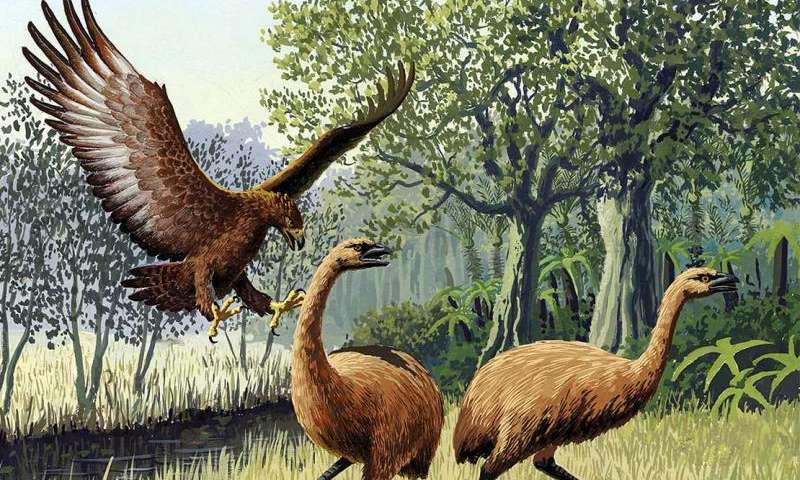
Artist’s rendition of an extinct Haast’s Eagle, left, hunting moa. [Credit: John Megahan, Creative Commons licence]
“We are going to see more of this in New Zealand,” said Dr. Thomas. “For a while now, researchers have used CT scanners to make digital versions of 3D bones, but few museums have this technology in-house. The 3D scanner we have is portable, so it can be brought into museum collections.”
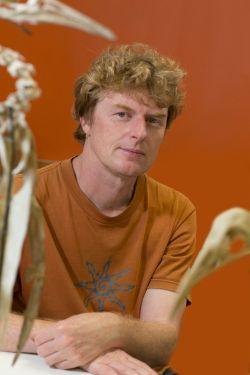
Alan Tennyson
The birds whose bones will be scanned this week include the adzebill, the Haast’s Eagle, and the Forbes Harrier. Right now they’re just names to most laypeople, but their digital models will make their features, like the adzebill’s weaponized beak or the harrier’s long legs, memorable. The scanning project is part of a growing trend in museums and research institutions to scan, digitally model and print bones and fossils so that they can be more closely studied and easily shared with the public.
“Technology like 3D printing is the way of the future, and will help to ensure precious objects, like bones from long extinct birds, are protected while still being fully accessible to the public,” said Alan Tennyson, vertebrate curator at the Museum of New Zealand.
Since the collaboration also involves sharing and exchanging exhibits, fossils at Auckland Museum will be scanned later this year and sent to the Museum of New Zealand. It’s amazing to think about, really, that something as rare as an ancient fossil can be so easily copied in perfect detail. It’s also amazing to think that long-dead species can be reconstructed. Below, you can play with a little bush moa – I bet that’s never something you imagined yourself doing, is it? Discuss this story in the 3D Printing Extinct Birds forum on 3DPB.com.
Subscribe to Our Email Newsletter
Stay up-to-date on all the latest news from the 3D printing industry and receive information and offers from third party vendors.
Print Services
Upload your 3D Models and get them printed quickly and efficiently.













You May Also Like
Metal 3D Printers for the Desktop Are Finally Starting to Feel Like Desktop Products
FDM 3D printing is becoming increasingly accessible, yet metal 3D printers designed for everyday desktop use remain rare on an ordinary workbench. The real challenge is not making a metal...
What 3D2GO Says About 3D Printing’s Growth in Southeast Asia
The Philippines offers an interesting case study in how 3D printing can develop in Southeast Asia, and Manila-based 3D2GO helps illustrate it. 3D printing in Southeast Asia doesn’t have to...
The Frankenservice Part 2: Have Your Cake and Eat it Too
This series of articles delves into a thought experiment. What if we let go of using a few machines very optimally, but instead use lots of different machines to meet...
Silencer Market Set to Test Metal Additive’s Readiness for Production Prime Time With Enormous Market Expansion
Throughout the history of additive manufacturing (AM) technologies, there are only a couple of really interesting case studies in which we see a market significantly disrupted and revolutionized by AM....