RMIT University Creates Cheaper, Stronger Titanium for 3D Printing


Titanium is a favorite of aerospace, medical, and high-performance engineering, mainly because it’s strong, light, and resists corrosion, making it perfect for aircraft components, implants, and other demanding applications. But titanium is expensive, and its high melting point, reactivity, and tendency to form uneven structures during printing might have slowed its adoption in some industries.
A team at RMIT University’s Centre for Additive Manufacturing in Australia has now tackled these problems. Led by PhD candidate Ryan Brooke, the team has developed a new titanium alloy for 3D printing that is about 30% cheaper to produce and offers better mechanical performance than the most commonly used titanium alloy, Ti-6Al-4V.
The work, published in Nature Communications and now protected by a temporary patent, could change how industries make titanium.
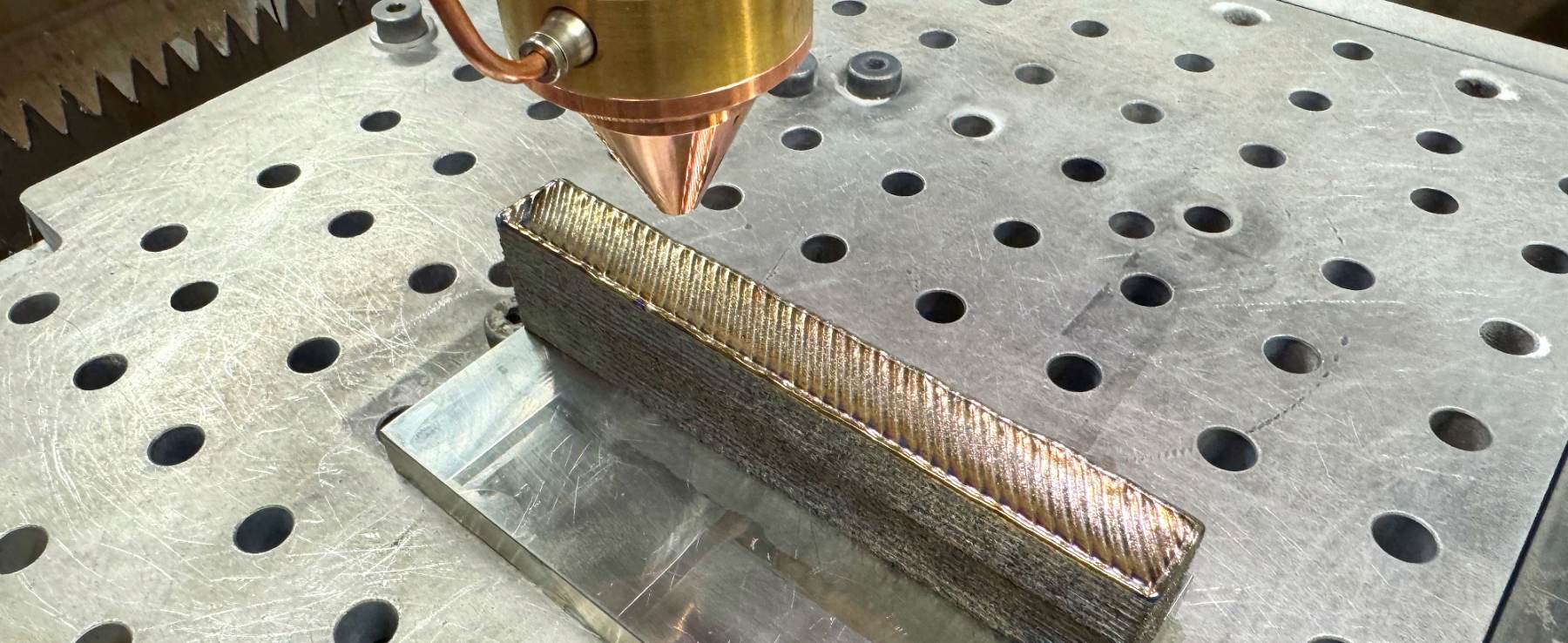
RMIT University researchers create stronger, cheaper titanium. Image courtesy of RMIT University.
Why Titanium Is So Valuable — and So Expensive
Titanium is known for being both strong and light. It’s also safe to use inside the human body, making it ideal for jet engine parts, spacecraft components, and medical implants like hip joints and dental posts.
The problem is the cost. Making titanium takes a lot of energy, and in 3D printing, it needs high-quality powders and precise handling. The most common 3D printed titanium alloy, Ti-6Al-4V, also uses vanadium, a metal that’s expensive and getting harder to source.
Brooke and his team tackled the problem in two ways. First, they redesigned the alloy’s recipe, replacing vanadium with cheaper, more common elements. This change alone cut production costs a lot. Second, they developed a new framework for designing alloys for additive manufacturing (AM). This method helps researchers quickly select alloying elements that are compatible with 3D printing, reducing trial-and-error testing.
A big part of this method is figuring out and controlling how the metal’s grains form when printed. In many 3D printed titanium parts, the metal cools into tall, column-like grains. This can make the part’s strength vary depending on the direction of the force, explain the researchers.
The new RMIT alloy avoids this issue, forming a uniform grain structure that gives the printed part consistent strength and ductility (the ability to bend without breaking).
Brooke, who has just accepted a Research Translation Fellowship at RMIT to investigate the next steps of commercialising the technology, said the area of 3D printed titanium alloys was ripe for innovations.
“3D printing allows faster, less wasteful, and more tailorable production, yet we’re still relying on legacy alloys like Ti-6Al-4V that don’t allow full capitalisation of this potential. It’s like we’ve created an aeroplane and are still just driving it around the streets,” he said. “New types of titanium and other alloys will allow us to really push the boundaries of what’s possible with 3D printing, and the framework for designing new alloys outlined in our study is a significant step in that direction.”
In fact, testing showed that the new alloy is 29% cheaper to produce than Ti-6Al-4V, stronger than standard 3D printed titanium, more ductile, which makes it more resistant to fracture, and uniform in structure, avoiding the weaknesses of columnar grains.
Industry Input from Day One
The project included early-stage market validation through Australia’s national science agency, the Commonwealth Scientific and Industrial Research Organisation’s (CSIRO) ON Prime, a pre-accelerator program designed to help researchers and entrepreneurs validate the market potential of their ideas. Brooke and the team spoke directly with aerospace, automotive, and medical device companies to identify industry needs.
“What I heard loud and clear from end users was that to bring new alloys to market, the benefits have to not just be minor incremental steps but a full leap forward, and that’s what we have achieved here,” said Brooke, who will continue commercialisation work under his new fellowship. “We have been able to not only produce titanium alloys with a uniform grain structure, but with reduced costs, while also making it stronger and more ductile.”
That feedback shaped the team’s priorities, lowering cost, improving strength, and ensuring structural uniformity.

Ryan Brooke, Professor Mark Easton and Dr Dong Qiu at RMIT’s Centre for Additive Manufacturing. Image courtesy of RMIT University.
The work was carried out at RMIT’s Advanced Manufacturing Precinct, which houses high-end AM equipment. While the exact composition of the new alloy is being kept confidential for now, the team has filed a provisional patent and is seeking partners to move toward commercial production.
Professor Mark Easton, who is an author on the study and is Deputy Head of the School of Aerospace, Mechanical and Manufacturing Engineering, said scaling up will require collaboration across the supply chain.
“We are very excited about the prospects of this new alloy, but it requires a team from across the supply chain to make it successful. So, we are looking for partners to provide guidance for the next stages of development,” Easton said.
Potential Impact
If brought to market, the new alloy could impact many industries that need titanium’s benefits but can’t afford its high price. For example, in aerospace, lighter, stronger, and cheaper titanium components could boost fuel efficiency and cut emissions. Meanwhile, in medical devices, lower-cost titanium implants could improve patient access while maintaining quality. In automotive and other engineering fields, the material could allow high-performance parts at lower price points.
Because the design framework developed by the team is not limited to titanium, it could also be applied to other metals used in AM, paving the way for more affordable, high-performance alloys across multiple sectors.
Subscribe to Our Email Newsletter
Stay up-to-date on all the latest news from the 3D printing industry and receive information and offers from third party vendors.
Print Services
Upload your 3D Models and get them printed quickly and efficiently.













You May Also Like
3D Printing News Briefs, October 10, 2026: Drones, WAAM, Ceramics, & More
We have a packed 3D Printing News Briefs for you this weekend! First, America Makes celebrated the recent National Manufacturing Day with 3D printed drones, and then it’s on to...
3D Printing News Briefs, October 3, 2026: Hypersonics, Hotends, & More
We’re starting off with defense in this weekend’s 3D Printing News Briefs, as Titomic was awarded a $5 million U.S. defense contract, and VulcanForms announced a partnership with Specter Aerospace...
The Part Is Only Half the Story: Why 3D Printing Needs a Digital Thread
A 3D printed part can generate a lot of information. The challenge is keeping track of it. Manufacturers need to know which design was used, what material went into the...
Advanced Manufacturing at IMTS 2026: 3D Printing and AI and Drones, Oh My!
Last week’s International Manufacturing Technology Snow (IMTS) in Chicago welcomed over 90,000 attendees to the jungle that is McCormick Place. With over 1.17 million square feet of exhibit space, and...