ICON and NASA Continue Collaboration to Move Lunar Construction Forward

NASA and ICON are pushing 3D printing closer to space missions by testing how Moon soil behaves in lunar gravity and advancing a laser-based system to turn that soil into building material for habitats, landing pads, and roads on the Moon and Mars.
Over the last few years, NASA has supported Texas-based construction tech company ICON in developing 3D printing systems that use local planetary material, or regolith, to build infrastructure off-Earth. This partnership began with NASA’s 3D Printed Habitat Challenge and evolved through various programs, including the Small Business Innovation Research (SBIR) initiative and CHAPEA, NASA’s ongoing Mars habitat simulation at Johnson Space Center.
The latest milestone came in February 2025, when ICON launched an experiment called Duneflow aboard a Blue Origin reusable rocket as part of NASA’s Flight Opportunities program. During the flight, the rocket simulated lunar gravity for about two minutes, giving ICON and NASA researchers a chance to study how simulated Moon dust behaves in low-gravity conditions. The goal was to compare the flow and characteristics of this simulant with real lunar regolith samples collected during the Apollo missions. These insights are key for developing automated 3D printing systems that can work well in different gravity environments.
At the center of ICON’s work is its next-generation construction platform, Olympus. This system is designed to print large-scale infrastructure directly on the Moon or Mars using native materials. Rather than relying on traditional concrete or transporting feedstock to space, Olympus uses a technique called Laser Vitreous Multi-material Transformation. So basically, it uses a high-powered laser to melt lunar or Martian soil, which then cools and solidifies into hard, ceramic-like structures. The result is a strong, resilient building material made entirely from what’s already available on the surface, so there is no need to bring bricks or concrete from Earth.
This innovation in in-situ resource utilization (ISRU) is especially important because sending materials into space is incredibly expensive. Every kilogram launched into orbit adds to the cost and complexity of a mission. So being able to print roads, landing pads, radiation shielding, or even crew habitats using materials already available on site would reduce the logistical burdens for future missions.
ICON’s 3D printing technology has been making headlines for years. The company used its Vulcan construction system to 3D print full-size homes in Texas and other parts of the US, proving that robotic construction at scale is possible. ICON’s Earth projects have helped test ideas that could work in space. NASA saw this potential and backed ICON through several programs to adapt their technology for use beyond Earth.
The Olympus system builds on years of NASA research into planetary construction. Programs like the Moon to Mars Planetary Autonomous Construction Technology (MMPACT) initiative, managed out of NASA’s Marshall Space Flight Center, are focused on creating autonomous systems that can build necessary infrastructure without human intervention. This is key for early-stage missions, where astronauts may not be present yet or may have limited time and resources for construction.
ICON’s efforts also complement earlier work funded through NASA’s Innovative Advanced Concepts (NIAC) program, including research led by Behrokh Khoshnevis of the University of Southern California. Khoshnevis pioneered the Contour Crafting technique, one of the earliest concepts for large-scale 3D printing on planetary surfaces. His work also included selective separation sintering, which uses heat and pressure to create small but precise parts in space.
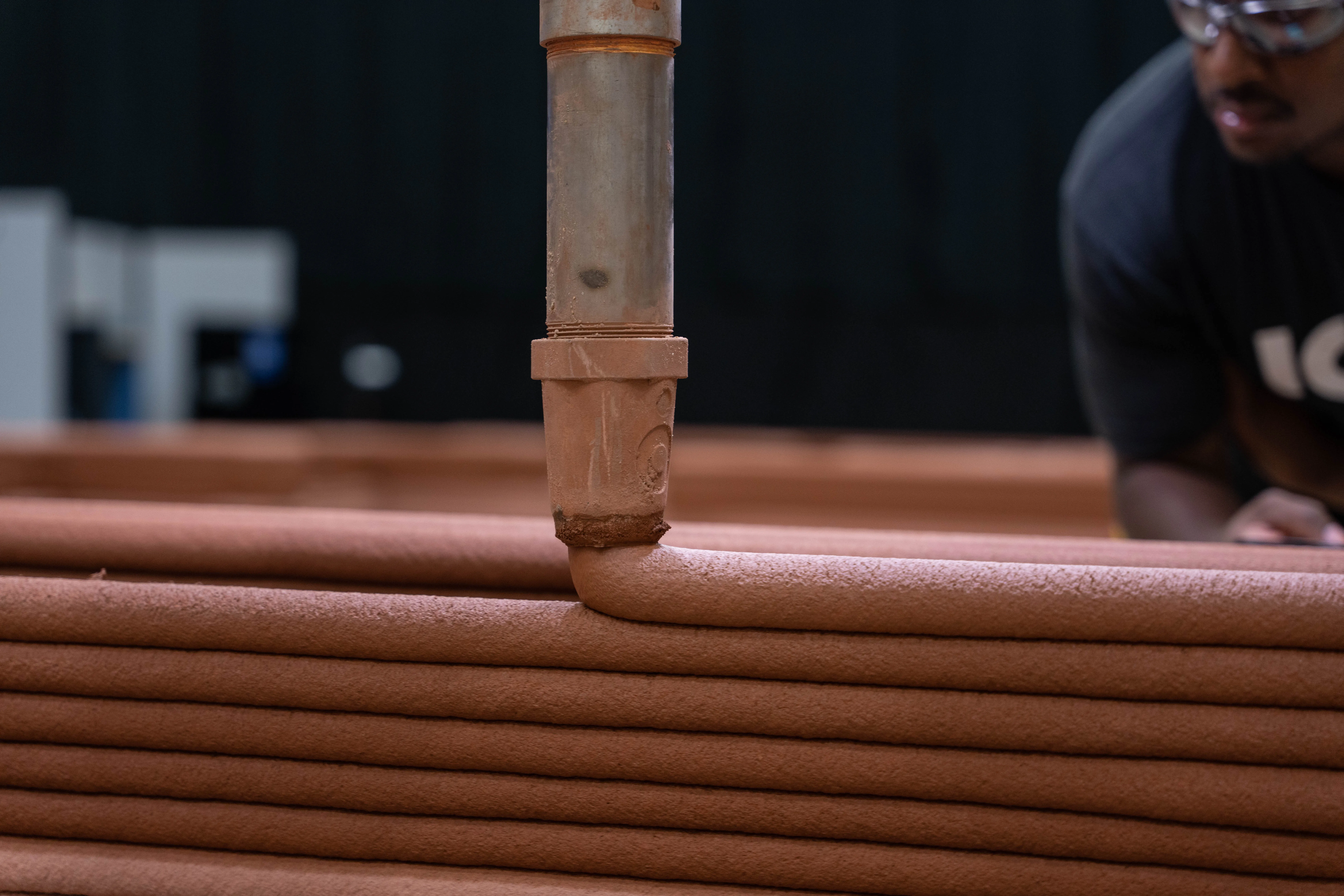
ICON’s Vulcan construction system 3D printing a simulated Mars habitat for NASA’s CHAPEA missions. Image courtesy of ICON.
Now, ICON’s more advanced system integrates the lessons learned from these early steps and applies them through a more powerful platform designed specifically for Moon and Mars missions. Olympus is being actively developed and tested, with hardware demonstrations already underway via NASA’s support.
ICON is also behind Mars Dune Alpha, a 1,700-square-foot simulated habitat built at NASA’s Johnson Space Center in Houston. The structure is part of the CHAPEA (Crew Health and Performance Exploration Analog) project, where volunteer crews live and work in a Mars-like environment for a full year. The habitat, created using ICON’s Vulcan printer, helps test how 3D printed living spaces could support long-duration missions to the Red Planet.
Taken together, NASA and ICON’s collaboration represents one of the most advanced efforts to bring 3D printing into space construction. In fact, NASA and ICON’s ongoing collaboration is now entering a critical testing phase, moving closer to using 3D printing to build real structures on the Moon and Mars using on-site resources.
Subscribe to Our Email Newsletter
Stay up-to-date on all the latest news from the 3D printing industry and receive information and offers from third party vendors.
Print Services
Upload your 3D Models and get them printed quickly and efficiently.













You May Also Like
Why the AM Industry Should Pay Attention to Schneider Electric’s $22.6B PTC Acquisition
By late 2024, there was already enough signaling of the additive manufacturing (AM) industry opportunity in the data center infrastructure market for AM Research to write a report on the...
How Does Nike’s 3D Printing Approach Fit Into Its Restructuring Plan?
Shares of Nike stock hit all-time highs in late 2021 but have cratered in the years following, with the company losing nearly 80 percent of its market cap since peaking....
3D Printing News Briefs, October 1, 2026: Defense, Enclosures, & More
In today’s 3D Printing News Briefs, we’re starting with defense news, first from Massivit and then from AML3D. Then we’ll move on to U.S. manufacturing of a new large-format LPBF...
South Korea’s Lincsolution Lands Hanwha Defense Deal as Hanwha Invests Billions in US
I recently wrote about how the South Korean additive manufacturing (AM) firm Lincsolution is building an aerospace and defense hub, part of the company’s construction of “the largest AM facility in...