Impossible Objects Receives $2.8m Investment to 3D Print with Kevlar, Fiberglass & Carbon Fiber

Impossible Objects is, even for the 3D printing world, apparently doing the impossible. The focus of the company is to create the world’s first composite 3D printed objects, using an impressive variety of materials, to revolutionize the already-revolutionary 3D printing space.
Larry Kaplan heads up the Impossible Objects team as the CEO. The former CEO of Navteq, Kaplan is leading the five-employee firm’s cha rge in developing novel 3D manufacturing machines to enhance upon the presently available capabilities.
“Current technologies are 20 or so years old,” said Kaplan. “They are great for prototyping but too slow compared to volume manufacturing. The parts coming out of 3-D weren’t as good as traditional manufacturing. To make a dent in manufacturing, you have to overcome the challenges of 3-D printing: speed of production, using a wider range of materials and coming up with superior mechanical properties.”
To help Impossible Objects on this venture, several new investors are jumping in to back the startup. Today, December 16th, Northbrook, Illinois-based Impossible Objects has received new investments to the tune of $2.8 million from OCA Ventures and angel investors. Among the angel investors are Armando Pauker (a partner at Apex Venture Partners in Chicago) and Len Wanger (managing partner at Deer Valley Ventures of Park City, Utah).

Larry Kaplan, CEO, Impossible Objects
The $2.8 million investment will lead to a strengthening in Impossible Objects’ offerings, from 3D printers to sales and marketing efforts. And it looks like they have just the right leadership team in place to advance the additive manufacturing space. With Kaplan as the CEO and serial entrepreneur Robert (Bob) Swartz, the company’s founder , now serving as the chairman and adviser, the experience at the top of this ladder exudes confidence and competence. In addition to Swartz and Kaplan, the Impossible Objects team includes Chief Manufacturing Officer John Bayldon, as well as a lab manager and a manufacturing technician.
After founding Impossible Objects, Swartz brought Kaplan on as CEO in June, expanding from his previous experience in leading Navteq through its IPO and subsequent sale to Nokia.
“OCA invested in Impossible Objects because it’s being led by an all-star team of Larry and Bob, who have a lot of experience building companies from early stage startups to IPO,” said Imran Ahmad, principal at OCA Ventures.
The newly invested seed money will help Impossible Objects in the goal to bring 3D printed components straight into use — they’re not looking to simply prototype. By creating their products using composite materials, Kaplan notes that they are immediately usable. They use two or more materials, from Kevlar to carbon fiber to fiberglass, in creating their products. This array of materials in each piece presents more usability than simple thermoplastic or limited metal options found in most 3D printers could provide. “Our parts,” said Kaplan, “are not just for prototypes; they’re for end use.”
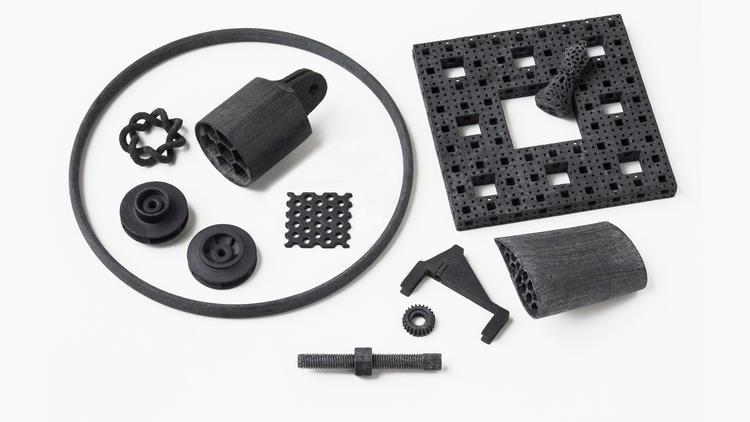
Impossible Objects has already created viable components for use in small aircraft and a fan blade. Looking at the longer term, the company is seeking to target aerospace, automotive, and medical applications which all require fail-proof parts. The machines that Impossible Objects seeks to make are based on technology that Swartz developed. They now use two machines to create their 3D printed objects, and presently serve aerospace and trucking industry customers. According to Kaplan, Impossible Objects will begin to sell industrial machines in about a year.
The additive manufacturing technology from Impossible Objects relies on a patent-pending process that Kaplan describes as a “combination [that] gives you the strength [of fiber] but the light weight of a polymer or plastic,” while also accentuating speed. A goal of the company is to enhance production speed to rival that of injection molding processes. For Impossible Objects’ process, polymer material is laid on thin sheets of fiber in the designed shape. These sheets are stacked, heated to reach the melting point of the polymer, and fused together. Excess material, finally, is buffed away via mechanical abrasion.
What do you think about additive manufacturing using composite materials? Let us know in the Impossible Objects Receives $2.8 Million Investment forum thread at 3DPB.com.
Subscribe to Our Email Newsletter
Stay up-to-date on all the latest news from the 3D printing industry and receive information and offers from third party vendors.
Print Services
Upload your 3D Models and get them printed quickly and efficiently.











You May Also Like
How Metal Additive Manufacturing Is Reshaping the Future of Aerospace and Defense Engineering
Additive manufacturing (AM) is steadily changing the way we think about producing metal parts for aircraft. Whilst aerospace and defense companies have been using metal AM for over twenty years,...
The AM Adoption Problem No One Models
Through its short history, Additive Manufacturing has been presented to the investment community as a classic high growth technology story. Manufacturing is a multi-trillion-dollar market. Even a small percentage looks...
The Business of Customized Sports Equipment: How 3D Printing Is Changing Athletic Gear
For years, 3D printing in sports has been linked mostly with prototypes, concept shoes, and one-off experiments for elite athletes. Helmets, cleats, and footwear midsoles often took over the headlines,...
The Maritime Industrial Base is on Full Display at Additive Manufacturing Strategies 2026
2025 is the year that the AM ramp-up by the U.S. Maritime Industrial Base Program (MIB) became common knowledge throughout the industry. But everyone who attended AMS 2024 was already...