3D Printing an Improved DMLS Automotive Component Using Topology Optimization and DfAM

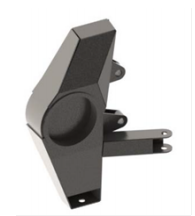 Engineers frequently use topology optimization to optimize the design and layout of parts to create lightweight and optimized structures. The technology often results in organic, complex shapes, however, which can be difficult to produce using traditional manufacturing methods. That’s why 3D printing pairs so well with topology optimization – it allows for the kind of freedom of design necessary to create those complex shapes. In a paper entitled “Application of Topology Optimization and Design for Additive Manufacturing Guidelines on an Automotive Component,” a group of researchers uses topology optimization to create a lightweight automotive component “while conforming to additive manufacturing constraints related to overhanging features and unsupported surfaces when using metallic materials.”
Specifically, the researchers use Design for Additive Manufacturing (DfAM) along with topology optimization to study the tradeoffs between the weight of the part, support requirements, manufacturing costs, and mechanical performance. They redesign an upright on the SAE Formula student race car to reduce support structures and manufacturing cost while using Direct Metal Laser Sintering (DMLS).
The upright is responsible for transferring loads from the ground to the chassis, and is an important component of the race car. The initial optimized design had a theoretical weight of 1.62 lbs. (735 grams). The model was analyzed for two orientations: flat on the build platform and on its side. A costing tool was used to calculate the overall manufacturing costs of the build. The calculated costs of the part printed flat and on its side were $2015 and $2995, respectively. FEM simulations were carried out to ensure that the mechanical performance of the final parts satisfied the loading conditions.
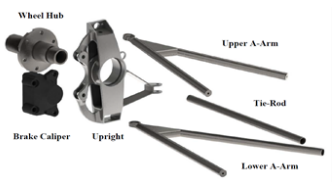
The researchers then worked to improve the design using a program called OPTISTRUCT, with the original design as a reference.
“Since the optimization problem involves multiple loading cases, a weighted compliance approach is used to determine the optimized layout while considering four different loading cases,” the researchers explain. “The objective function is defined as minimize compliance response subjected to 20% volume fraction as the optimization constraint.”
The aim of the redesign was to reduce the need for supports, and the researchers were able to do so, although the weight of the part was increased. After reviewing the FEM analysis, the part was redesigned once again to reduce the weight. The final part required 91.7% less support structure, and the total manufacturing cost is reduced by 51.7%.
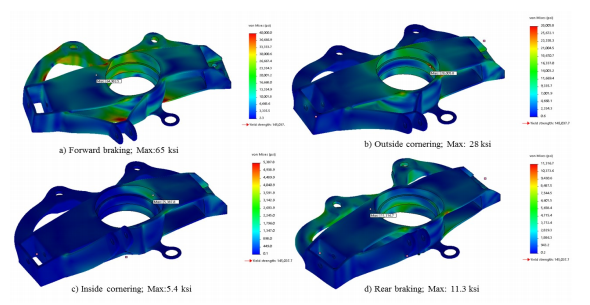
“Future work entails formalizing an approach that integrates topology optimization, FEM, support design, and DfAM rules into a more coherent framework,” the researchers conclude. “We also plan to fabricate and test Redesign 2 using EOS M280 machine and collect actual fabrication data similar to Design 0 to get a more accurate measure of the support requirement and trapped powder. Also, geometry affects the residual stresses and deflections caused by frequent heating and cooling cycles in a laser-based additive manufacturing process. Hence, for functional parts like this, it is important to know the performance of the design during the AM process. Thermo-mechanical simulations will be carried out to estimate the deflections in the part and this data will be used to redesign, if required.”
Authors of the paper include Nithin Reddy, Vincent Maranan, Timothy W. Simpson, Todd Palmer and Corey J. Dickman.
Discuss this and other 3D printing topics at 3DPrintBoard.com or share your thoughts below.
Subscribe to Our Email Newsletter
Stay up-to-date on all the latest news from the 3D printing industry and receive information and offers from third party vendors.
Print Services
Upload your 3D Models and get them printed quickly and efficiently.













You May Also Like
The Hidden Cost of Lost Engineering Intent
Recent reporting on the UPS MD-11 engine separation on Flight 2976 has understandably focused on the immediate question: what happened? The investigation will determine that, as it should. Serious engineering...
3D Printing News Briefs, May 28, 2026: Continuous Fiber Reinforcement, Bioprinted Trachea, & More
In today’s 3D Printing News Briefs, America Makes announced the winners of its JAQS-SQ Project Call. Axtra3D is partnering with Keystone Industries to expand its dental material ecosystem, while BigRep...
Stratasys Acquires Markforged, Analysis of AM’s Latest Consolidation Move
A very long time ago, in 2023, the additive manufacturing (AM) industry was enraptured over the attempts by a large chunk of its publicly traded original equipment manufacturers (OEMs) to...
Why Additive Manufacturing Has Finally Earned Its Place on the Production Line
For years, the conversation around additive manufacturing followed a predictable script. Engineers would acknowledge its usefulness for prototyping – faster iterations, cheaper design validation, no tooling to worry about –...