3D Printed Robot Mimics Human Emotions

 What do you think of when you hear the word “robot?” You probably don’t think of emotions. Human beings are described as robotic if they lack emotion. Robotic and human seem polar opposites. But now researchers at the Korea Institute of Science and Technology (KIST) have developed a humanoid robot that mimics human emotions, delivering movie lines with appropriate gravity and becoming visibly moved when listening to music.
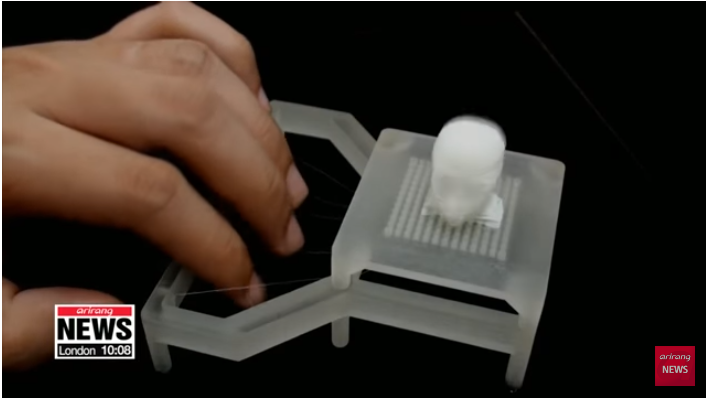
It’s a far cry from Westworld, but the robot designed by the researchers is a step toward the development of robots that are more, well, human. They used an interesting 3D printing-like technology to create it, too. First, they designed a 3D model and created a foldable blueprint, which was then printed on a thin foam material. The foam pieces, which are connected by pieces of string running down their centers, are stacked on top of each other to form a humanoid head.
“Using the same techniques as 3D printing, it creates the desired 3D figure by repeating layers from the bottom. It takes about two to three hours,” explained I.M. Se-Hyuk, Senior Researcher of Robotics at KIST.
When the researchers press on the ends of the strings, the robot moves like a marionette, but when artificial intelligence is brought into the equation, the robot actually reacts to its environment.

“If combined with an intelligence structure, it will be able to react to what I say and interact as such,” continued Se-Hyuk.
It’s a bit eerie to watch, as it has the contours of a face, but not actual features – yet it moves similarly to the way a human face does. It doesn’t have the capacity to chase you through a park like some of its cousins, but it can stare eyelessly at you, which is almost as bad. If you have a robot phobia, this one likely won’t ease your discomfort.
 If you’re a fan of robots and all that they can be programmed to do, however, this one is pretty cool. The researchers expect that it will be used for graphics production in the film industry, which answers the question “Why give a robot the ability to express human emotions?” The human face is an incredibly complex thing with subtle cues and reflections, and it can express a lot with very little movement. My favorite actors have always been the ones who can express great emotion while appearing to do very little with their faces or bodies. In that regard, this robot won’t likely be winning an Oscar anytime soon – not for best actor, anyway, though maybe for special effects. Its facial movements aren’t quite subtle, but rather puppetlike.
Still, the robot is a fascinating example of what technology is capable of doing, and its fabrication is an interesting variation on 3D printing as well. I’ve never seen anything else quite like this particular robot, even as many robots are becoming more humanoid. It will be interesting to see how it may be used in movies – keep an eye out for KIST in the credits of films to come.
Discuss this and other 3D printing topics at 3DPrintBoard.com or share your thoughts below.
Subscribe to Our Email Newsletter
Stay up-to-date on all the latest news from the 3D printing industry and receive information and offers from third party vendors.
Print Services
Upload your 3D Models and get them printed quickly and efficiently.













You May Also Like
The Manufacturing Race Behind the Drone Revolution
We are in the middle of a major manufacturing shift focused on the production speed and payload capacity of uncrewed aerial systems (UAS), or drones. A recent Manufacturing Dive article...
ADDMAN to Buy Up to $10.8M in Nickel 718 Powder from 6K Additive Over 30 Months
After years of buildup, we’re finally starting to see what the US metal additive manufacturing (AM) market could look like at scale. To be sure, it’s still not quite there,...
Metal AM in a Multipolar World, Part 2: How PBF and DED Could Change by 2035
The first decades of PBF development were heavily shaped by machine capability: more power, more lasers, larger build volumes, better recoating, and improved process monitoring. These developments will continue, but...
Advanced Manufacturing at IMTS 2026: 3D Printing and AI and Drones, Oh My!
Last week’s International Manufacturing Technology Snow (IMTS) in Chicago welcomed over 90,000 attendees to the jungle that is McCormick Place. With over 1.17 million square feet of exhibit space, and...