3D Printed Cylinders Tower Over Mars Surface in Latest Design for Habitat Challenge


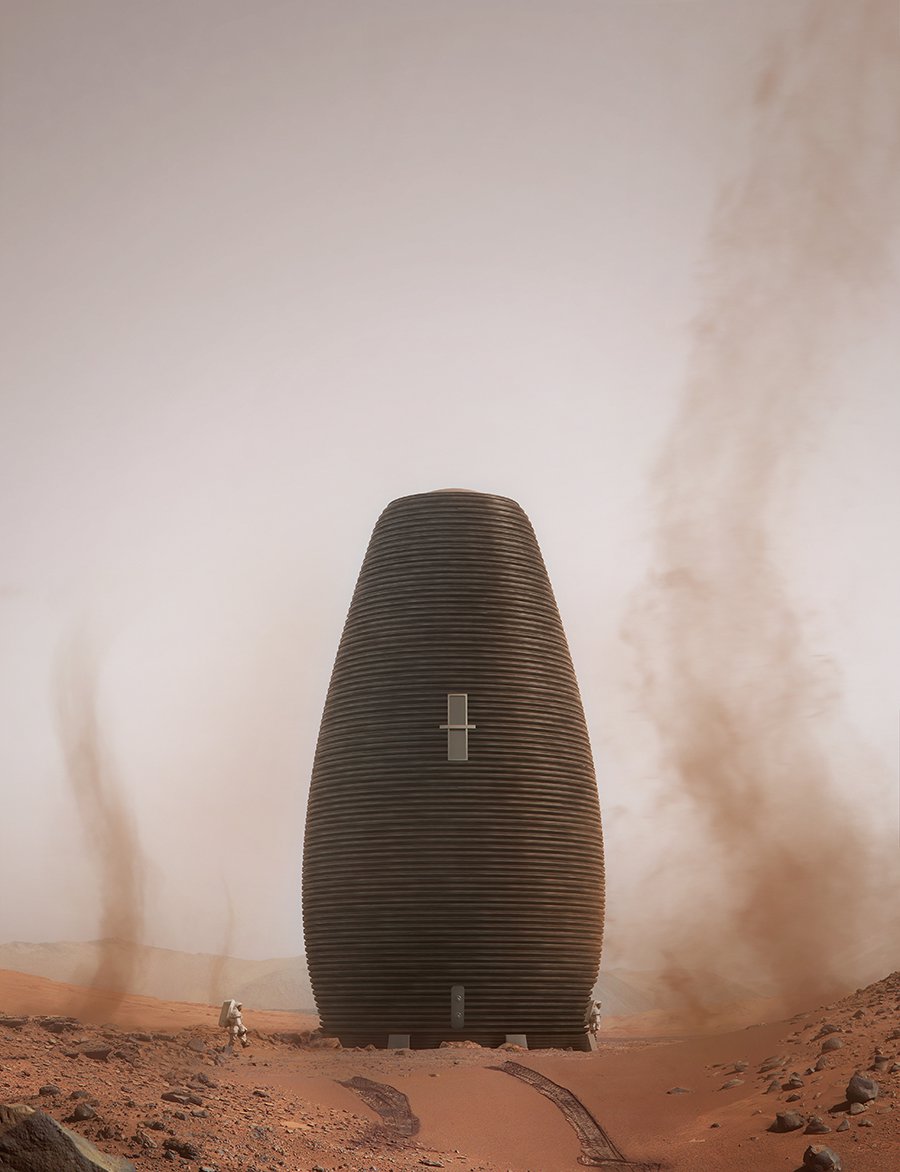 NASA’s 3D Printed Habitat Challenge has seen several companies competing for a high honor – to design the first habitats for humans on Mars and the moon. Using 3D printing, these competitors have proven their ability to create structures such as cones, cylinders and beams. The most recent phase of the competition takes things to a new level by asking the teams to present their ideas for entire structures. A lot of the ideas offered thus far have been low dome-like structures, some partially buried in the ground. But AI SpaceFactory, the second place winner of the most recent competition round, has something a bit different in mind.
MARSHA (MARS HAbitat), features tall, cylindrical structures that resemble elongated eggs, optimized to handle internal atmospheric pressure and structural stresses. They’re quite different from Earth dwellings, which are designed to handle mostly gravity and wind.
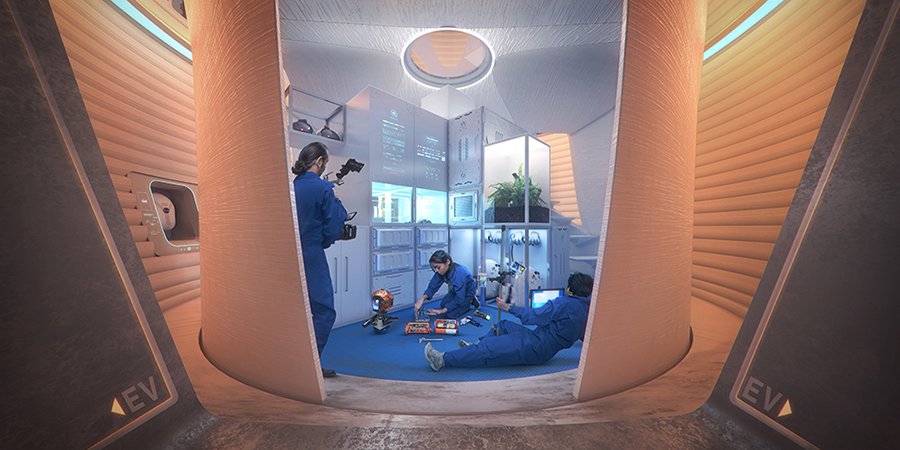
The ground level of each MARSHA structure has a “garage” that contains external systems and exploration activities with a supporting wet lab. Above that is the main hub, with 34 square meters of joint dry lab and kitchen. The third level has individual cabins, a sanitation pod, and a hydroponic garden. The fourth level is a recreation and exercise area and features a bright, water-filled skylight. Each building is made from two “shells” with the space between acting as a light-well. Circadian lighting is designed to recreate Earthlight.
The reason so much work is being put into developing methods and materials for construction on Mars is that it isn’t realistic at all to consider bringing building materials from Earth, so everything must be fabricated from material readily available on the red planet. To that end, AI spaceFactory is developing basalt fibre-reinforced PLA (bf-PLA), with the basalt extracted from Mars rocks and the PLA harvested and processed from plants grown on Mars. Basalt fibre is super-strong and happens to be a natural insulator, so it’s convenient that it will be so readily available, as well.
 Whenever humans do get to the point at which colonizing Mars is an imminent possibility, NASA plans to send robots ahead to the planet to gather materials and 3D print the habitats so that they’re ready for people when they arrive.
“Architecture on Earth plays a critical role in the way we live. On Mars, this role reaches a higher level of importance since architectures are machines which keep us alive,” says AI spaceFactory. “In space architecture, every design decision is of great consequence to the success of a mission. Structures must be resilient and interior layouts must function around mission demands. But since sustained social and mental health is also mission-critical, space habitats should offer an element of humanity. The result is a credible and evocative habitat with an alien yet familiar beauty.”
The structures may look alien from the outside, but on the inside, they appear comfortable and livable. The fact that they’re built vertically means that there’s no need for a robot to travel across an unknown surface to build them; a stationary rover with a telescoping arm builds the structures.
NASA has awarded AI SpaceFactory almost $21,000 to further develop the project.
Discuss this and other 3D printing topics at 3DPrintBoard.com or share your thoughts below.
[Images: AI spaceFactory]Subscribe to Our Email Newsletter
Stay up-to-date on all the latest news from the 3D printing industry and receive information and offers from third party vendors.
Print Services
Upload your 3D Models and get them printed quickly and efficiently.












You May Also Like
3D Printing News Briefs, August 1st, 2026: Project Calls, Contact Lenses, Chairs, & More
We’re starting with the winners of two America Makes project calls in this first 3D Printing News Briefs of August! Then we’ll move on to AM quality control for aerospace,...
Caracol to Build Large-Format 3D Printing Hub in Milan With Designtech & LAMÁQUINA
In the 1990 classic in economic strategy, The Competitive Advantage of Nations, business theorist Michael Porter wrote, “Most commentators on the Italian economy have persistently underestimated Italy, because they have...
Beyond Thermoplastics: Why JuggerBot Is Betting on Hybrid AM
For years, thermoplastics have been the workhorse of additive manufacturing (AM). They are pretty easy to process, available, and compatible with many of today’s industrial 3D printers. From prototypes to...
3D Printing News Briefs, July 22, 2026: Delisting, Wind Turbine Blades, & More
We’re covering business and energy news in today’s 3D Printing News Briefs. Würth Additive Group has closed its doors, and BigRep delisted from the Frankfurt Stock Exchange. RA Wind received...