Wacker Debuts Silicone 3D Printing Technology to North American Market at IDTechEx

 As the entire industry looks to push the capabilities of 3D printing technology to the next level, the demand for advanced materials has never been greater. For about 70 years now, silicone has been considered a high-tech material that has provided functionality for a number of applications, and it’s now finally making a transition into additive manufacturing. One company paving the path for 3D printed silicone is the Munich-based global materials and technology manufacturer Wacker Chemie.
The German company announced their new silicone 3D printing technology last year, and debuted the ACEO Imagine Series K, their first industrial 3D printer for silicones, at K 2016: International Trade Fair for Plastics and Rubber back in July. This past week, for the first time, Wacker introduced their ACEO technology to the North American market during the IDTechEx Show, which just took place from November 16 to 17 in Santa Clara, California.
 Using a unique drop-on-demand technique similar to material jetting, their specialized 3D printing technology features a print head that deposits single silicone voxels on a building platform. These deposited voxels form a smooth and homogenous surface, as each finished layer is cured via UV light. Wacker’s technology also utilizes a support material for complex prints, as well as overhangs and cavities, which can be dissolved away with water after the printing process is completed. The printed part is post-cured at high temperatures to ensure that the exceptional mechanical properties of silicone prevail.
“We decided to develop a contactless technology, which means that we have no connection between the print head and the component during the dosing process of the single droplets,” said Dr. Bernd Pachaly, the head of the R&D department from Wacker Silicones. “This brings significant advantages that allow both high precision and freedom in design.”
As for the mechanical properties of silicone, the high-tech material is best known for its longevity and elasticity. On top of that, silicone is exceptionally temperature-stable and media-resistant, making the highly transparent material ideal for a number of applications. It can also be formulated to be electrically conductive or insulating, while certified silicone grades are biocompatible, giving it high value in the medical field.
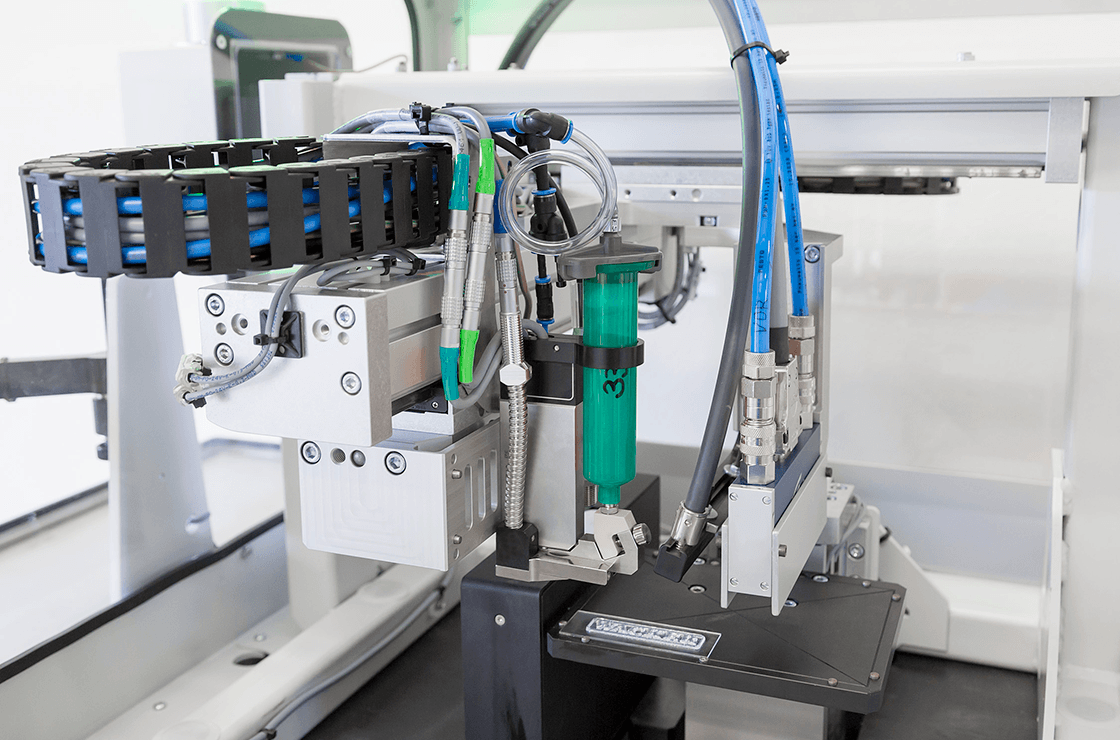 Wacker has spent the last two years developing the software, hardware, and materials that make up their silicone 3D printing technology. All of their development has been grouped under the ACEO brand. On the ACEO website store, customers are able to upload 3D models to be printed in silicone at the Burghausen-based ACEO Open Print Lab and shipped directly to them. The makerspace includes an interdisciplinary team capable of offering contract development for design and material, among other services.
According to Dr. Pachaly, Wacker is only at the beginning of their silicone 3D printing journey, and already have different grades and colors of the material available. From here, they plan to develop more durometers and colors, as well as materials formulated to meet the requirements of biocompatibility. Discuss in the ACEO forum at 3DPB.com.
Subscribe to Our Email Newsletter
Stay up-to-date on all the latest news from the 3D printing industry and receive information and offers from third party vendors.
Print Services
Upload your 3D Models and get them printed quickly and efficiently.











You May Also Like
Resetting the Role of AM in Defense, and the Role of Defense in the Economy
The Trump administration recently revealed that it is requesting a $1.5 trillion defense budget for FY2027, confirming Trump’s initial announcement of that topline number at the beginning of 2026. So...
Most 3D Printing Metals Are Adapted. This One Was Designed with AI
A research team from the University of South China and Purdue University developed a new type of steel designed specifically for 3D printing, using machine learning to guide the process....
Divergent & GA-ASI: How Connecting at AMUG Led to an Important Industry Partnership
As I mentioned in my AMUG 2026 overview, I had a lot of delays traveling to Reno, Nevada to attend the conference. So unfortunately, I missed “From Hypercars to Defense...
Artemis II Launches With 3D Printing Onboard, and a Much Bigger Role Ahead
A new chapter in human spaceflight began today as NASA launched Artemis II from Kennedy Space Center, sending astronauts on a journey around the Moon for the first time in...