A 20-Year-Old 3D Printed Object Emerges From the Dust at MIT


Branden Gunn
Although 3D printing technology has only very recently become a hot topic, garnering media attention, and progressing to a point where widespread adoption begins to make sense, the technology itself has actually been around for quite some time. There is no doubt that over the last few years the 3D printing space has seen tremendous innovation and improvements, but over 30 years ago, the first 3D printed object was fabricated, and close to 20 years ago researchers and students at MIT began printing more complex objects. In fact, it was at MIT where Dr. Ely Sachs first coined the phrase ‘3D printing’.
One may think that the actual 3D prints created over 20 years ago have been lost in the sands of time, however, a man named Branden Gunn recently received a gift which he will certainly cherish for a very long time. Gunn is a 3D printing enthusiast himself, who runs the blog Engunneer, and works at 1366 Technologies, alongside two pioneers within the 3D printing space, Ely Sachs, and a man named Jim Serdy, who worked with Sachs at MIT in the 90’s.
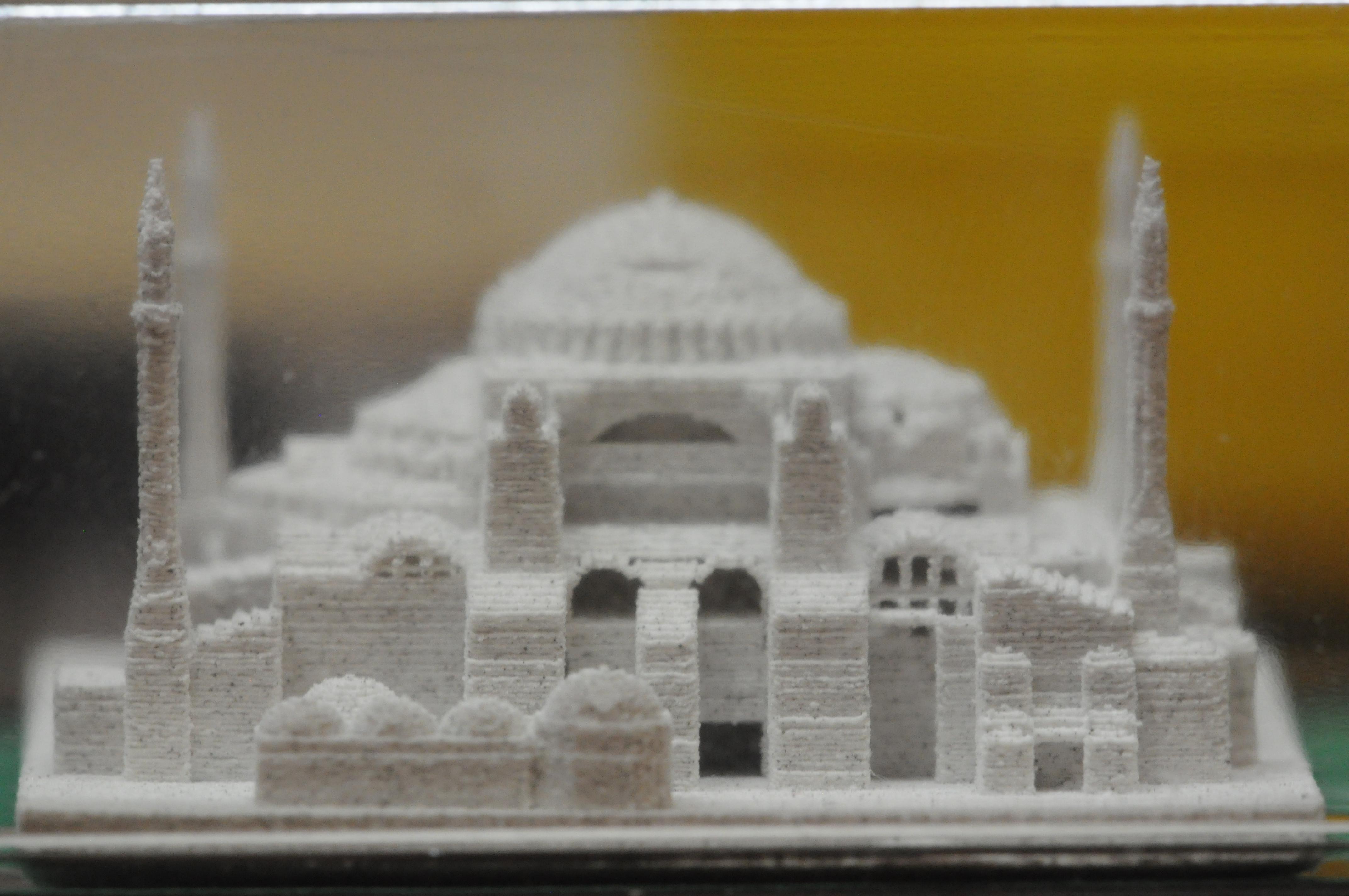
3D Print of Hagia Sophia, circa 1995-96
“We were actually at a company beach party when I was talking with Jim about 3D printing in general, and he went to get the model for me from his car,” explained Gunn to 3DPrint.com when questioned about an old 3D print of the Hagia Sophia, from 1995-1996, that he had received. “I was not expecting it as a gift.”
The actual print, which measures just four centimeters across, depicts the famous building, nearly 1,500-years-old, located in Istanbul Turkey. The Hagia Sophia was once a Greek Orthodox patriarchal basilica church, and later an imperial mosque, prior to its current day use as a museum.
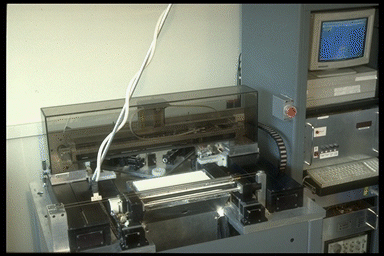
MIT Alpha 3D Printer (Image Credit: Mit.edu)
The actual print is a relic within the 3D printing space, one representing the progress which has been made with this technology in a rather short period of time. Fabricated on the MIT Alpha 3D Printer, via a dry alumina powder, which was systematically bound via a special binding solution, it is rather detailed for the time period. The printer itself can be found on display at the MIT Museum.
“It’s a powder+binder process that was eventually licensed to 6 different companies, most notably Z-Corp (who has since re-branded),” explained Gunn. “The powder is dry, and a print head from an ink-jet printer ejects a small drop of binder at 10m/s towards the powder surface below. As the drop falls, there are electrical fields that guide it to the target position to improve accuracy and resolution. The print head itself is also moving at 1.5 m/s while squirting the binding fluid.”
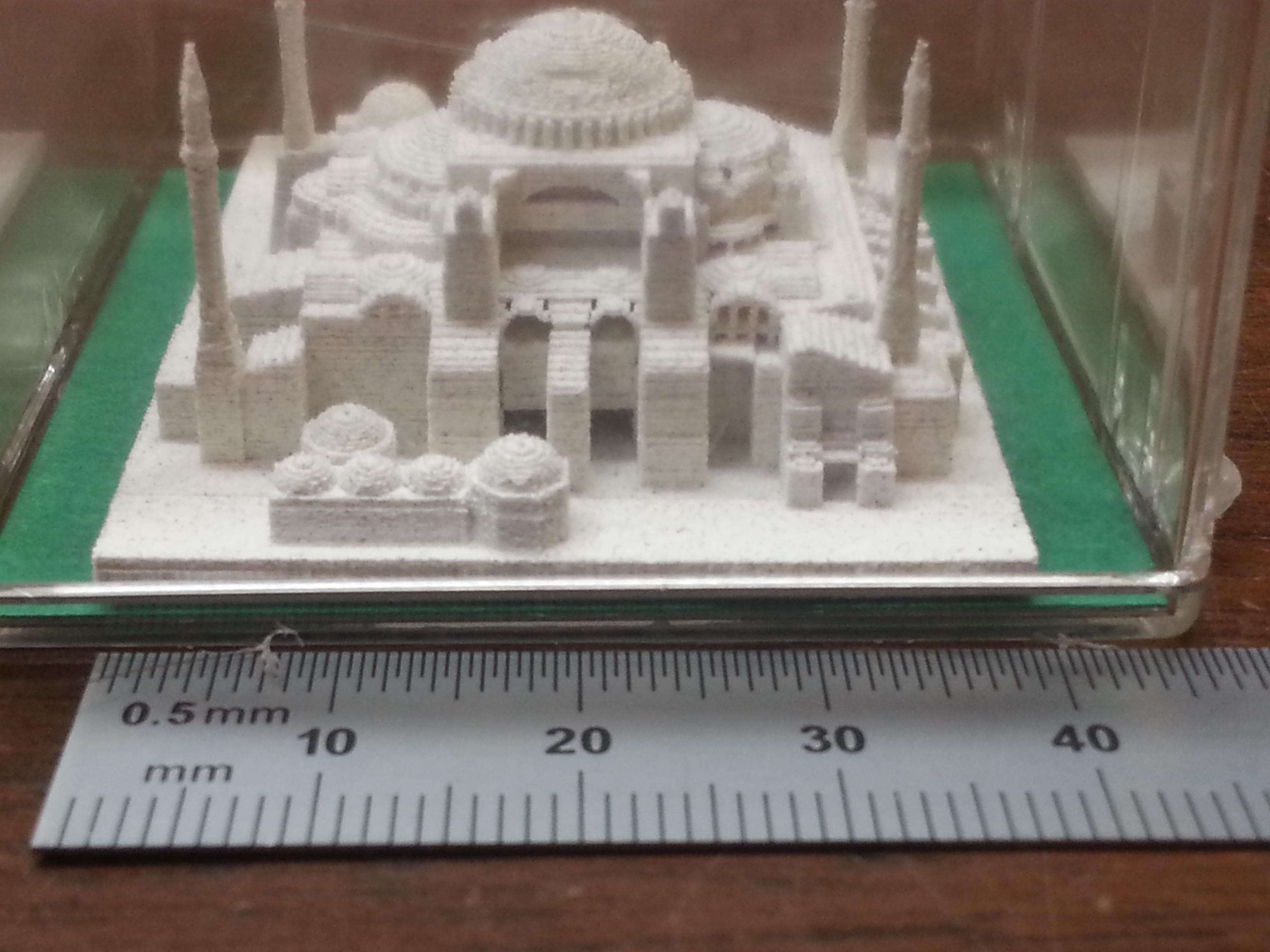
Serdy told Gunn, that only a very few number of prints like this were done at MIT, and even fewer remain in existence today. The piece, which you can see by the images we have provided, is rather detailed for its size, especially considering the date it was printed. With that said, it also shows how much the technology has progressed in the last two decades.
As for the STL file for this print. When asked if he still had it, Serdy mused that he probably does still have a floppy disk somewhere, but the disk itself would be approximately 20 years old.
Let’s hear your thoughts on this amazing piece of 3D printing history within the historic 3D prints forum thread on 3DPB.com.
Subscribe to Our Email Newsletter
Stay up-to-date on all the latest news from the 3D printing industry and receive information and offers from third party vendors.
You May Also Like
Precision at the Microscale: UK Researchers Advance Medical Devices with BMF’s 3D Printing Tech
University of Nottingham researchers are using Boston Micro Fabrication‘s (BMF) 3D printing technology to develop medical devices that improve compatibility with human tissue. Funded by a UK grant, this project...
3D Printing Webinar and Event Roundup: April 21, 2024
It’s another busy week of webinars and events, starting with Hannover Messe in Germany and continuing with Metalcasting Congress, Chinaplas, TechBlick’s Innovation Festival, and more. Stratasys continues its advanced training...
3D Printing Webinar and Event Roundup: March 17, 2024
It’s another busy week of webinars and events, including SALMED 2024 and AM Forum in Berlin. Stratasys continues its in-person training and is offering two webinars, ASTM is holding a...
3D Printed Micro Antenna is 15% Smaller and 6X Lighter
Horizon Microtechnologies has achieved success in creating a high-frequency D-Band horn antenna through micro 3D printing. However, this achievement did not rely solely on 3D printing; it involved a combination...