3D Printed Device, My Driving Pal, Tracks and Monitors Everything from Kids to Cars

Web-based 3D printing service, Sculpteo, reported on one enterprising member of the innovative maker community that capitalized on the capacity of 3D printing to make rapid prototyping of 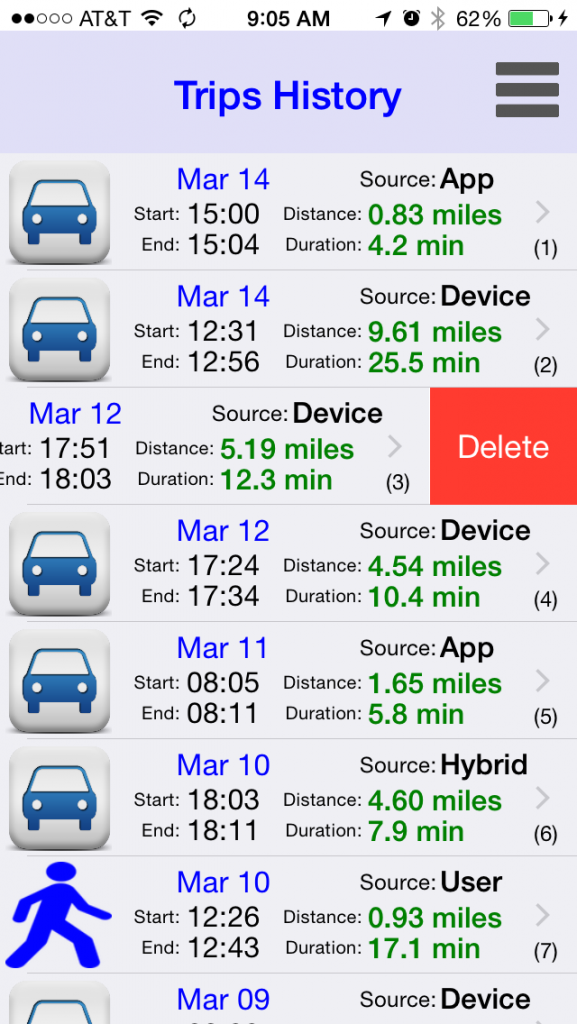 new products affordable. Shahram Rezaei has created a multi-purpose device-app called My Driving Pal (MDP). It features a suite of tracking, monitoring and securing applications. MDP can be used to track anything from a child or pet to a bike or car. The device, which is connected to any object a user wishes to track, is housed in a 3D-printed case.
The MDP device and app communicate with each other through Bluetooth Low Energy (BLE), a wireless personal area network technology that’s ideal for a variety of uses from security, fitness, and health care to home entertainment. In the case of the MDP device, it’s the BLE beacon function that is most applicable. BLE, marketed as Bluetooth Smart, provides reduced cost and power consumption while still maintaining a similar communication range as standard Bluetooth.
When the MDP device and the smartphone to which it is linked are within the maximum range of 15 meters (just under 50 feet) of one another, the MDP tracks the “asset” (whatever or whomever you’ve connected the device to), and the device goes into idle mode. The tracking data remains on the smartphone and is not transmitted to the MDP server. However, once the phone is out of range of the device, and whatever person or thing is carrying the object is moving, the MDP’s built-in GNSS (GPS) receiver and cellular modem kick in. The user gets a push notification that the device is on the move.
The little gadget is housed in a 3D printed casing. Initially Rezaei and his development team considered using the injection molding process to manufacture their prototypes. They soon realized, however, that the cost to prototype, well before full-scale manufacturing would even take place, was far too expensive. As a software developer, Rezaei was more familiar with the app side of the MDP development process, but a friend in the know told him about 3D printing and, specifically, the services provided by Sculpteo. Additive manufacturing, Rezaei realized, could facilitate an inexpensive, rapid prototyping process.
Rezaei wanted to be able to offer customers the option of customizing their MDPs, including choosing from a range of colors and choices about sizing. Sculpteo’s rapid prototyping process made it possible–and affordable–for them to create 3D-printed examples in 11 different colors to provide customers with visuals.

If you’re using a traditional prototyping method like injection molding, unless you have a pretty healthy budget–and the majority of start-ups simply do not–then you can’t afford to go through the invaluable process of creating a series of iterations of a product as you work out the kinks. As they progressed through the experimentation/prototyping phase, for instance, Rezaei and his team found that one iteration of the case for the device was loose. They made the necessary adjustments in the 3D model and moved forward.
One of the benefits of the MDP Device-App, says Rezaei, is its capacity to monitor the temperature of the interior of a motor vehicle when, say, a child or pet are inside. The device has a built-in 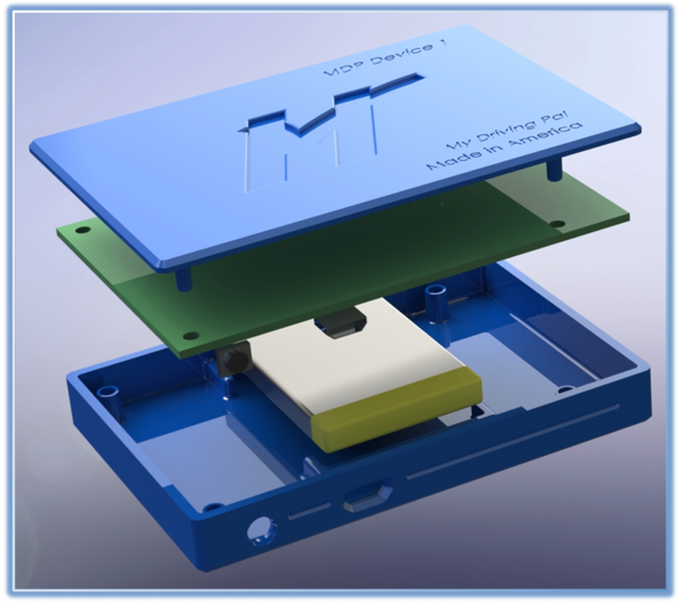 temperature sensor as well as a sound detection sensor. If conditions in the vehicle are approaching a level that would put occupants at risk, the user is notified by the app on their smartphone to take action. While it probably goes without saying that such a feature could indeed prevent a clearly avoidable tragedy, we’re just going to go ahead and say that leaving either a child or a pet unattended in a vehicle is not a good idea to begin with–with the former, with children, it’s almost certainly illegal.
That said, there are multiple other ideal uses for the MDP system such as tracking a stolen car or bicycle, monitoring the whereabouts of pets and children and also, for instance, elderly family members who may be suffering from Alzheimer’s Disease or dementia and are thus in danger of wandering off. Besides the many possible uses of MDP in monitoring and tracking, the device can also be helpful in monitoring and recording distances if you’re going on a road trip, biking or running. In short, the applications for this application are potentially quite diverse.
The MDP is currently in its final development phase and Rezaei has launched a Kickstarter campaign to help raise money for that final push. He and his team hope to begin shipping MDPs to customers in November of 2015.
Let us know your thoughts on Rezaei’s use of 3D printing for the creation of this device. Discuss in the My Driving Pal forum thread on 3DPB.com.
Subscribe to Our Email Newsletter
Stay up-to-date on all the latest news from the 3D printing industry and receive information and offers from third party vendors.
Print Services
Upload your 3D Models and get them printed quickly and efficiently.











You May Also Like
Waiting Has a Cost: the True Value of Additive Manufacturing
One of my favorite expressions is “Hurry up and wait,” because it perfectly captures one of my least favorite scenarios to have to live through. You rush to get ready...
Stratasys Partners With Defense Prime Heavyweights to Qualify SAF PA12 for Industrial 3D Printing
Perhaps the most valuable lesson that the additive manufacturing (AM) industry has learned in its technical maturation era over the last five years or so is that you can’t really...
Suppressor Resilience: A Billion Dollar AM Market Opportunity
Across the United States, thousands of entrepreneurs are flocking to the suppressor opportunity. Whereas previously suppressors were something for special forces and movies, now they’re in demand with gun enthusiasts,...
Via EOS Partnership, Texas’s ACMI Is the First Customer for the AMCM M 8K 3D Printer
EOS’s two major announcements in the last few months have been the launch of the EOS M4 ONYX at Formnext 2025 and the news from a couple of weeks ago...