Woman Creates a 3D Printed Hand-cranked Record Player

 Record players were first introduced back in the late 19th century, in order record and reproduce sounds, and while these machines are no longer used very much today, the technology lives on and remains quite the clever invention. The same man that invented the light bulb, Thomas Edison, is also the inventor of the first phonograph (record player). Edison’s machine recorded sound onto a tinfoil sheet phonograph cylinder. Since then the phonograph evolved to play round plate-like discs using grooves that are engraved into its surface.
Today, while records are no longer the preferred method of reproducing sound, as they have been replaced by much higher quality, more reliable digital forms of reproduction, there are still hobbyist and antique collectors who love to listen to their music on the old-fashioned record.
With the advent of 3D printing, there have been some individuals who have taken the modern technology of additive manufacturing and used it to recreate a bit of our past. Back in July, we covered a story on a record that was 3D printed on a Stratasys Objet 500 Connex 3D printer. The sound quality came out quite nicely, although due to the resin it was made with, it was not very useable on typical record players.
 So, a record could be 3D printed, as long as the 3D printer used was of high enough quality to recreate the tiny grooves which are required on its surface. Could the same be said for recreating a working record player though?
One woman from New Zealand, named Oana Croitoru, decided to find out, with her entry into the MakerBot Ghostly Vinyl Challenge. The challenge which asked designers to use vinyl records and turntables as a starting point to design novel objects that would delight record collectors, music lovers and audiophiles, runs until the end of this month, and Croitoru, with her design, has as good of a shot as any to win.
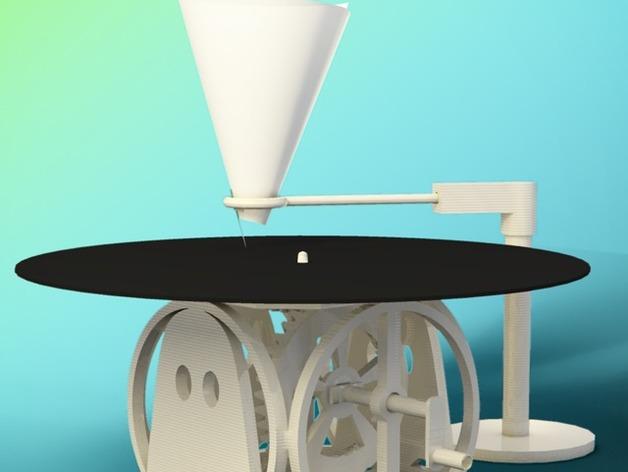
Croitoru decided to design a Hand Cranked Vinyl Player, which is a uniquely designed 3D printed device which can play records by hand.
“All pieces for [the] record player are neatly aligned and designed to fit in a 15x15x15cm cube, and print beautifully on the Replicator 2, without any rafting or supports,” Croitoru wrong. “Once all the pieces are printed, it assembles in about 5 minutes. Then you just add a little glue to make sure nothing flies of as it spins and you’re ready to go.”
In addition to the 3D printed parts and glue, the device also requires a needle for the amplifier, some tape, and a piece of paper. Croitoru’s “deluxe edition” can be created using some small felt squares that are glued to the top of the player, reducing friction, scratching and noise.
The record player is able to play all sorts of records, although Croitoru recommends using 78rpm versions, as others will require a slower crank speed, one which would be very difficult to control. In the video below you can see a demonstration of her device. While the sound quality leaves a lot to be desired, she explains that the version shown in the video is not the latest version currently available on Thingiverse. The latest version should sound quite a bit better.
There are six separate STL files currently available to download on Thingiverse. What do you think? Have you tried 3D printing this record player? How did it sounds? Discuss in the 3D Printed Record Player forum thread on 3DPB.com.
Subscribe to Our Email Newsletter
Stay up-to-date on all the latest news from the 3D printing industry and receive information and offers from third party vendors.
Print Services
Upload your 3D Models and get them printed quickly and efficiently.











You May Also Like
BigRep Launches ONE.5X 3D Printer, Announces New Massive Dimension Partnership at RAPID + TCT 2026
As the whole world is starting to realize, the Hormuz supply chain fallout is only just beginning to filter into the global economy, and the rising cost of plastics should...
3D Printing’s Chicken-and-Egg Problem: No Demand Without Scale, No Scale Without Demand
There’s a simple problem at the center of the 3D printing industry, and it hasn’t really gone away. Companies say they will invest in additive manufacturing when there is steady...
Orano Federal Services & UNC Charlotte Show How AM Could Cut Costs in Nuclear Energy Resurgence
Outside of the defense sector, few industries have been impacted by Russia’s ongoing occupation of Ukraine more than nuclear energy. The same appears to already be happening in response to...
EOS to Spotlight AI, Robotics, and Industrial Tooling at Hannover Messe
The US-Israel war on Iran is already catalyzing the sorts of major shifts to global supply chains that will effectively amount to permanent economic changes. In this context, the nations...