It’s Formnext 2026 in Frankfurt this week, and we’re continuing to bring you the biggest news from the show floor, from new printers and services to post-processing and more. In this roundup, we’ll share some of the latest additive manufacturing (AM) software news from Formnext.
Dyndrite & Xact Metal
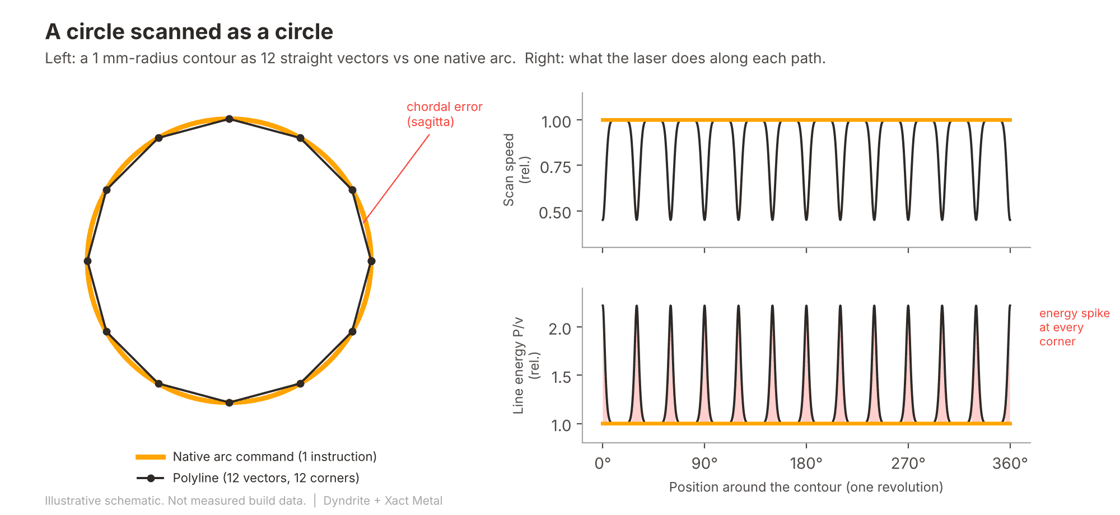
First, Dyndrite and Xact Metal announced what they call the “world’s first truly available full G-code toolpath integration” for laser powder bed fusion (LPBF) 3D printing OEMs. As such, Xact Metal has opened up full-level control access to its printers’ scanning systems, which enables Dyndrite’s LPBF Pro software to directly command native arcs and other scan orders. LPBF toolpaths reduce every curve into a chain of short, straight chords, and each one of these adds geometric errors. Scan mirrors are forced to slow down at every corner, and it takes about 222 straight-line vectors to maintain 1 µm accuracy on a 10 mm-radius circle. But, that goes down to only one vector with a native arc, which is what Dyndrite can now offer by integrating G-code toolpaths into Xact Metal printers. This will give users advanced toolpath control, including more laser commands (pulsing, dynamic set point, for example), delay settings, and moves that aren’t just linear, like Bezier curves and arcs. The benefits include reduced porosity and defects, less wear and tear on the optical subsystem, improved surface finish, reduced file size and print times, and the ability to print applications that were previously “unweldable” in LPBF technology.
“For over nine years, my team and I have worked with OEMs to open their systems. Since Juan Mario and his team introduced Xact Metal’s first printer, they have consistently expressed to me their desire to do exactly that,” said Dyndrite’s Founder and CEO Harshil Goel.
“I’ve been a fan of Dyndrite for many years, and I couldn’t be more excited to open our platform to Harshil and his team. Since introducing our first printer, we’ve wanted to give customers complete freedom over how they program their builds and not be restricted by the systems we control. The partnership gives Dyndrite LPBF Pro complete control over the Xact Metal print platform, allowing customers to produce build files with unprecedented freedom in every aspect of the toolpath to improve part quality and get the most value from their investment,” said Juan Mario Gomez, CEO of Xact Metal.
Native arc and full scan-command toolpathing is available through Dyndrite LPBF Pro for the Xact Metal XM200G and XM200G µHD, with the XM300G to follow later. Learn more at Xact Metal Booth C89, Hall 12.0.
Fives AddUp & Dyndrite
Speaking of Dyndrite, Fives AddUp, a Fives Group subsidiary specializing in metal 3D printing, is also partnering with the digital manufacturing software company. As such, the FormUp machine range will be integrated into the Dyndrite LPBF Pro build preparation software. Currently under development, the build processor will make it possible for users to generate build files directly in LPBF Pro for the FormUp 350; compatibility will be extended once the large-format FormUp 750 is launched next year. Dyndrite LPBF Pro lets users generate supports, position parts for printing, adjust laser melting strategies, automate build prep tasks, and general build files. Through this integration partnership, FormUp users will be able to choose between Dyndrite LPBF Pro or AddUp’s existing software suite, depending on their requirements. Users will keep control over the instructions sent to the printer, so they can adjust what they need. This is the first time that Fives AddUp has given users the ability to use a file generated outside its software suite for printing on a FormUp system.
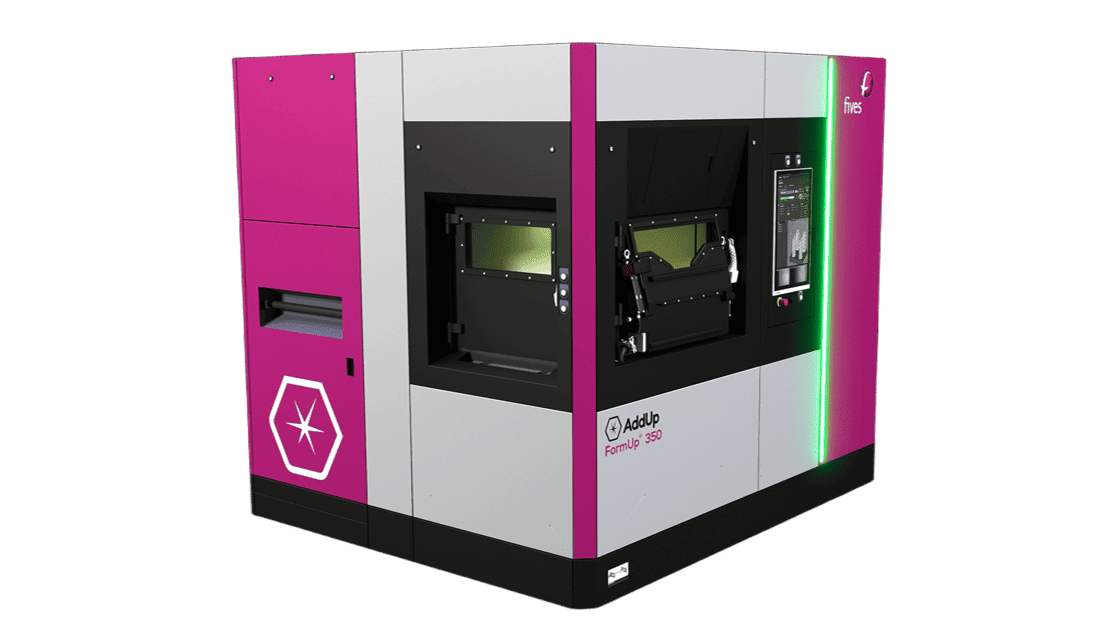
FormUp 350
“This collaboration with Dyndrite addresses the expectations of manufacturers in critical industries that want to simplify their digital workflow without compromising process control. Integrating AddUp FormUp machines into LPBF Pro will provide a new way to optimize parameters, automate build preparation and compare machine performance on a common basis,” said Jérôme Dubois, Technical and Innovation Director, Fives AddUp.
You can learn more at the Fives AddUp Booth D32, Hall 11.0.
Fives AddUP & ADAXIS
Fives AddUp also announced a strategic partnership with ADAXIS to speed up industrialization of laser powder Directed Energy Deposition (DED). ADAXIS has expertise in programming, manufacturing supervision, and multiphysics simulation, and developed AdaOne multi-axis AM software. The partnership will give manufacturers a new software solution for programming DED operations, as it will allow users of Fives AddUp’s BeAM 400 and BeAM 800 machines to prepare operations, simulate machine movements, generate multi-axis toolpaths, and create programs within the AdaOne environment. The overarching goal is to make DED easier to implement and more integrated by enhancing connectivity between software and printers. This new software environment for the BeAM systems will give users a high level of control over toolpaths and manufacturing quality, but more flexibility in choosing digital tools. Additionally, the companies will develop a joint roadmap that focuses on integrating “physical phenomena” specific to laser powder DED-LB/P, like variations in laser powder and powder flow rates, into AdaOne.
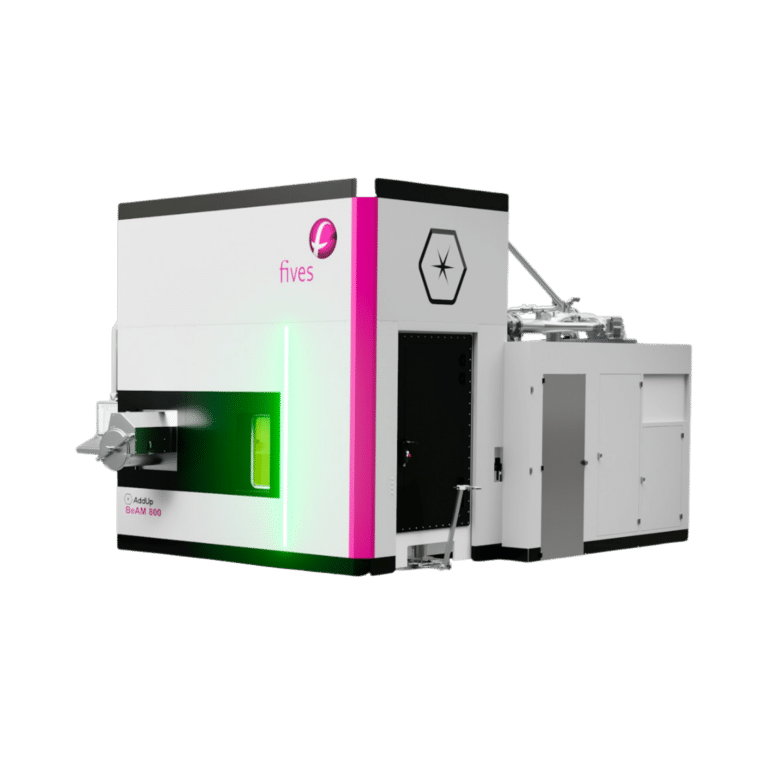
BeAM 800
“The challenge of DED is no longer simply to generate toolpaths, but to control what actually happens during deposition. By combining AddUp’s process knowledge with AdaOne’s digital capabilities, we aim to advance programming, simulation and the use of machine data,” said Guénolé Bras, Chief Technology Officer, ADAXIS. “This practical collaboration between two French areas of expertise helps make DED technology more integrated and more accessible to manufacturers.”
You can visit ADAXIS at Booth D79, Hall 12.1.
Euler
Euler, which Executive Editor Joris Peels said was his favorite software at Formnext 2024, is software-only quality control monitoring for metal LPBF printing. it analyzes the layer photos that a 3D printer’s own camera already takes, and uses the images as early warnings of defects, while a part is still printing. That means no added sensors to install or machine qualifications to undergo: just analysis software that can supposedly be set up in less than 10 minutes. A metal LPBF camera typically photographs each layer after fresh powder is spread, and again after the laser passes. Euler Connect instantly streams the photos to deep-learning AI models, which check each image, marking defects like spatter, warpage, and streaking. By following how defects develop in previous layers, problems are flagged early to avoid defects; critical findings are sent straight to the team. You can also see the whole build in 3D, built from the layer photos, and each finished build gets an automatic report for QA.
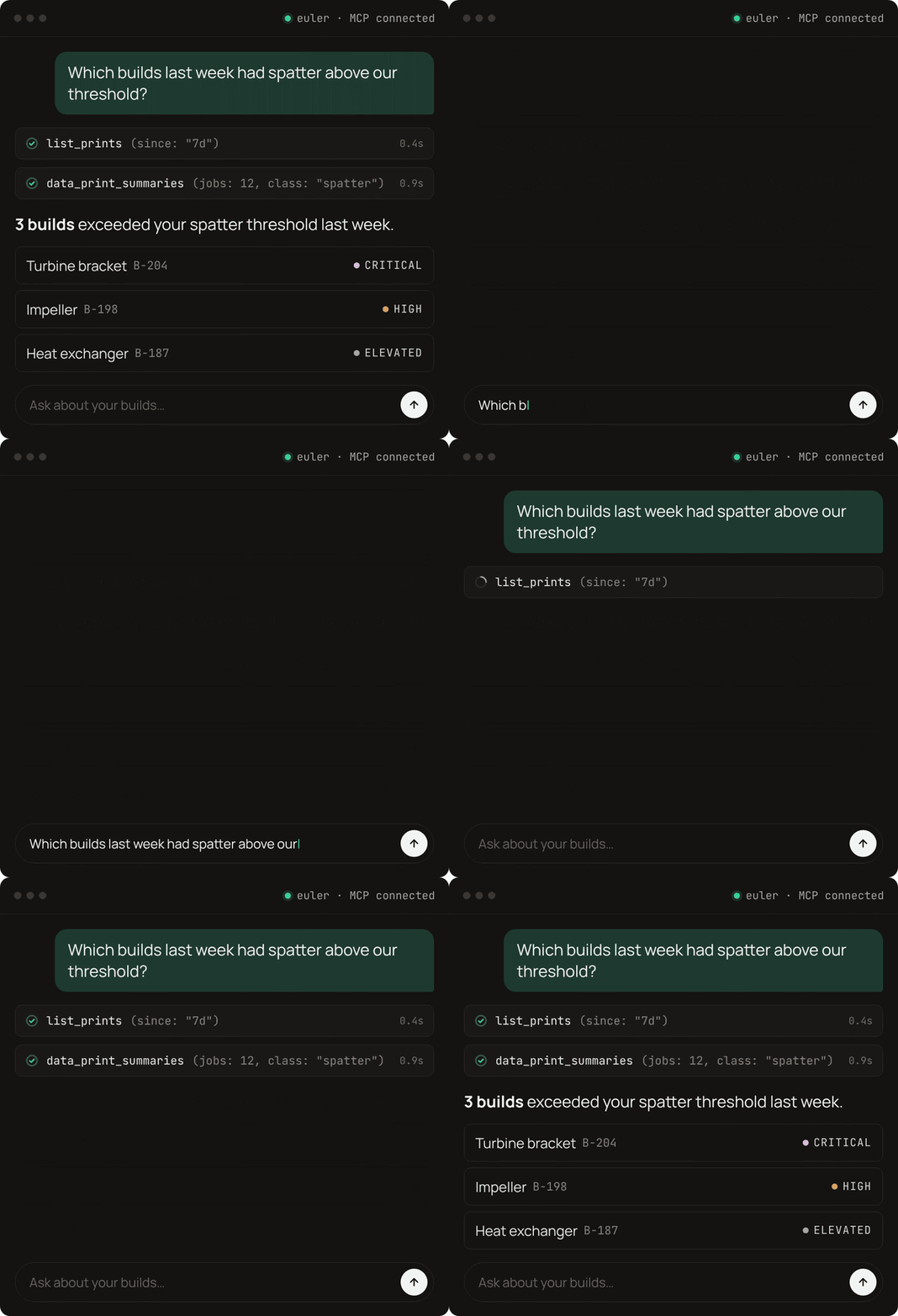
It already sounds pretty interesting, and the team is showing several new features at Formnext this week. First, the startup announced Euler MCP (Model Context Protocol), which connects everything to AI assistants like ChatGPT and Claude so you can ask questions about your builds, defects, and printers. Your chosen assistant opens the print at the correct layer, and for security purposes, is read-only, with admins deciding who should get access. Build alerts spotted in the photos are sent straight to Slack and Microsoft Teams. Additionally, a 3D viewer allows users to walk through sample builds layer by layer. Euler builds a see-through 3D model and heatmap of each print using the machine’s exposure images, so you don’t have to share any CAD designs. You can move it around, see where the defects are inside the part, and even leave a comment on the important layers. Finally, you can choose a batch of prints, and Euler’s analysis tools will tell you which one doesn’t fit, and which defect is the issue.
Visit Euler at Booth A32, Hall 11.0, to learn more, and even try out some of the new features!
Metamorphic AM & Voxshell
Metamorphic AM will be demonstrating a broader vision for Design for Additive Manufacturing (DfAM), showing how organizations can engage with advanced DfAM at different levels with the help of engineering, geometry, and simulation. In addition to its existing Rapid Geometry Review and engineering consultancy services, Metamorphic has a new Rhino 8/Grasshopper plugin and computational design platform, Morphé. It helps keep advanced geometry connected to the data, design logic, print parameters, and optimization from which it was generated, and offers implicit modeling, voxel processing, and vector-field-driven geometry. Metamorphic is exhibiting alongside Voxshell, which creates automated meshing technology for CFD and FEA. Its ChopMesh platform works to quickly convert complex geometry into volumetric meshes ready for simulation. At Formnext, the two will showcase a new Morphé-to-ChopMesh workflow demonstrator. Morphé now supports direct OpenVDB (.VDB) exports, which means that geometry generated within Grasshopper can move right into ChopMesh to be converted into volumetric CFD and FEA meshes. This negates intermediate STL file repair and too much manual cleanup, and enables a more connected workflow.
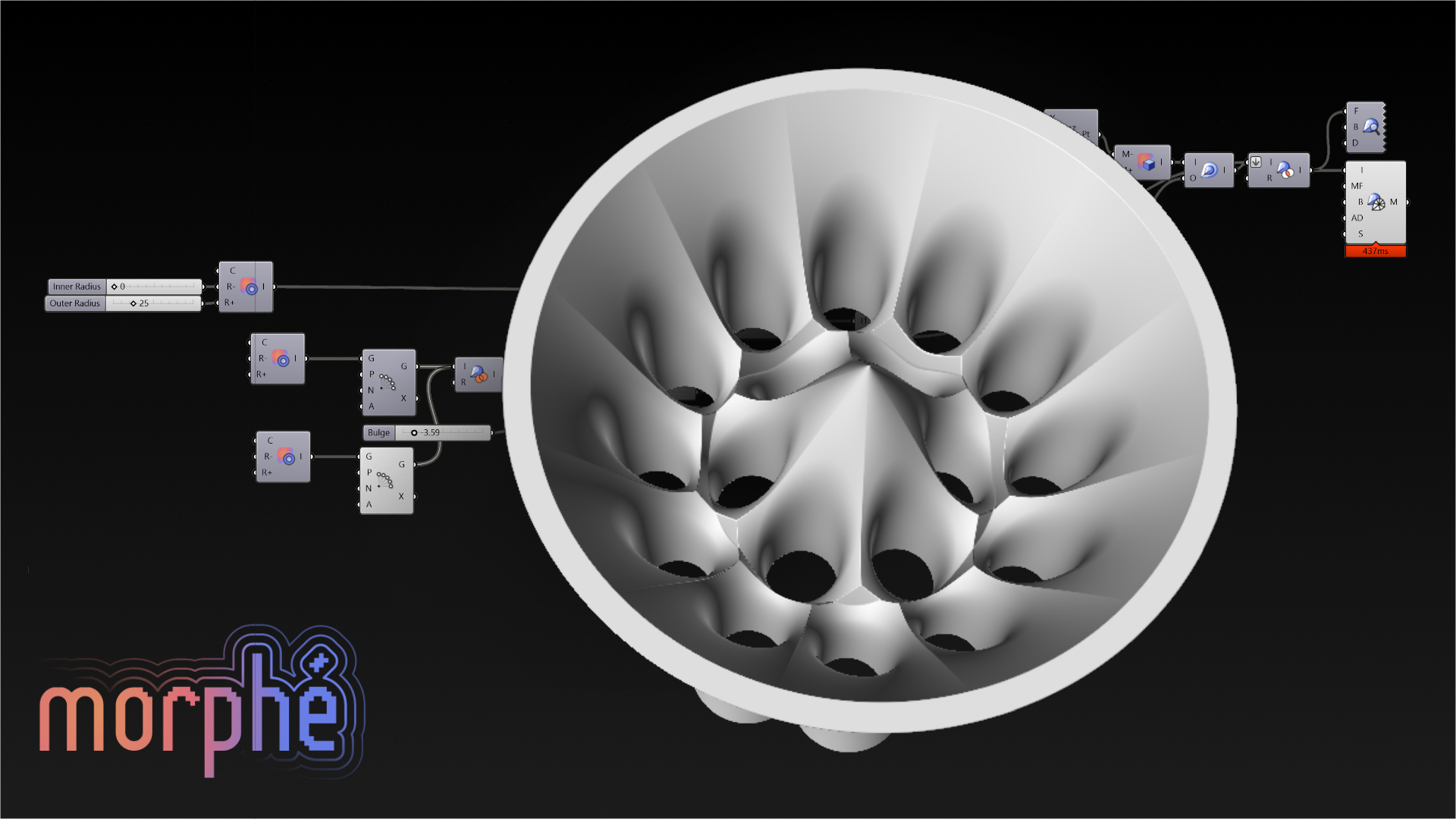
“The connection with Voxshell is particularly exciting because it demonstrates where these workflows should be heading,” explained Manolis Papastavrou, Co-Founder and Computational Design Lead, Metamorphic AM. “Creating advanced geometry is only valuable if engineers can analyse and iterate it efficiently. Moving directly from Morphé into ChopMesh brings geometry generation and simulation preparation much closer together.”
You can visit both Metamorphic AM and Voxshell at Booth E76, Hall 12.1.
Phase3D
Finally, Phase3D is introducing User Profiles in Fringe Operator, which can help create a foundation for automated responses. These profiles are customizable, saved inspection configurations, which combine selected use cases, thresholds, measurements, and alerts for a specific AM application. In order to scale metal AM in critical industries, you need measured specifications for QA, and Phase3D’s in-situ inspection capabilities already give manufacturers a solid basis for evaluating build conditions. But User Profiles bring these measurements into application-specific workflows, so manufacturing teams can define acceptable conditions, find deviations, and set up criteria to inform automated printing. Phase3D is offering teams a repeatable framework for taking calibrated inspection data and measurements and turning them into actionable criteria for quality; the result is hopefully lower qualification costs. Teams using these profiles can define the criteria that identify both conditions that need engineering review, and deviations that require more urgent action.
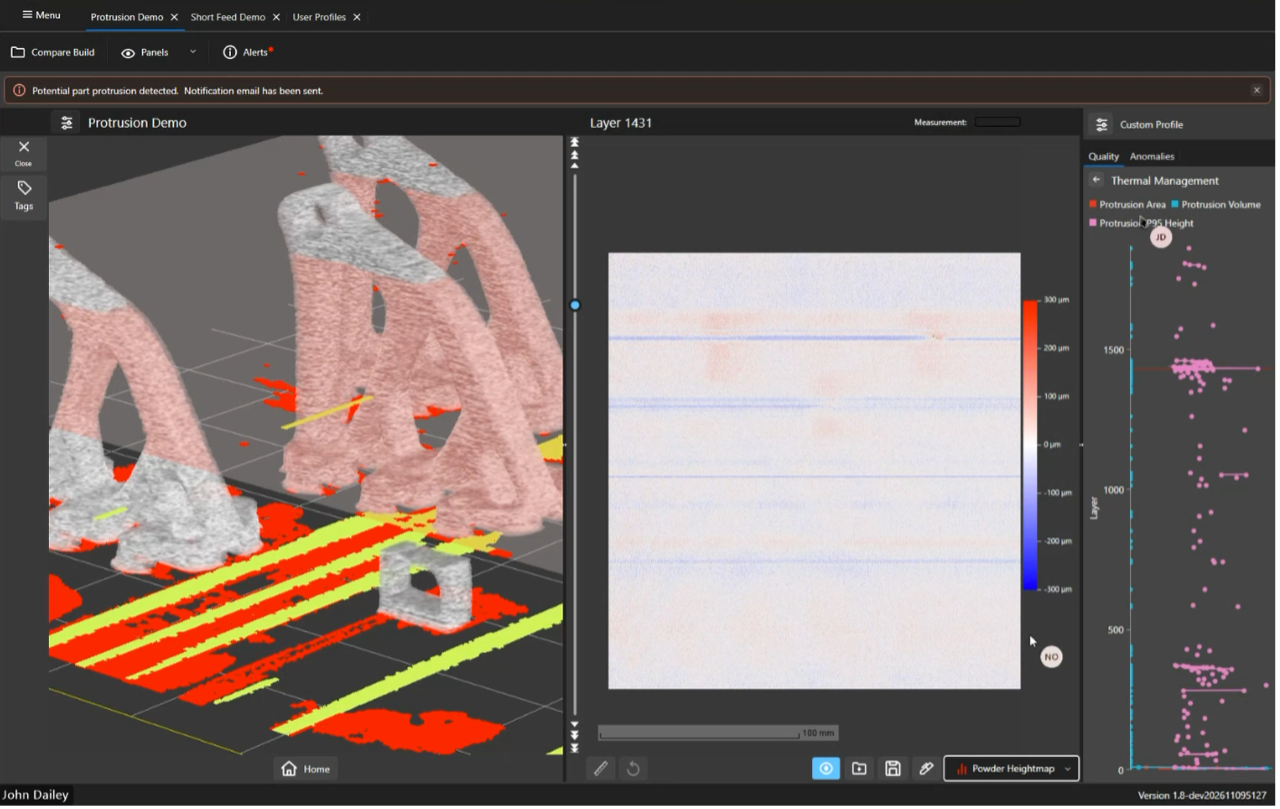
Fringe Operator displays a 3D build visualization, layer heightmap, and quality charts tracking protrusion area, volume, and height to support thermal management monitoring.
“The knowledge gained during development needs to carry through to production. User Profiles let teams set limits for their process, refine them as they learn, and apply those same limits automatically across their fleet. That consistency helps teams build on previous qualification work and focus testing where it’s needed most,” explained Niall O’Dowd, PhD, CEO and Founder at Phase3D.
Learn more at Phase3D’s Booth A56, Hall 11.0.