
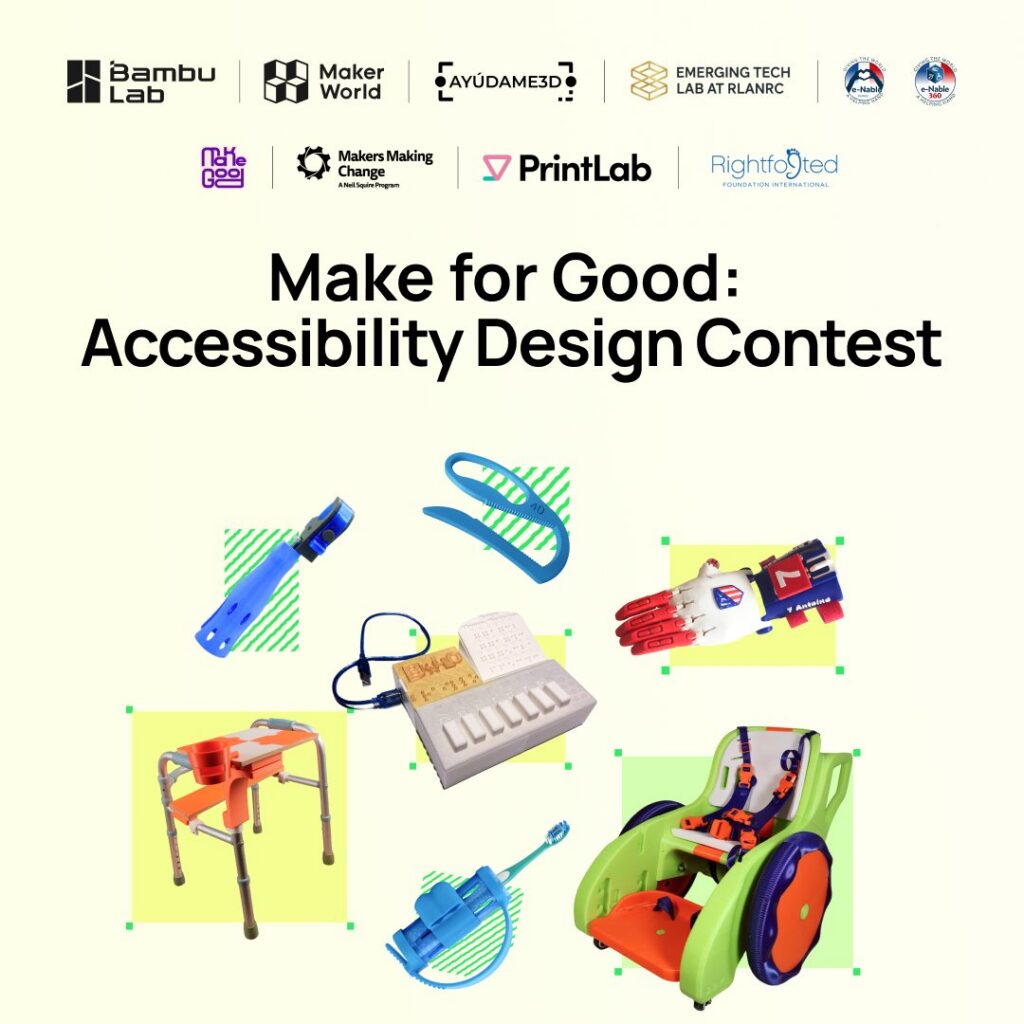
In 2023, Chinese 3D printer OEM Bambu Lab launched MakerWorld, its collaborative 3D model platform. By early 2026, the platform had about 10 million monthly active users and started to expand its role beyond just a model-sharing website. This month, Bambu partnered with seven top accessibility organizations that use 3D printing to launch a global design challenge on MakerWorld.
The Make for Good: Accessibility Design Contest runs through December of 2026, and asks makers to invent real 3D printed accessibility aids based on 24 specific design briefs.
“Everyone deserves tools that make everyday life a little easier,” the contest page states.
“This contest invites you to turn real accessibility needs into practical, printable solutions.”
For years, we’ve seen people turn to 3D printing to create custom assistive devices and aids for people with disabilities, making it easier for them to do everything from using a knife and eating to holding a kayak paddle and even playing video games. Now, MakerWorld is putting the call out to its massive community of designers around the world to create helpful objects for those with disabilities that solve real everyday needs.

PrintLab example lessons
Each of Bambu Lab’s seven challenge partners contributed design briefs born out of work with real disabled users. Each brief describes the context, the target users, and the design goal for the requested device, the current solutions, where and how the device will be used, any necessary requirements, and user preferences. They include a foot-operated bike helmet buckle aid, an adaptive car key turner, a toe-operated toothpaste squeezer, a customizable wheelchair storage system, and more.
Since 2017, Spanish Ayúdame3D has delivered 3D printed assistive devices, or trésdesis (“threeDsis”), to over 1,000 people in more than 70 countries. For this challenge, the nonprofit has requested a tool for tying a ponytail with one hand, and a toothbrush that does not have to be pinched between your fingers to hold. E-Nable France, part of the global E-Nable community, is asking makers to develop a one-handed kitchen toolkit that can be used for independent cooking. U.S nonprofit MakeGood delivers free, custom assistive technology for people with disabilities, like its Toddler Mobility Trainer. Its request for this design challenge is a pickleball paddle holder for people with weakened hand-arm musculature.
Online platform PrintLab offers courses, tools, and certifications in 3D CAD and 3D printing, and created the Make:able Challenge, its own assistive technology design challenge. For the MakerWorld challenge, UK-based PrintLab is asking participants to create a tabletop game that a young cerebral palsy patient can play with their friends. Makers Making Change, a program of Canadian nonprofit Neil Squire Society, connects volunteer makers with disabled people in need of assistive technology. They’re asking for multiple assistive devices in this challenge: a guitar pick that stays in place with limited grip, a knitting needle support for stroke patients, and a one-handed marker-cap aid.
The Emerging Tech Lab (ETL) at Rancho Los Amigos National Rehabilitation Center in California is an innovation hub. The ETL works with rehabilitation professionals and people with disabilities to make practical assistive devices, like reaching tools that don’t require a handle to be squeezed, using 3D printing and other digital fabrication methods. U.S. nonprofit Rightfooted Foundation International (RFI) supports people without arms, as well as their families, focusing on practical tools, building skills, education, mentoring, and advocacy. It was founded by Jessica Cox, who was born without arms and uses her feet for daily tasks, though some are more difficult with others. For instance, she can pull on one sock with a bare foot, but then she’s lost the friction needed to get the second sock over her heel. Cox also uses a disposable scoop to clean up her service dog’s waste, but can only carry it by holding the bag under her chin. RFI has requested aids for both of these challenges, and then some.
“These are not hypothetical users. Jessica already walks her dog. Someone in a ward at Rancho already drops something and has to ask a stranger to pick it up,” said Qianye, Creator Operation at MakerWorld. “The question for makers is very small and very specific: can you print the missing piece so that person does not have to ask?”
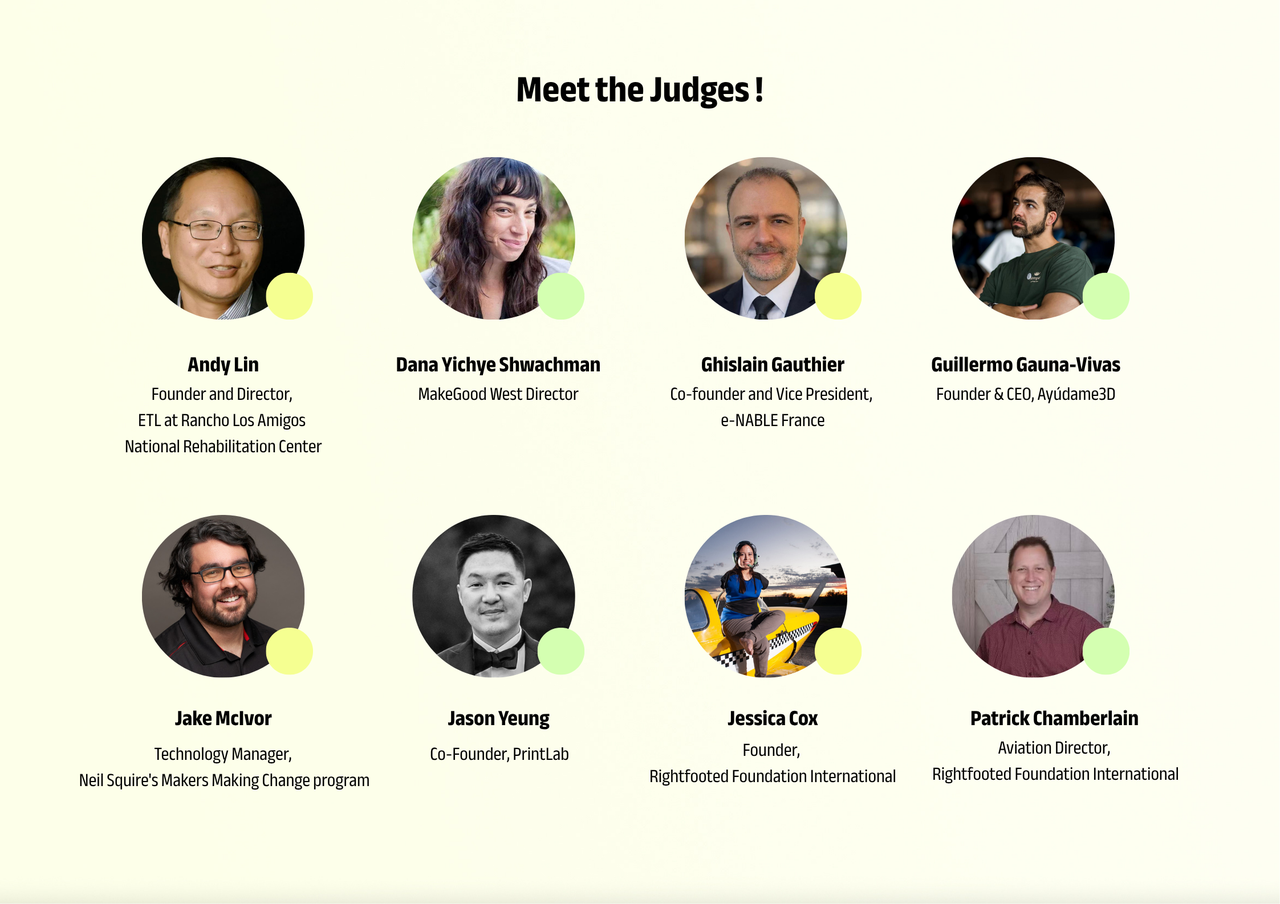
By hosting the 3D printed assistive device challenge on MakerWorld, a larger community of skilled creators is likely to participate. It also fosters empathy and understanding of the barriers people with disabilities are faced with everyday. All entries must be submitted by November 15th UTC, and judges from the participating organizations will spend a month printing models on the shortlist and having users test them. Feedback from these testing sessions will inform the winners.
The organizations will all promote the challenge in their home countries, and offer assistance in other ways. For instance, Ayúdame3D will send some of the winning devices to communities around the globe, including Africa, and RFI will do the same. The ETL is helping to ensure that the designs reflect the everyday environments, lived experiences, interests, and goals of the people the devices are supposed to help. PrintLab provided a Challenge Toolkit that was originally used to support student participants in its Make:able Challenge, and Makers Making Change shared its OpenAT Design Guide and OpenAT Templates.
This contest is meant to help people, not whittle down the competitors until the last elite is standing. There will be 618 winners, and all of the winning files will be added to open design libraries and distributed through established volunteer networks. 14 people will win the UGC Award (Social Media and MW Community) of 100 MakerWorld (MW) points, and 80 people will get 500 MW points as Shortlist Award winners. 500 people will win Make For Good Recognition and a MakerWorld Achievements Badge. There will be 24 Grand Prize Winners—one for each design brief—who will receive a Bambu Lab A1 Combo 3D printer.
All of these are problems that non-disabled people never have to think about, but for those with disabilities, these everyday tasks can require an extraordinary amount of effort. The Make for Good Challenge just wants to make life a little easier for them.