
The bar for metal additive manufacturing has moved. Early on, the question was often simple: Can the machine print the material and produce a dense part? That still matters, but it is no longer enough.
You can see this across metal AM. Laser powder bed fusion continues to advance quickly. More lasers, higher power, beam shaping, larger machines, better monitoring, and increased automation are pushing L-PBF further into production. Recent major events like Formnext, TCT Asia, AMUG, and RAPID + TCT have shown how quickly the laser side is scaling.
The most visible example is China. Eplus3D announced the EP-M3050 metal AM system with a build volume over three meters in X and Y and up to 256 lasers. This is an extreme example, but it shows where L-PBF is heading: scale, parallelization, automation, and cost reduction.
This progress deserves respect. L-PBF has the largest installed base, the broadest ecosystem, and the strongest production momentum in metal AM. It also shapes how many people view metal AM. Productivity discussions often focus on laser count, build rate, surface finish, machine utilization, and established material portfolios. That is understandable. The leading process becomes the way people think about the field as a whole.
The risk is that other processes are judged by laser-based assumptions.
EB-PBF often falls into this trap. It is often framed in terms of old references: electron beam versus laser, vacuum versus inert gas, hot build versus cold build, rougher surfaces versus smoother surfaces. These comparisons are familiar, but they also miss a more interesting question: what happens when the electron beam becomes a more precise manufacturing tool?
From melting to control
EB-PBF is not simply a laser process with a different heat source. It combines vacuum, elevated powder bed temperature, electromagnetic beam deflection, rapid beam movement, charge management, thermal history, and electron-material interaction. Together, these conditions create a different physical regime from L-PBF.
The difference matters most when the application is driven by material behavior, qualification confidence, or thermal control.
Beam control means more than moving the beam from one coordinate to another. It includes where energy is applied, how quickly it is applied, how the beam is focused, how heat accumulates, how exposure is sequenced, how preheating and melting interact, and how often the machine repeats the same strategy.
For metallurgists, these are not secondary settings. Beam dwell time, scan speed, focus, sequence, and local energy density affect melt pool shape, temperature gradients, cooling rate, and reheating. Those factors influence grain growth, residual stress, cracking sensitivity, and final properties.
For EB-PBF, this is the more interesting discussion.
The old view of EB-PBF focused on process attributes: vacuum, heat, surface finish, and materials. The stronger view is about process control. In mature EB-PBF, the beam becomes a tool for thermal strategy.
Point melting is a signal
One clear signal is the growing interest among several EB-PBF suppliers in various forms of point-based exposure strategies. Electromagnetic beam deflection enables very high scan and jump speeds, which makes these strategies possible.
Colibrium Additive reports that EBM Point Melt melts powder through small spots rather than conventional lines. The company connects the method to more accurate temperature control, reduced temperature gradients, reduced sintering needs, improved surface quality, and simpler support structures.
Similar ideas appear in work by Freemelt, ProBeam, and others. More importantly, EB-PBF is moving from conventional scan paths toward programmable beam logic.
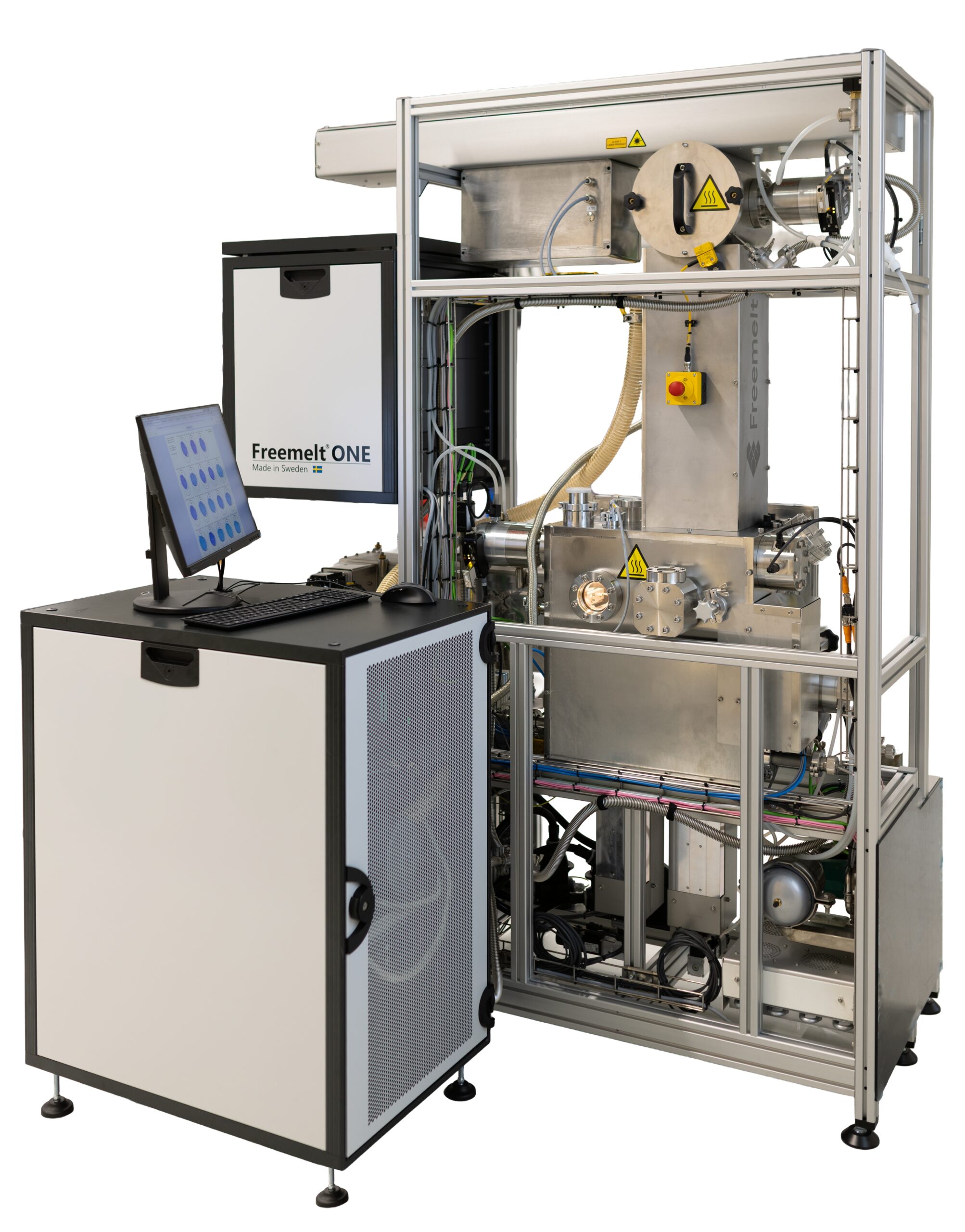

A hatch strategy treats the beam path mainly as a route across a layer. Point-based exposure makes the timing, position, and sequence of energy input more central. Heat can be distributed differently. Local thermal gradients can be managed differently. The exposure strategy becomes part of the metallurgy.
Research has pointed in this direction for years. Some early ideas emerged before scan speeds and machine capabilities made practical implementation realistic. Work on Alloy 718 has shown that EB-PBF melting strategies can tailor grain morphology, including transitions between columnar, equiaxed, and bimodal structures, by changing processing conditions and local solidification behavior.
Many of the most valuable AM applications are limited by material formation rather than geometry alone. Residual stress, cracking, evaporation, local overheating, swelling, distortion, and microstructure variation are process problems before they become inspection problems. They are created during the build, and EB-PBF offers ways to influence them that are difficult to reproduce in laser-based systems.
Better beam control gives engineers a way to address those problems.
Observation changes the argument
Control matters more when it can be shown and understood.
This is one of the most interesting areas in EB-PBF. The electron beam is the energy source, but electron-material interaction can also create useful process signals.
JEOL describes a back-scattered electron (BSE) image monitoring function on the JAM-5200EBM. The system captures backscattered electrons emitted from the electron beam and uses them to observe surface morphology and defects layer by layer. JEOL links this directly to its background as an electron microscope manufacturer.


Internals of the JAM-5200EBM. Image courtesy of JEOL.
The point is broader than a single machine feature. Industrial AM needs strong process evidence.
A process image has limited value as a picture. Its value increases when it helps connect what happened during the build to the final part’s condition. That connection is central for process development, root cause analysis, material qualification, and production confidence.
Academic work is also moving in this direction. Research at Linköping University on in-melt electron analysis has explored the use of emitted electron signals to monitor melt pool characteristics and surface depression during EB-PBF. The authors present the approach as a promising tool for process control in PBF-EB.
Parameter sets are useful, but they are weak evidence on their own. Density measurements come late. A post-build inspection shows the result after the process has finished. Layer-wise process information gives engineers another view into cause and effect. Real-time process monitoring through back-scattered electron imaging provides continuous observation and a stronger basis for process control across every layer of the build. For difficult materials and expensive parts, this could become a major advantage.
Layer-wise process information gives engineers another view into cause and effect. Real-time process monitoring through back-scattered electron imaging provides continuous observation and a stronger basis for process control across every layer of the build. For difficult materials and expensive parts, this could become a major advantage.
About the Author:


Ulf Lindhe. Image courtesy of The Org.
Ulf Lindhe is a veteran executive in the additive manufacturing industry with decades of experience spanning technology development, industrial strategy, and global market expansion. He has held senior leadership roles within the metal additive manufacturing sector, contributing to the commercialization and international growth of advanced AM systems. Over the course of his career, Lindhe has worked closely with aerospace, medical, and high-performance engineering companies, helping bridge the gap between technological capability and practical industrial deployment.
This is Part 1 of a two-part series by Ulf Lindhe on the future of electron beam powder bed fusion (EB-PBF). In Part 2, Lindhe explores how these advances could reshape industrial adoption, qualification, and the broader competitive position of EB-PBF within metal additive manufacturing.