

We’re taking care of business first in today’s 3D Printing News Briefs, followed by a story about 3D printed glasses and then moving on into the aerospace sector. 3YOURMIND is sharing a preview of its upcoming virtual AM Summit, and Rize published a new case study. TriPro 3D Technology introduced a new 3D printer, and a doctor at the Beijing Tongren Hospital is hoping to correct patients’ vision with 3D printed glasses. Launcher completed another test for its 3D printed rocket engine, a 3D modeler put a lot of work into creating a 3D printed NASA helmet, and engineers at NASA’s Ames Research Center created a 3D printable model of its flying telescope.
3YOURMIND Presenting Virtual AM Summit

The AM Summit’s website states, “Learn how to get started with 3D design, identify your first successful business cases, and how to optimize workflows like leading companies around the world do. Participate in the digital conference online from your desk and chat in real time with the audience and the experts”
Rize Presents Customer Case Study
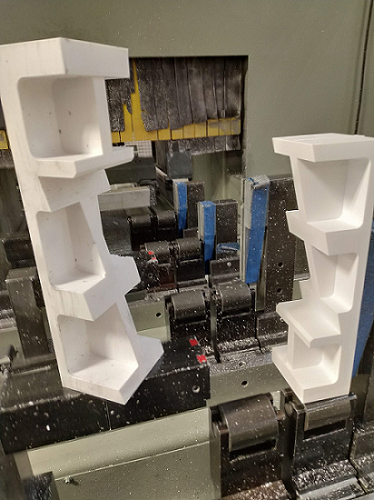
“I put Rize One right next to my desk, so I can use it all the time. It’s so easy, anyone can use it,” Black said.
“We’re finding creative new uses every day for our Rize 3D printer.”
NHF is now enjoying a 15% increase in production speed and $200,000 cost savings per year on fixtures.
TriPro Introduces Industrial 3D Printer
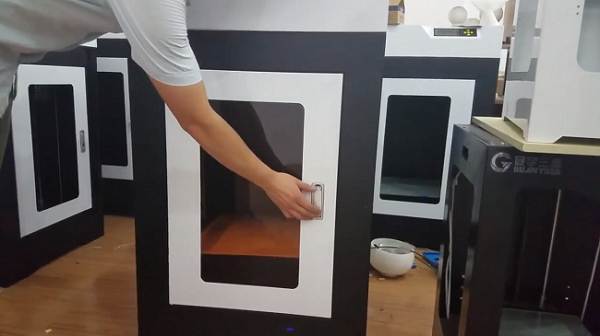
“We highly recommend this machine for designing, for manufacturing, prototyping, importance of functional and parts manufacturing,” said Achilles from TriPro.

3D Printed Glasses for Correcting Vision

Dr. Song Hongxin with a pair of 3D printed glasses at Beijing Tongren Hospital. [Image: Beijing News]
Dr. Song, who was inspired by the adaptive optical system of NASA, explained, “Normal corneas have a smooth and convex surface, while their (keratoconus patients’) corneas are bumpy with many irregular concaves.”
While traditionally made glasses aren’t always customizable, and can be expensive when they are, 3D printing allows physicians to customize glasses more accurately to fit a patient’s cornea.
Launcher Completes Hot-Fire Test
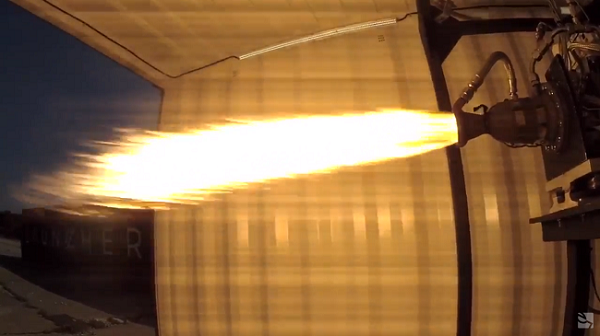
During the 30 second test, Launcher achieved its highest “performance and temperature mix ratio for LOX/RP-1” and reached a combustion temperature of about 6,000°F, which is over twice the melting point temperature of its 3D printed Inconel 718 combustion chamber.

3D Printed NASA Helmet
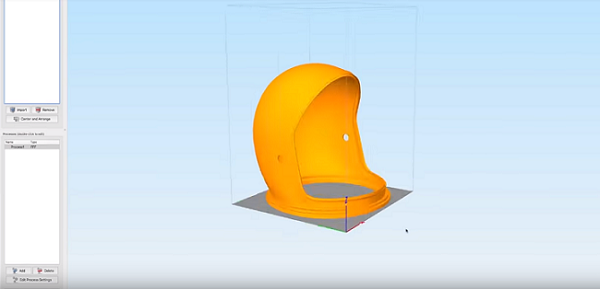
“Darrell came to my attention last year because he’s ludicrously prolific and incredibly facile at 3D printing and model making and ambitious in his scope,” Savage said in the new video.
“In our ongoing collaboration, Darrell will continue to deliver some videos for Tested.com, including this one, in which I commissioned Darrell to make a space helmet for me.”
It’s not just any space helmet either – Savage is working to replicate the orange Advanced Crew Escape Suit (ACES), also called a pumpkin suit. This full pressure suit was worn by Space Shuttle crews after STS-65, and Darrell adapted a high-fidelity model that Savage purchased in order to make the helmet 3D printable. It took over 100 hours of 3D printing to create the helmet – you can check out the full process in the video below.

3D Printable SOFIA Flying Telescope Model
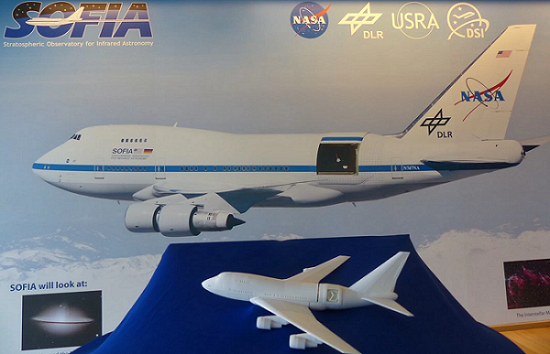
A 3D printed model of the Stratospheric Observatory for Infrared Astronomy (SOFIA) is displayed beneath a photo of the real thing.
[Image: NASA/SOFIA]
The digital files to 3D print your own SOFIA model are free to download.
“SOFIA flies higher than commercial jetliners to get above 99 percent of the water vapor in Earth’s atmosphere, which blocks infrared light from reaching the ground. This is why SOFIA is capable of making observations that are impossible for even the largest and highest ground-based telescopes,” NASA officials said.
Discuss these stories and other 3D printing topics at 3DPrintBoard.com or share your thoughts in the Facebook comments below.