We’re starting off with exciting AMUG news in today’s 3D Printing News Briefs, as Neil Hopkinson was selected for the 2027 Innovators Award. Then we’ll move on to business, with Titomic securing EXIM financing, VoxTech3D appointed an exclusive distributor for Nano-XS3DTech Manufacturing, and Wayland Additive selling a printer to the University of Innsbruck. We’ll end with a Kickstarter campaign for a new sub-$5,000 metal 3D printer for the desktop.
HSS Inventor Neil Hopkinson is 2027 AMUG Innovators Award Recipient

Professor Neil Hopkinson
The Additive Manufacturing Users Group (AMUG) just announced that the recipient of its 2027 Innovators Award is additive manufacturing (AM) pioneer Professor Neil Hopkinson, Vice President of SAF Technology at Stratasys, and the inventor of High Speed Sintering (HSS) technology. The award is given to, as AMUG explained, “individuals whose innovations have significantly advanced” the AM industry. Hopkinson thought up HSS with the idea of making AM scalable, by negating the need to selectively fuse each part with a laser. The resulting technology, invented and patented at Loughborough University in 2013, helped establish a new approach to polymer powder bed fusion (PPBF) technology, and has since generated more than £1 billion in revenues for licensees and supply-chain partners. Hopkinson spent 20 years in academia before joining Xaar plc, where he helped introduce an HSS-based printer and create Stratasys joint venture Xaar 3D Ltd. Xaar 3D introduced the SAF-powered H350, and when Stratasys acquired the joint venture, Hopkinson joined as VP of Technology.
“Our list of Innovators Award recipients has recognized industry pioneers including Chuck Hull, Hans Langer, and Carl Deckard. The list also includes Scott Crump, inventor of FDM® and co-founder of Stratasys. Neil Hopkinson now joins Scott Crump on that list,” said Dallas Martin, AMUG President.
“Having experienced HSS’s impact firsthand and knowing Neil personally, I can think of no one more deserving of the Innovators Award than Neil Hopkinson.”
On March 17, 2027, Hopkinson will take the stage during the Innovators Showcase at the AMUG Conference in Atlantic City, New Jersey. You can register here.
Titomic USA Receives $10.3 Million Loan from EXIM

Engineer at work at Titomic’s new Huntsville facility. Image courtesy of Titomic.
Aussie advanced manufacturing company Titomic uses its proprietary cold spray Titomic Kinetic Fusion (TKF) technology to serve the U.S. and allied industrial base. It recently announced that The Export-Import Bank of the United States (EXIM) has approved a USD 10.3 million (AUD 14.7 million) direct loan to Titomic USA, Inc. The loan is provided from EXIM’s Make More in America Initiative, which extends the bank’s financing to export-oriented domestic manufacturing projects, particularly ones in sectors that are important for national security. The financing will support the expansion of Titomic’s capabilities in Huntsville, Alabama, with the purchase of an integrated high-pressure cold spray production cell for the Huntsville facility. By adding this cell, Titomic can grow its domestic capacity for manufacturing, repairing, and restoring metal components in the U.S., which will decrease reliance on overseas production and improve industrial resilience. The EXIM transaction is also expected to support at least dozens of new full-time jobs in Alabama.
“America needs a strong manufacturing base to remain competitive around the world. EXIM’s financing for Titomic will support advanced manufacturing in North Alabama and help expand our country’s industrial capabilities,” stated Representative Dale W. Strong (AL-05). “We have the workforce and expertise to lead in this industry, and we need to keep building on that strength here at home.”
VoxTech3D is Exclusive North American Distributor for Nano-XS3DTech
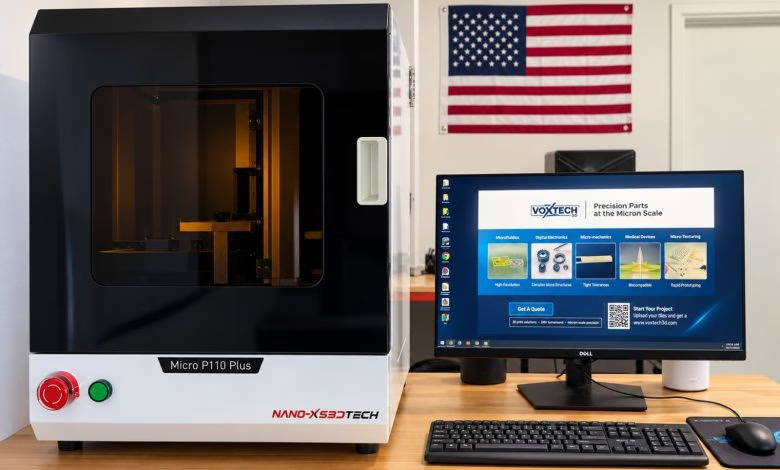
Micro-precision 3D printing service bureau and equipment distributor VoxTech3D was recently appointed the exclusive distributor in North America for Nano-XS3DTech Manufacturing Co., Ltd. (“Xingsheng Precision”), which manufactures micro digital light processing (micro-DLP) 3D printers and materials. It will distribute Nano-XS3DTech’s printers in the U.S., Mexico, and Canada, and serve as an authorized reseller in the UK and Europe. Nano-XS3DTech makes a line of four micro-DLP printers with optical resolutions of 2, 10, 15 and 35 microns, and feature resolution that’s supposedly comparable to established micro-stereolithography systems. The light-engine architecture is said to enable print speeds up to 10x faster than similar systems, at much lower prices. The company also develops a large portfolio of proprietary micro-DLP resins engineered for its printers. This agreement between VoxTech 3D and Nano-XS3DTech gives the North American market an additional source for micro-precision AM.
“North America is the most important market for micro-precision manufacturing, and we wanted a partner who understands how American engineers qualify a new technology. VoxTech3D’s team brings decades of additive manufacturing experience and a customer-first model that lets companies prove our technology on real parts before they invest. We are proud to have them represent Nano-XS3DTech,” said Collin Liu, Founder of Nano-XS3DTech.
The companies will exhibit together at Formnext, and demonstrate the micro-DLP platform, materials, and sample parts at Booth A174, Hall 12.0.
Wayland Additive Installs Calibur3 System at University of Innsbruck
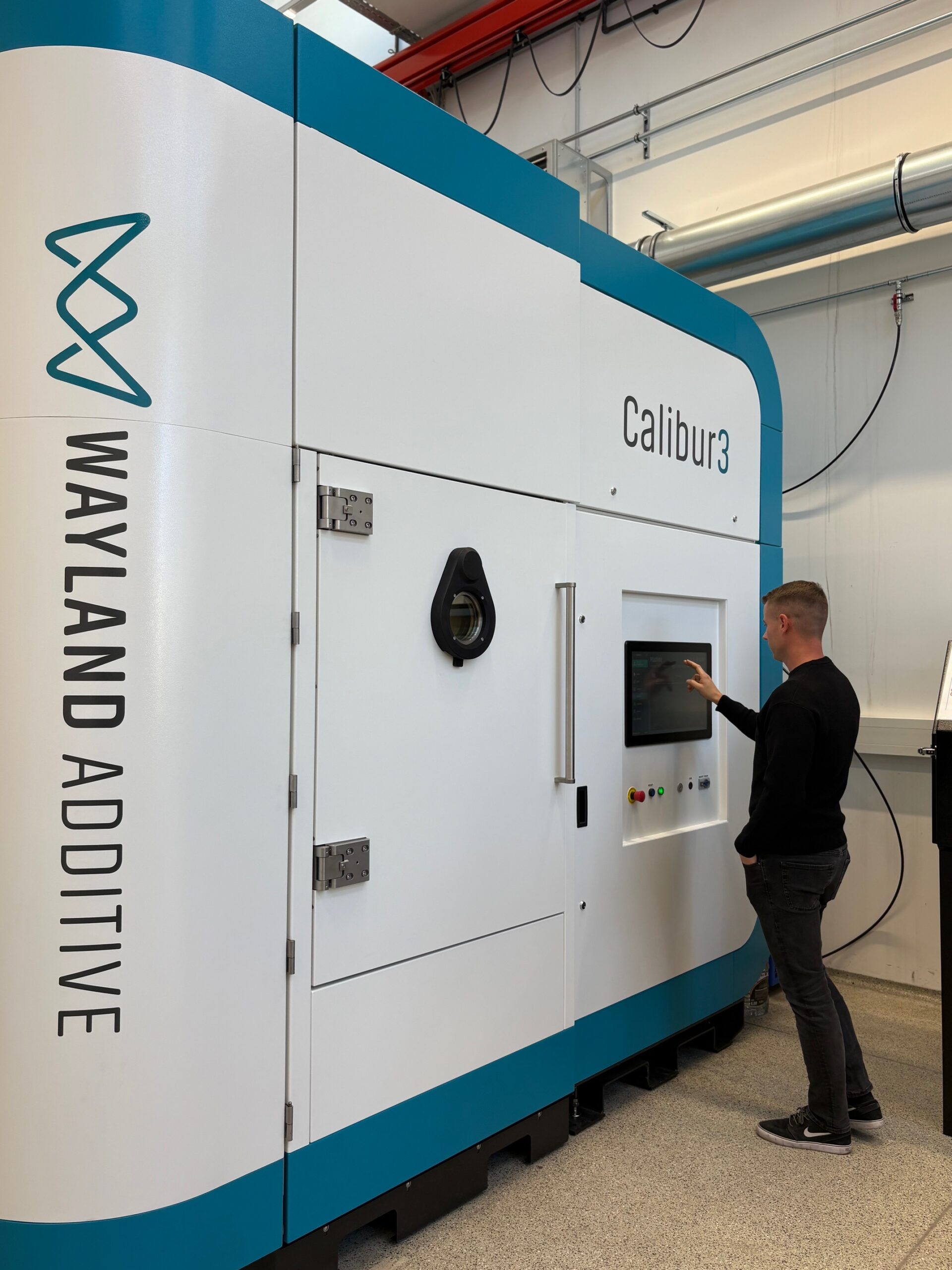
UK electron beam (eBeam) company Wayland Additive announced that its latest Calibur3 metal printer was delivered and installed at the University of Innsbruck, one of Austria’s leading research institutes for advanced materials and manufacturing. The system was acquired for the Faculty of Engineering Sciences (Fakultät für Technische Wissenschaften), Department of Mechatronics, and the Group for Materials Science, and the researchers will use it for process development and materials research, focusing specifically on processing high-temperature and “difficult” materials. Most eBeam powder bed fusion (PBF-EB) systems need to pre-sinter the powder bed in order to mitigate smoke events caused by electrostatic charging. The faculty specifically wanted the Calibur3 because the proprietary NeuBeam technology neutralizes the charge during the build process, which offers more thermal control and operational flexibility. They also appreciate its open architecture and optional small build tank (SBT), which allows them to modify scan strategies, energy input, and beam parameters in real time for faster iteration.
“I regard the Wayland Calibur3 machine as the most innovative PBF-EB machine for materials research on the market at the moment. This is because of the freedom in temperature management independent of an otherwise necessary pre-sintering step and full control of the scanning strategy in combination with high-speed, high resolution thermal imaging which is especially beneficial for adjusting the microstructures of the alloys to achieve the best material properties,” explained Dr. Jakob Braun, Senior Scientist at the University of Innsbruck.
At next week’s Formnext, Wayland Additive will have representatives from the University of Innsbruck at its Stand B139, Hall 12.0.
Studio 3e8 Unveils Mesa 1 Metal Desktop 3D Printer
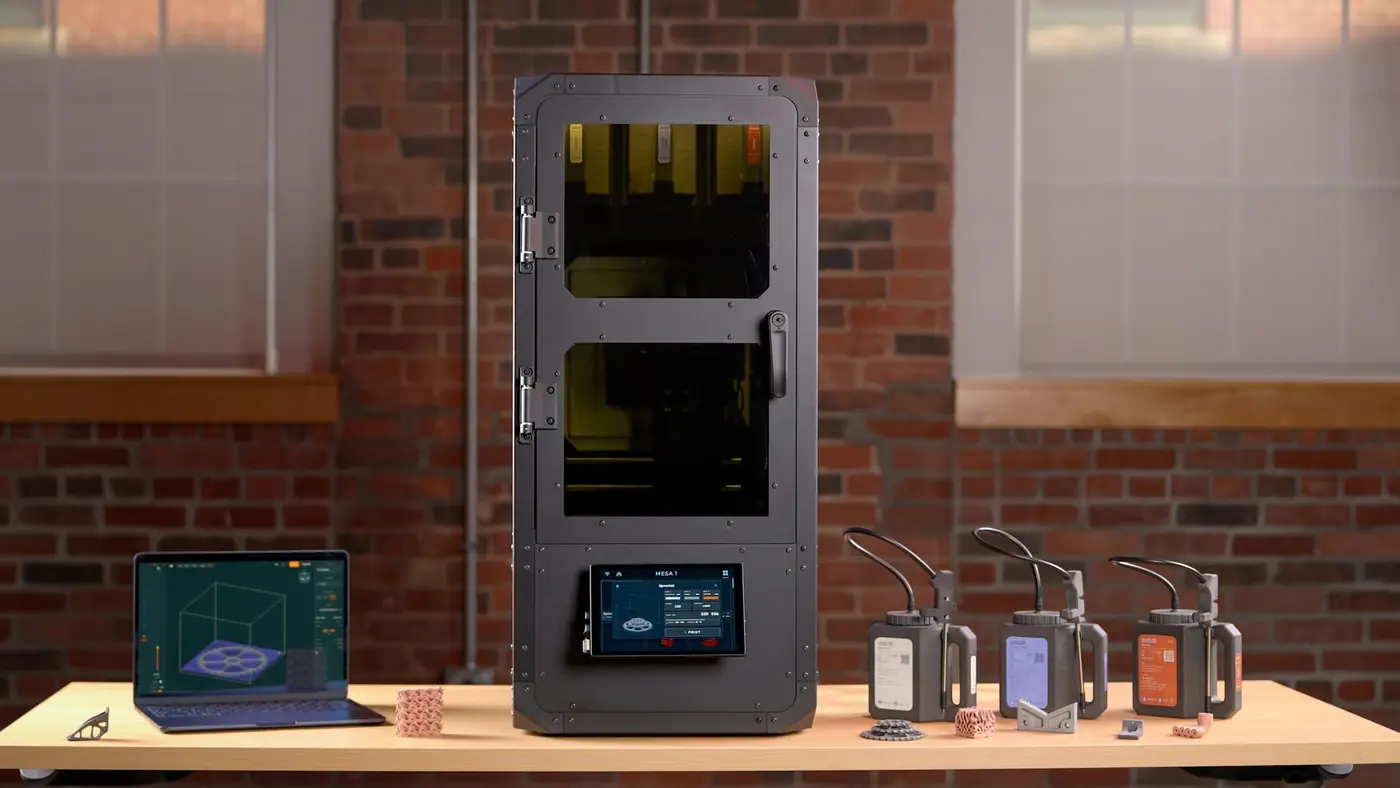
Massachusetts-based Studio 3e8, founded in 2023, revealed the Mesa 1 desktop metal 3D printer, which launches on Kickstarter December 1st, starting at $3,500. The startup wanted to make owning and using a metal 3D printer more accessible. Studio 3e8 says the Mesa 1 “puts professional-quality metal parts within reach of any workspace,” thanks to its new metal 3D printing technology, called Scaffold Contrast Sintering (SCS), and easy ecosystem of hardware, software, and materials (copper and carbon steel to start with). Once a 3D model is sliced and uploaded, the slicer generates a print in two materials: one metal, and one scaffold. No lasers or binders are used in the process, and users supposedly don’t have to handle loose powder post-print. The Mesa 1 deposits the materials from sealed powder cartridges, with the metal building up the part and the scaffold holding the shape in place. Tuned vibration lets the powder flow through the nozzle, and the part is printed directly into a crucible inside the integrated furnace, which sinters it automatically into dense metal. The scaffold material stays loose, and once it’s cooled, Studio 3e8 says the part easily lifts out of the scaffold. As the startup explains, specialized chemistry removes oxygen from around the part during sintering, so no gas supply or vacuum chamber are needed for the Mesa 1.
“Our team saw the barriers to metal printing firsthand working on industrial 3D printing and manufacturing systems,” said Casey Johnson, Co-Founder and CEO of Studio 3e8. “We built the tool we always wanted.”
You can sign up for Mesa 1 launch updates here.