In this weekend’s 3D Printing News Briefs, America Makes announced the winner of its GOTHAAM Project Call. Then it’s all about healthcare 3D printing news, with Stratasys and Limbitless Solutions expanding their partnership, the new Nebraska Center for 3D Innovation focusing on healthcare applications, and Onkos Surgical announcing a major milestone. We’ll finish with hybrid bioprinting of blood capillary networks.
America Makes Announces GOTHAAM Project Call Winner
This month, America Makes and the National Center for Defense Manufacturing and Machining (NCDMM) announced the winner of the $5.5 million GOTHAAM Project Call. Funded by the Office of the Under Secretary of War, Manufacturing Technology Office (OSW ManTech), GOTHAAM, or Generation Of Technical-data for High-strength Aluminum Alloy Material, is focused on developing material allowables for a high-strength aluminum alloy that’s equivalent to 7075-T73. These allowables need to work across three classes of laser powder bed fusion (LPBF) systems, in order to ensure scalable production on printers that are small, medium, and large-format. The winner is General Atomics Aeronautical Systems (GA-ASI), which will work with its team partners to develop and deliver an aerospace-grade, corrosion-resistant aluminum alloy, with applications in both the commercial and defense sectors.
In addition to GA-ASI, the GOTHAAM team partners include:
- Lockheed Martin
- Northrop Grumman
- Airbus Space & Defense + АР Works
- MIMO Technik
- Quadrus Corporation
- Hadrian Additive
- Nikon AM
- EOS America
- Valimet
- Toyal America
- Equispheres
- AMG Aluminum
- Rio Tinto
- Sunrise Metals
- Nio Corp.
- Dyndrite
- Scot Forge
Stratasys & Limbitless Solutions Expand 3D Printed Prosthetics Partnership
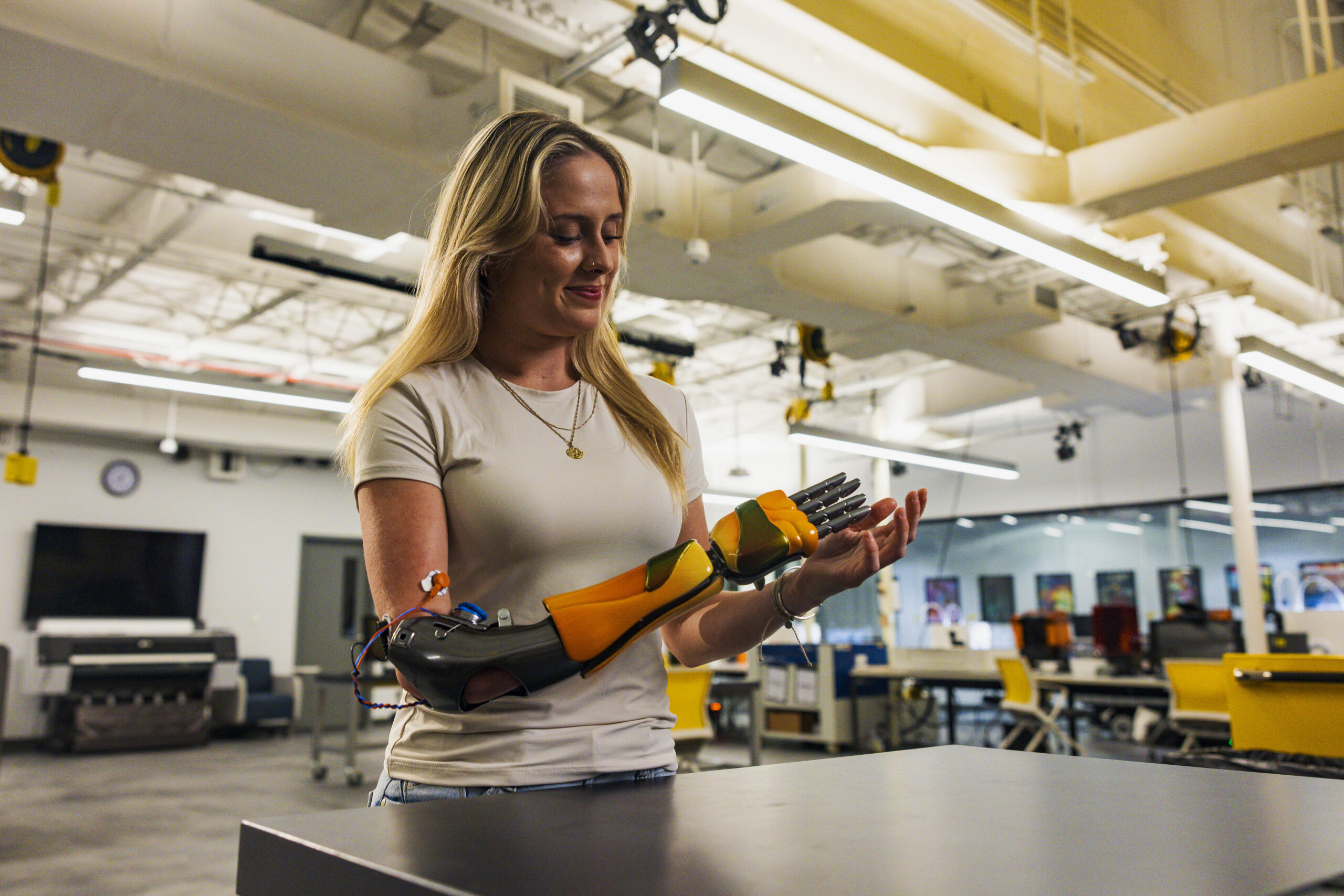
Annika using her customized prosthetic limb with color-shifting paint from Limbitless Solutions, developed using Stratasys-enabled manufacturing processes.
Stratasys and Limbitless Solutions, a nonprofit research facility at the University of Central Florida, have expanded their existing 12-year collaboration, which has helped deliver hundreds of 3D printed prosthetic devices to children. For over a decade, Stratasys has supported Limbitless in its work to increase accessibility to prosthetics through STEAM education, assistive technology, and interdisciplinary teamwork. There’s a dedicated Limbitless lab at the university, which houses multiple Stratasys 3D printers that students can use to get hands-on experience with the technology to create social impact. Stratasys has also donated materials and engineering expertise to help provide prosthetics to children with limb differences, and Limbitless has printed end-use prosthetic components and 3D printed molds for thermoformed cosmetic elements with the company’s technology. This partnership expansion will feature a renewed focus on education, sustainability, and increasing access to 3D printed prosthetics for children. Stratasys actually donated one of its Certified Pre-Owned (CPO) F370® 3D printers to the cause, which not only supports student education and community outreach, but also the company’s commitment to circular manufacturing.
“This long-standing partnership reflects the best of what Stratasys has to offer. Through our Mindful Manufacturing™ approach, we are advancing sustainability while supporting meaningful social impact. By reconditioning high-performing equipment through our Certified Pre-Owned program, we not only reduce waste but also enable purpose-driven organizations like Limbitless to extend their reach and empower more lives,” said Rosa Coblens, VP Sustainability & Communications at Stratasys.
Nebraska Center for 3D Innovation Developing 3D Printed Healthcare Technology

Photo courtesy of University of Nebraska at Omaha
This month, the Nebraska Center for 3D Innovation (NE3D) began operations at the University of Nebraska at Omaha (UNO). Backed by an $8 million grant the university received from the National Science Foundation (NSF) Research Incubators for STEM Excellence (E-RISE) awards, NE3D is a new statewide research hub for developing healthcare 3D printing. According to NE3D lead Jorge Zuniga, a UNO biomechanics researcher, the program began in 2016 as a small group of people from partner organizations having informal meetings about how to use 3D printing “to help people improve the medical outcomes of individuals that may need it.” It’s now grown into a formal partner network, and is based at UNO’s Biomechanics Research Building. Zuniga said the center’s mission is “to provide an expedited path from UNO’s lab to people who will benefit directly from the lab’s research at minimal cost.” The funds from the NSF grant will be used to expand NE3D’s research and development in three distinct areas: 3D printed prosthetics, antimicrobial materials, and anatomical models for surgical planning. Looking ahead, NE3D’s four-year plan includes developing soft robotic components and sensors for better prosthetics, and more.
Zuniga said, “We believe that all this research we do in laboratories should ultimately and rapidly benefit the community. Because if you don’t do that, what are you going to spend your whole life working on? Things that are never going to directly benefit people?”
Onkos Surgical Completes 1,000th Case with My3D Pelvic Implant Platform
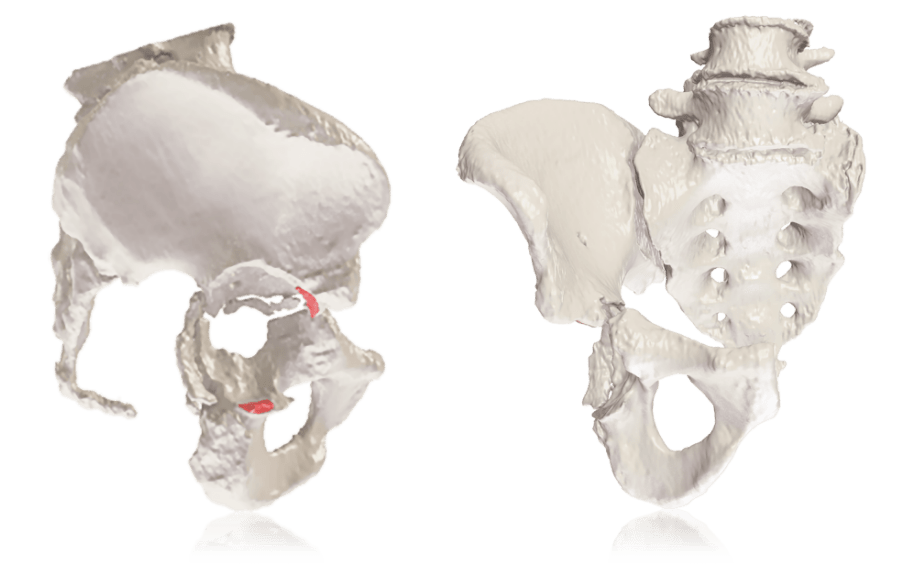
Image courtesy of Onkos Surgical
Onkos Surgical recently announced a major milestone: the company completed the 1,000th case using its personalized My3D patient-specific pelvic implant platform. My3D received FDA 510(k) clearance in 2022, and combines advanced imaging, collaborative case planning, 3D anatomic modeling, and implant design to support surgical planning for orthopaedic procedures. As Founder and CEO Patrick Treacy said, the platform’s “personalized approach is built around understanding each patient’s unique anatomy and helping surgeons translate that understanding into a thoughtful reconstruction plan.” This milestone shows that the My3D solution continues to be adopted and used by surgeons for complex pelvic reconstructions. It makes sense, because those kinds of orthopaedic cases, with bone loss and tumors, can really benefit from this kind of personalized approach. Unsurprisingly, the company is continuing to invest in technologies that pair anatomic modeling, implant design, preoperative planning, 3D printing, and workflow optimization.
“Reaching 1,000 My3D Pelvis cases represents more than a milestone, it reflects the knowledge and expertise our engineers have developed through close collaboration with surgeons,” said Rick Swanson, Onkos Surgical’s Director of Patient Solutions. “The clinical insights gathered from each case continue to strengthen our personalized design process and support future surgeon-led planning sessions.”
Researchers Develop Bioprinting Method for Producing Blood Capillary Networks
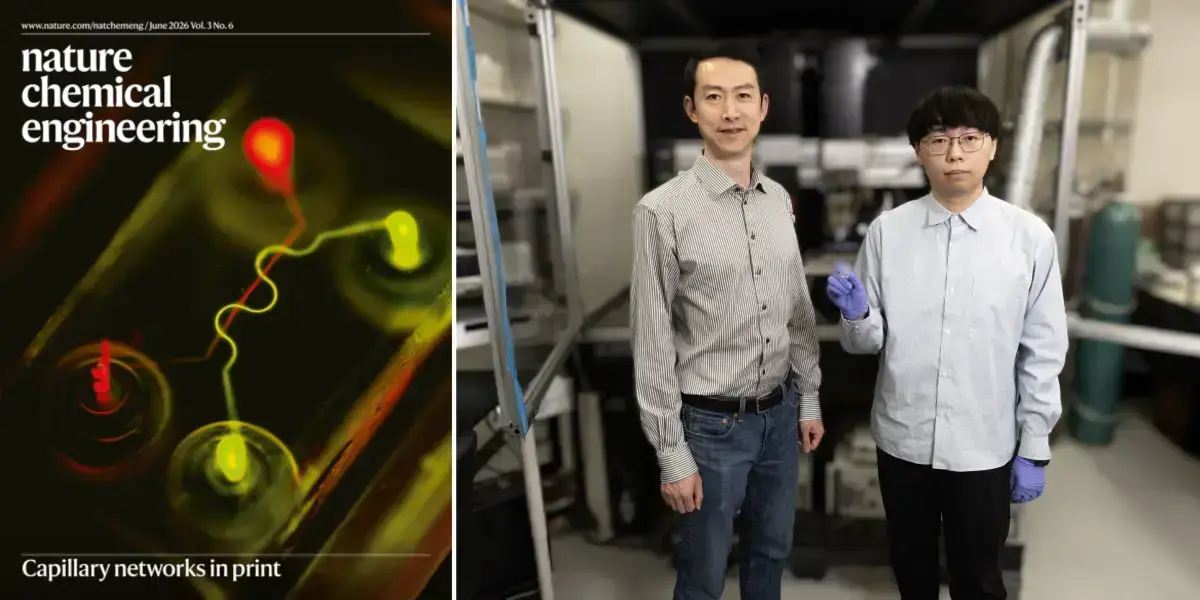
(Left) Capillaries fabricated by Yanliang Zhang, the Advanced Materials and Manufacturing Collegiate Professor in the Department of Aerospace and Mechanical Engineering, and colleagues, visualized with fluorescent imaging, appeared on the cover of Nature Chemical Engineering earlier this year. (Right) Zhang and Yuxuan Liao, doctoral student and lead author of the study. (Photo by Wes Evard / Notre Dame College of Engineering)
Organ transplant recipients have to take immunosuppressive medications, stick to a very strict lifestyle, and understand that at any point, their body could reject the organ. Scientists have long been working to solve this issue by bioprinting organs and tissues from a person’s own cells, but it’s proven very difficult to replicate the scale and complexity of the human body’s vascular networks, and capillaries in particular. Researchers at the University of Notre Dame came up with a novel hybrid bioprinting method that can fabricate vascular networks with capillaries that have diameters of fewer than 10 micrometers. As they explain in their paper, the method integrates two specific 3D printing techniques, and uses machine learning to autonomously optimize print parameters for vascular configuration. Extrusion printing is used to print the soft, gel-like scaffold called the matrix, which mimics human tissue. Then, once a section of the matrix has been extruded, threads of gelatin are printed on it using aerosol jet technology; these threads are later removed to leave channels embedded inside the matrix. The researchers produced stable one-, two-, and three-dimensional vascular structures using this hybrid method, and select channels in each were later successfully lined with living cells.
“Printing blood vessels that mimic natural living systems is very difficult since the vessels vary in size. Getting the smallest vessels right, without losing scalability and structural integrity, has remained one of the greatest challenges to current state-of-the-art bioprinting,” said Yanliang Zhang, Advanced Materials and Manufacturing Collegiate Professor in the Department of Aerospace and Mechanical Engineering.
Yanliang Zhang developed the approach in collaboration with Y. Shrike Zhang, associate professor of medicine at Harvard Medical School and Brigham and Women’s Hospital. The end goal is develop an intelligent, autonomous bioprinter to fabricate fully functional tissues and organs, like the liver, kidneys, and even the heart.