
In 1947, that fun-loving bunch, the Bulletin of the Atomic Scientists, unveiled a concept called the Doomsday Clock, an attempt to measure how close humanity is to “a human-made global catastrophe.” Steven Camilleri, the CTO and co-founder of Australia’s SPEE3D, an original equipment manufacturer (OEM) of cold-spray additive manufacturing (CSAM) systems, is proposing that his home country adopt something not unlike the Doomsday Clock, but specifically tailored to a context of industrial resilience.
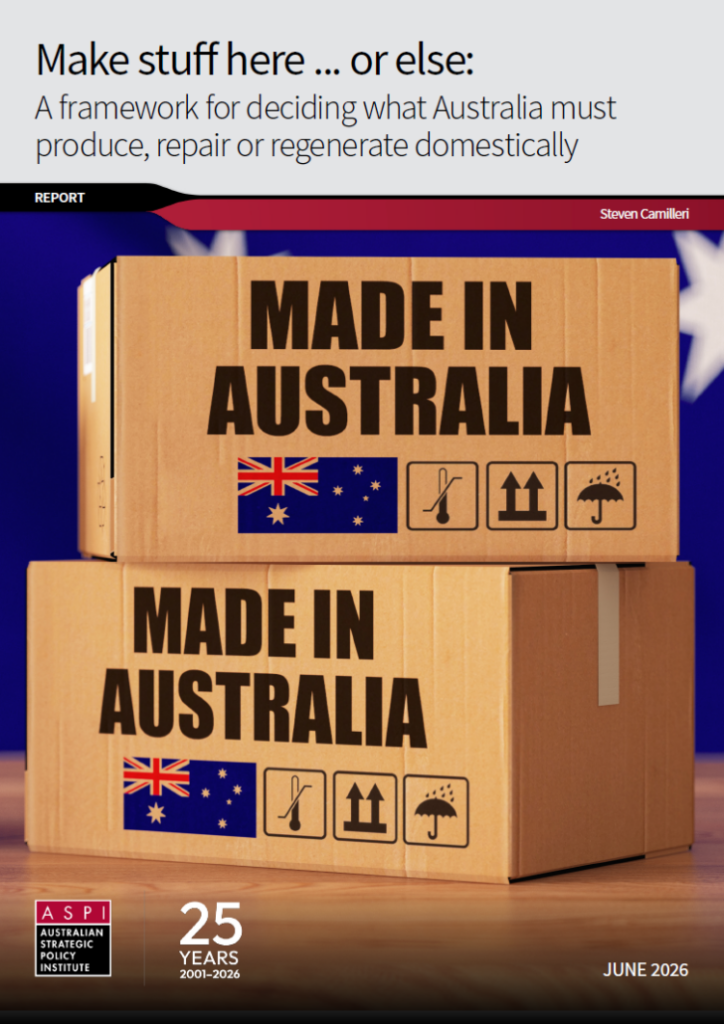
This isn’t in his capacity as an advanced manufacturing executive, but rather follows from Camilleri’s work starting Make Stuff Here, a blueprint for Australian industrial autonomy that I covered last year when it was still in its early phases. Now, Camilleri has fleshed out the concept systematically in a paper for the Australian Strategic Policy Institute (ASPI), titled “Make stuff here…or else: A framework for deciding what Australia must produce, repair or regenerate domestically.”

You can, and should, download the full report here. The core recommendation that it revolves around is the brilliant idea that the Australian government should formulate a ‘National Resilience Test’ used to arrive at a ‘Sovereignty Countdown’ for critical infrastructure and supplies: the amount of time that the nation would be able to provide the relevant goods and services for itself during a major supply disruption.
Obviously, this would require extensive cooperation between the public and private sectors, as Camilleri also proposes, along with a handful of other major recommendations necessary for implementing the overall framework, such as industrial policy support for workforce development. Notably, Camilleri does not suggest his plan as a replacement or alternative to existing policies and programs that Australia has been implementing in recent years, but argues for its alignment with, and complementarity to, the various tracks that the nation has already introduced as economic resilience measures.
“This report argues that national resilience is not an abstract policy ambition but a measurable engineering problem,” Camilleri writes. “At its core is the concept of the Sovereignty Countdown: the time a critical system can continue operating if external supply is disrupted. Every essential function—water, energy, fuel, food logistics, communications—operates within this constraint. When the countdown expires, continuity depends on external actors, and sovereignty narrows in practical terms.
Australia currently operates within a dangerous lag. Policy has pivoted towards resilience, but physical capability hasn’t yet caught up. Decades of rational, efficiency-driven decisions have hollowed out the domestic production layer—the industrial ecosystem that repairs, replenishes and sustains national systems. In its place, Australia relies heavily on storage and logistics. Those extend time but don’t regenerate supply. When supply chains falter, the nation shifts from steady-state operation to drawing down finite reserves.”
Back in the first month of the Iran War, I wrote a post, “Please Localize Your Supply Chains,” in which I pointed out, “Resilience is starting to feel like the only economic metric that matters, which is noteworthy, for one, because there is no defined metric that I know of that actually measures resilience. But there are plenty of measurements that can serve as indicators of a lack of/threat to resilience.” It’s natural, then, that I would be a huge fan of this report and this proposal, and I think the US would do well to adopt a similar framework.
Yes, there is some sort of “agreement to discuss an agreement” apparently now in place, and if the war is indeed on its way to being over, it’s easy to see why no one would want to second-guess that. At the same time, do we really think that this is going to be the end of this sort of dynamic?
Iran has proven you can stand up to the world’s most expensive military and hold the global economy hostage with favorable geography and cheap drones. Surely there are many other nations that have studied closely the precedent that has been set. And, aside from that, the prewar global environment wasn’t exactly a bastion of economic certainty. In addition to the devastating human cost, a primary reason the threat of a prolonged conflict is so terrifying is because global energy supply chains had already been subject to years of strain.
None of that is to say that the US, or Australia, or other powerful, well-to-do nations, should respond by embracing insularity. Quite the opposite, and that’s what’s especially laudable about Camilleri’s proposal: it does not denounce existing international economic partnerships, but is meant to provide a pathway for those partnerships to be realistically facilitated and optimized.
The status quo was constructed for a world where everything is operating smoothly, and that’s why it has few viable solutions for the present moment. We can all still hope that things won’t be so bad, but that doesn’t mean we shouldn’t plan for the inevitability that, from time to time, real problems do arise.
Featured image courtesy of ASPI