

Last September, AM Research published a white paper sponsored by Stratasys on the role of additive manufacturing (AM) in enabling point-of-need tooling production across various industries. The white paper, “3D Printed Tooling: A Generational Opportunity to Reshape Supply Chains”, was released only a few months after Stratasys and Automation Intelligence opened the North American Stratasys Tooling Center (NASTC) in Flint, Michigan, a facility designed to accelerate prospective customers’ familiarization with the advantages of 3D printed tooling.
As Fadi Abro, Stratasys’ Sr. Global Director of Automotive Mobility, and Dallas Martin, AM Engineer at Toyota North America, discussed with me in an interview published last October, automotive OEMs are becoming far more interested in leveraging AM for their tooling supply chains, primarily due to their tariff exposure. Stratasys has just reemphasized its leading position in enabling tooling for the auto sector with the announcement that Subaru of America is one of the first customers to use the new T25 High Speed Head for the F770 3D Printer.
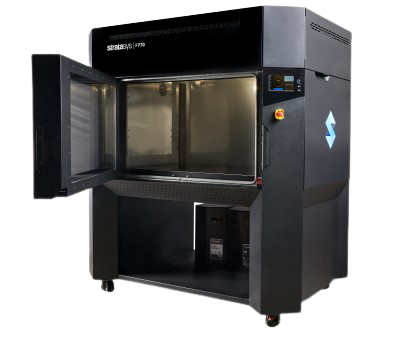

According to Stratasys, Subaru of America has reduced the development time for tooling components by over 50 percent with the T25 High Speed Head, while also seeing a 70 percent overall cost decrease for prototyping and tooling. For an even more in-depth look at the efficiency gains Subaru of America has already achieved with the new print head, check out this case study that Stratasys published earlier this month.
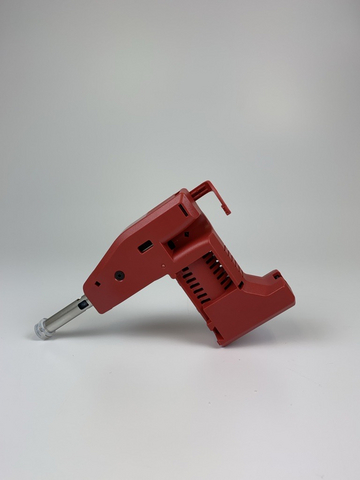

One of the results highlighted in the case study showed that the Subaru team was able to print a 36-inch-long tool nearly twice as quickly with the T25 print head compared to the T14. Perhaps the most significant benefit of that productivity increase is that Subaru of America can now free up print capacity that can now be handled entirely by the F770: in other words, one F770 is now doing the work that previously required two printers.
In a press release about Subaru of America’s initial gains from the T25 High Speed Head, Matt Daroff, Project Engineering Manager at Subaru of America, said, “Being able to get the enhanced throughput with the F770 has made for a more reliable and robust operation. Getting parts to our internal customers earlier gives them an opportunity to identify things we may not have caught in development. This enables us to make corrections sooner, minimizing waste of time and material on defective output before it’s produced.”
Meanwhile, Stratasys’ Chief Industrial Business Officer at Stratasys, Rich Garrity, said, “Our customers want the ability to move fast without sacrificing part quality or incurring unnecessary costs. The T25 High Speed Head delivers exactly that — helping manufacturers produce large tooling faster, with confidence that the parts will perform under demanding industrial conditions.”
I think that this kind of release, where AM hardware OEMs are improving throughput with peripheral modifications like new components and software updates, is the smart long-term play right now for the AM industry. In the near term, a company like Stratasys might be sacrificing the potential for new printer sales by making a customer’s existing machine twice as productive with what essentially amounts to a minor tweak.
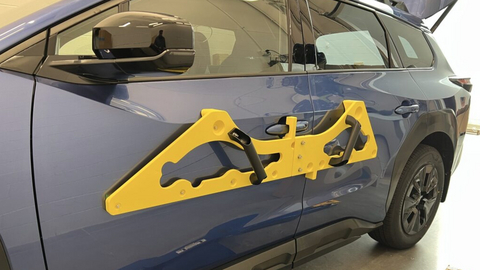

However, for an enterprise as large as Subaru, doubling the efficiency of your existing production infrastructure is precisely the sort of thing that will attract the attention of the decision-makers who can develop strategies to scale implementation of the hardware that yielded the gains. On the other hand, if Subaru of America had been forced to buy another printer to achieve the same results, the same decision-makers would, soon enough, likely start looking for any alternative solution down the road.
Thus, in addition to letting the new print head make the case to Subaru that the automaker should ramp-up its future adoption of Stratasys hardware, Stratasys has also reiterated its fundamental reliability to a key customer. This is the sort of thing that Stratasys does best, epitomized by the company’s 2024 establishment of a Customer Advisory Board.
Finally, many in the AM industry may view AM for tooling as “old news” and hardly the sort of thing that can support renewed growth of AM adoption. But for all of the enterprises that suddenly have a reason to give AM a second look, or even a first look, due to the intractability of disruptions to global trade arrangements, I think the AM industry is in a phase where “everything old is new again”. There is still a whole world out there that is unfamiliar with the use cases that industry veterans have come to treat as commonplace.
Images courtesy of Stratasys