Oerlikon, headquartered in Switzerland, was busy making announcements at Formnext this year regarding new developments; however, collaborations continue to be all the rage within the 3D printing industry (which is very good for users who reap the rewards of complementary partnerships working to please them) and Oerlikon did not disappoint as they reported progress on their continued work between Oerlikon AM and Hirtenberger, an Austrian company that specializes in surface finishing.

This new process offers:
- Smoother surface textures
- Production of complex parts that may require interior supports
- Removal of supports with destroying the parts or prototypes

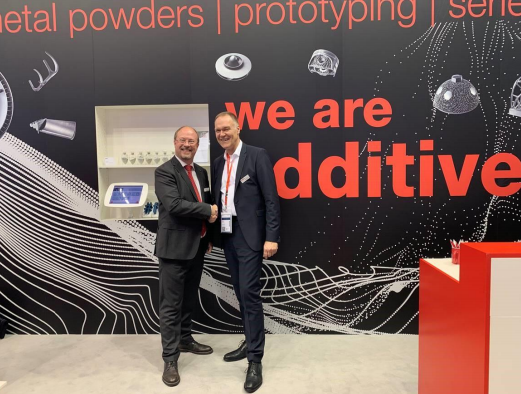
From left to right: Dr. Wolfgang Hansal, Managing Director, Hirtenberger Engineered Surfaces and Dr. Sven Hicken, Oerlikon, Head of Additive Manufacturing Business Unit.
“For Oerlikon AM, the Hirtisation Process addresses one of AM’s major challenges, which is to provide our customers with parts with more complex geometries – some of which are not possible nor economical with existing AM and post-processing technologies,” said Dr. Christian Haecker, Head of Oerlikon AM Industrialization. “The process fits perfectly in our desire to offer customers services and products along the entire value chain. We also see a benefit in increasing repeatability of defined AM surface quality.”
The technology should be introduced to North America by the two companies in 2020.
“We provide a crucial step in the process chain of 3D printing of metal parts,” said Dr. Wolfgang Hansal, Managing Director, Hirtenberger Engineered Surfaces. “We see ourselves as an industrial enabler of automated surface finishing. We maintain the full freedom of the printed parts design, while allowing cost efficient post-processing. Closing the interfaces along the production chain from post-processing back to construction, design and printing is key for the establishment of reliable additive manufacturing, from prototyping to large quantity serial production. For these reasons, Oerlikon AM is an important partner.”
Oerlikon continues to improve 3D printing and AM processes, from being involved in other collaborations to participating in an AM open cluster, to working to create new materials. Hirtisation uses some very aggressive solvents so the process may not be suited for all applications and users. We have heard of positive results from one service bureau however while one German automotive company reportedly had to turn theirs off. In metals right now Hirtisation represents an incredible promise to radically reduce costs and improve Ra. If they get it right Oerlikon and Hirtenburger could make a major impact with it. What do you think of this news? Let us know your thoughts! Join the discussion of this and other 3D printing topics at 3DPrintBoard.com.
[Source / Images: Oerlikon press release]