
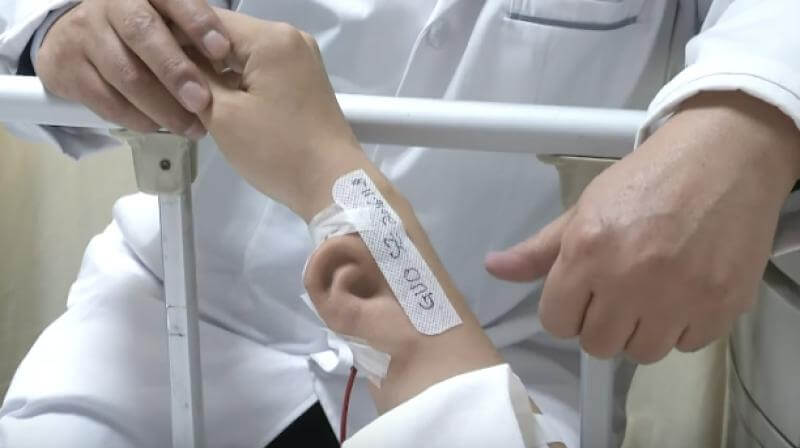
You’ve probably heard the phrase “the walls have ears” but what you may not have heard is that in a hospital room in China, a man’s arm has ears too. Well, an ear actually. Before you start a Twitterstorm panicking about the state of human rights in China, let me assure you that this was a voluntary and medically sound procedure to help a man who had lost his ear in a car accident, not the result of mad scientists run amok.


The patient, identified only as Ji, lost his ear and damaged his face in a car accident a year ago. Because of the damage to the surrounding skin, traditional ear prosthetics are not an option and so plastic surgeon Dr. Guo Shuzhong decided to go a less traditional route and try to grow a new ear for Ji that would then be surgically attached to his head as a transplant. The first phase of this operation was to 3D print a skin expander under the skin in Ji’s forearm. Then, every day, water was injected into the expander so that the skin would stretch and grow, producing enough tissue to shape into an ear.

“The accident not only took his ear, but also destroyed the blood vessels and skin around the ear. Therefore, conventional artificial ears cannot work for him. We decided to grow a new ear on his arm in advance…The whole operation had to be done using 10x magnifying surgical glasses and sutures thinner than a human hair.”

“The actual use of such 3D printed biomaterials on human beings [in the United States] is not that far away, though the regulatory framework of the United State Food and Drug Administration (FDA) presents additional challenges for tissues and organs as opposed to surgical implants which are made of existing approved and clinically accepted materials (such as titanium, steel, certain plastics etc.). A party seeking to obtain regulatory approval…[for]…biomaterials and/or organs will need to proceed through the full approval process.”
A further issue that complicates the development of these 3D printed tissues is the wrangling over the morality of working with stem cells. This is particularly unfortunate as many of the stem cells that are useful for the kind of research in 3D printing are actually those that are extracted from fat in adults, not the more controversial fetal stem cells. But the lobbying and hyper-emotional misinformation that are part and parcel of making political points have obscured that fact, and the effects of restrictions on the use of stem cells have also slowed down research and development. China, on the other hand, has some of the least restrictive stem cell oversight policies in the world.

As the United States grapples with these issues, there has still been a great deal of development both in the US and around the world that has moved the growth of a human ear, if not into the realm of regularly practiced medicine, at least into a waiting area in the wings, something that could potentially help not only people who are in need of a replacement ear, but also those who may have damage to cheeks, noses, or any other body part comprised of cartilage.
In the meantime, we will watch and see the results of patient Ji’s ear in the long term as China moves ahead with this procedure that is still not considered ready for prime time here in the United States. Discuss in the Patient Grows New Ear forum at 3DPB.com.
[Source: TechSpot]