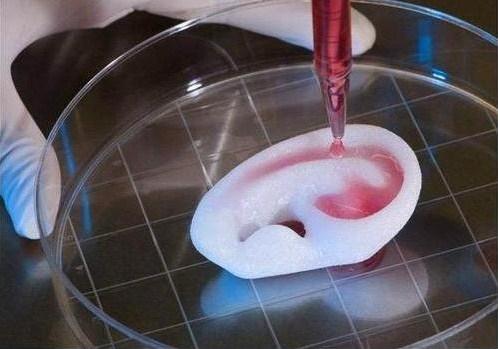
Laser assisted bioprinters were invented first. Later, Laser Induced Forward Transfer (LIFT), a technique initially invented for inorganic molecules, was appropriated by the biological sciences. After refining the technique, researchers reported a cell survival rate of 95%. This is because, unlike its predecessor, the beam does not come into direct contact with its cargo. Living cells are, not unexpectedly, quite sensitive to elevated temperatures. Laser pulses cause an absorbing layer to vaporize, resulting in the creation of droplets. The size of the droplet can be adjusted by altering the energy behind the pulse. Laser-free methods, inspired by household inkjet printers, came later. In 2002 Makoto 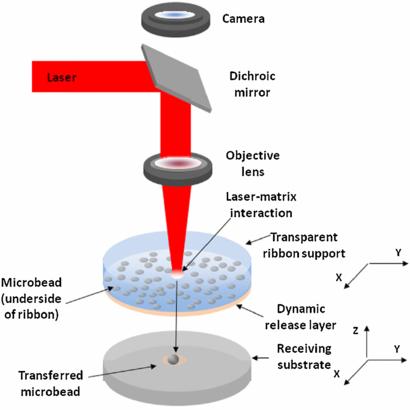
We are not amoebas; the contents of our bodies are not suspended in a gooey ectoplasm. They are anchored by the extracellular matrix (ECM) and, developmentally speaking, are dependent on a dizzying array of chemical cues. The ECM supplies bodily structures with their shape and with the correct set of messenger molecules to grow, maintain, and remodel the tissue. Because animals need to take in nutrients, excrete waste, and receive sufficient oxygenation, vascularization and neovascularization are both essential, as is initial porosity of the chosen scaffold. Biocompatibility is key from a clinical perspective and the correct bioactivity is needed from an engineering one. The scaffold releases biomolecules to “influence cell morphology and alignment.” This can be achieved in a few different ways. Hydrogels, for instance, release the desired proteins at the right times by swelling. Hydrogels have been made from a variety of substances familiar to molecular biologists: alginate, chitosan, collagen, matrigel, gelatin, and agarose. All of these substrates are noncovalently crosslinked. Covalently linked synthetic hydrogels like polyethylene glycol can be fine tuned for responsiveness, but problems with biodegradability and biocompatibility persist.
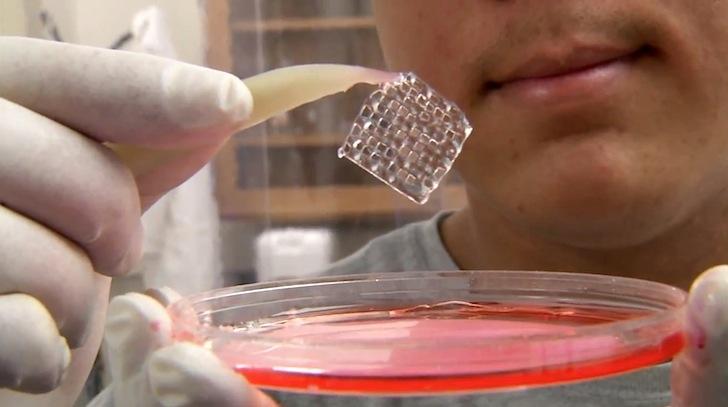
For curious minds and antsy hands there are a number of easy-to-follow DIY tutorials for modifying old (or new) inkjets. These guides are only a Google search away. Far from being the pointless playthings of wet lab lovers, the technology has gained the attention of two household names: L’Oréal and Procter & Gamble. Both companies have a seemingly inexhaustible thirst for skin cells to test their products. Currently it takes a week for a skin sample to form. Organovo is also working with the pharmaceutical titan Merck to produce liver and kidney tissues, a significantly more complex undertaking. Spheroids containing parenchymal (fundamental) cells are loaded into a syringe. In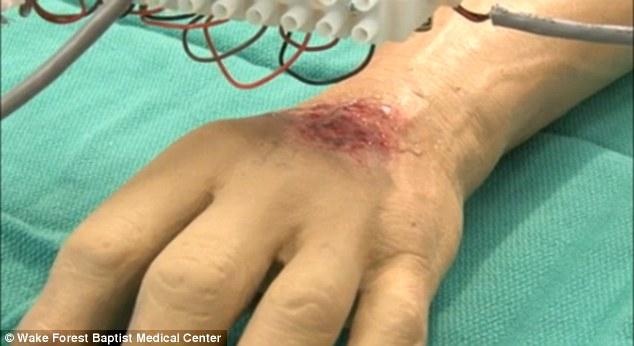
Computers play a substantial and growing role in all areas of modern biology. In order to create a decent program one must first become familiar with the Differential Adhesion Hypothesis (DAH). Put simply, cells move towards other cells with a similar adhesiveness in order create stable structures. As it is with so many other seemingly simple phenomena, the models needed to simulate DAH require a little more than basic arithmetic. Although the mathematical barrier to entry is not dreadfully high. Monte Carlo Methods are useful in creating simulations and solving optimization problems. This entails generating many possible pathways and evaluating their outcomes. Predictive modeling, even if it does not give perfect answers, is an excellent tool in facilitating discovery. One day clever researchers may design superlivers capable of attacking an even wider variety of toxins. Maybe they will make pancreases immune to diabetes and cancer. Before these wonders are wrought researchers must continue to wrestle with the rules written by billions of years of evolution. In the words of Francis Bacon, a life extension luminary before the term existed: “nature to be commanded, must be obeyed.”
About Author
Adam Alonzi is a writer, biotechnologist, documentary maker, futurist, inventor, and programmer. He is the author of A Plank in Reason and Praying for Death: A Zombie Apocalypse. His personal blog can be found at adamalonzi.wordpress.com. And his podcast can be found at adamalonzi.libsyn.com.
Works Cited
- Bacon, Francis, Francis Bacon, and Francis Bacon. Advancement of Learning ; And, Novum Organum ; And, New Atlantis. Chicago: Encyclopædia Britannica, 1955. Print.
- Barnatt, Christopher. “ExplainingTheFuture.com : Bioprinting.” ExplainingTheFuture.com : Bioprinting. Explaing The Future, n.d. Web. 17 Aug. 2015.
- Chan, B. P., and K. W. Leong. “Scaffolding in tissue engineering: general approaches and tissue-specific considerations.” European spine journal 17.4 (2008): 467-479.
- Chua, Chee Kai, and Wai Yee Yeong. Bioprinting: Principles and Applications. N.p.: n.p., n.d. Print.
- Gilpin, Lyndsey. “3D ‘bioprinting’: 10 Things You Should Know about How It Works.” TechRepublic. TechRepublic, n.d. Web. 17 Aug. 2015.
- Jakab, Karoly, et al. “Three-dimensional tissue constructs built by bioprinting.”Biorheology 43.3 (2006): 509-516.
- Li, Chuang, Alan Faulkner-Jones, Alison R. Dun, Juan Jin, Ping Chen, Yongzheng Xing, Zhongqiang Yang, Zhibo Li, Wenmiao Shu, Dongsheng Liu, and Rory R. Duncan. “Rapid Formation of a Supramolecular Polypeptide–DNA Hydrogel for In Situ Three-Dimensional Multilayer Bioprinting”